A gay bear is more than a body type. The term describes a cultural identity and community that developed around men who were often older, larger, hairier or more rugged-looking than the narrow ideal promoted in many mainstream gay spaces. Over time, “bear” became associated not only with appearance, but also with self-acceptance, friendship, warmth, humour, body diversity and a sense of belonging.
Table of Contents
The definition has never been completely fixed. Some people identify as bears because of their physique or facial hair. Others feel connected to the community’s social values, history or welcoming atmosphere. Many participate without adopting the label at all.
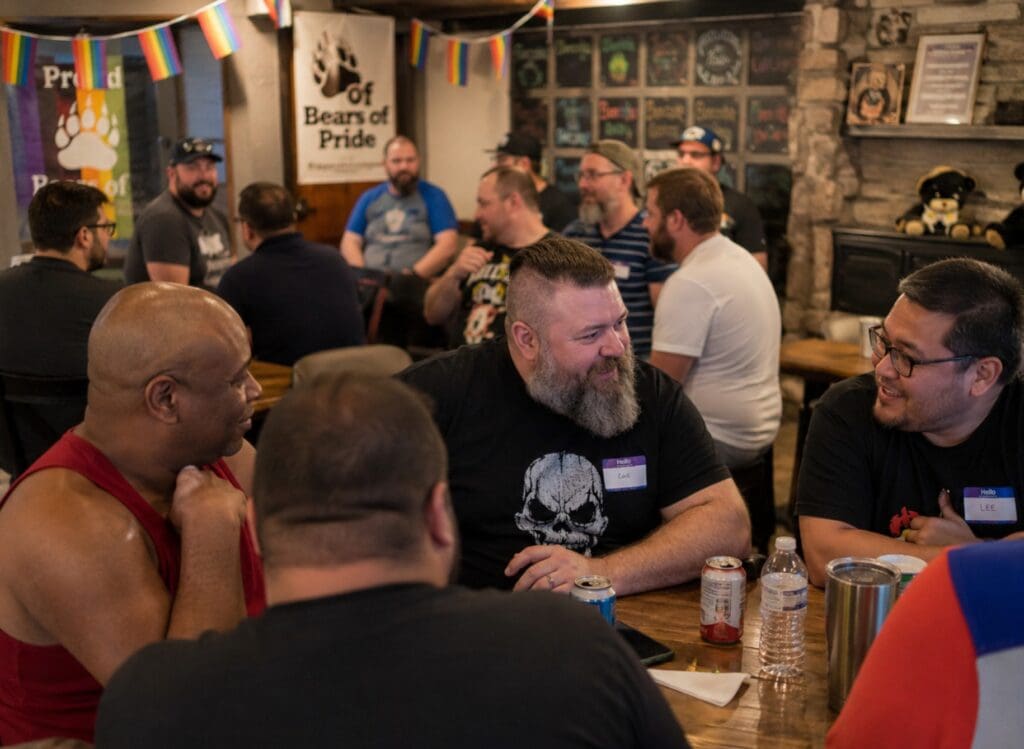
If you have spent time on gay dating apps, LGBTQ+ forums, queer social media, or bear community spaces, you have probably seen the word bear used to describe a certain type of gay or bisexual man.
What Does “Gay Bear” Mean?
In its traditional sense, a bear is a gay or bisexual man who may be broad, stocky, heavyset, muscular, hairy, bearded, mature or some combination of these characteristics. Yet treating that description as a strict checklist misses the cultural meaning of the word.
A man does not automatically become a bear because he has a beard or a larger body. Nor does someone need to meet a universal physical standard before using the identity. Bearhood is largely self-defined and shaped by participation, affinity and community recognition.
Craig Byrnes, the creator of the International Bear Brotherhood Flag, reached a similar conclusion while researching the community. According to an account published by Mary Baldwin University, he found that no single definition could capture what it meant to be a bear. His response to people asking whether they qualified was that it was ultimately a question they had to answer for themselves. (Mary Baldwin University)
This flexibility is important. “Bear” functions partly as an appearance-based description, but also as a cultural home. For many people, it offers a way of saying:
I do not need to erase my age, size, hair, softness or masculinity to be visible and valued.
The Origins of the Bear Subculture
Earlier Uses of the Word
The modern Bear movement took shape primarily during the 1980s, but the language has older roots. LGBTQ+ historical reporting has identified references to a gay “bear club” as early as the 1960s, while a 1979 article in The Advocate used animal categories to describe different gay male types, including bears. The word gained much wider cultural recognition after the launch of Bear Magazine in 1987.
These early references should not be confused with a fully organised community. A nickname or descriptive term can exist long before people build institutions, events, publications and social networks around it.
The Community That Emerged in the 1980s
The GLBT Historical Society describes the Bear community as a subculture that developed in the 1980s to celebrate older, larger, hairier and ruggedly masculine gay men who were often excluded from prevailing standards of attractiveness in gay popular culture. San Francisco became one of the most influential centres of this emerging identity. (GLBT Historical Society)
That origin matters because Bear culture was not simply a new fashion category. It was, in part, a response to rejection.
Mainstream gay imagery of the period often centred a limited ideal: youthful, lean, highly groomed or conventionally athletic. Men whose bodies aged differently, carried more weight, grew more hair or did not fit that visual template could feel invisible even inside spaces that were supposed to offer freedom from heterosexual judgement.
Bear culture created an alternative. It turned characteristics that had been dismissed as undesirable into signs of affection, confidence, familiarity and pride.
Print, Clubs and Early Online Networks
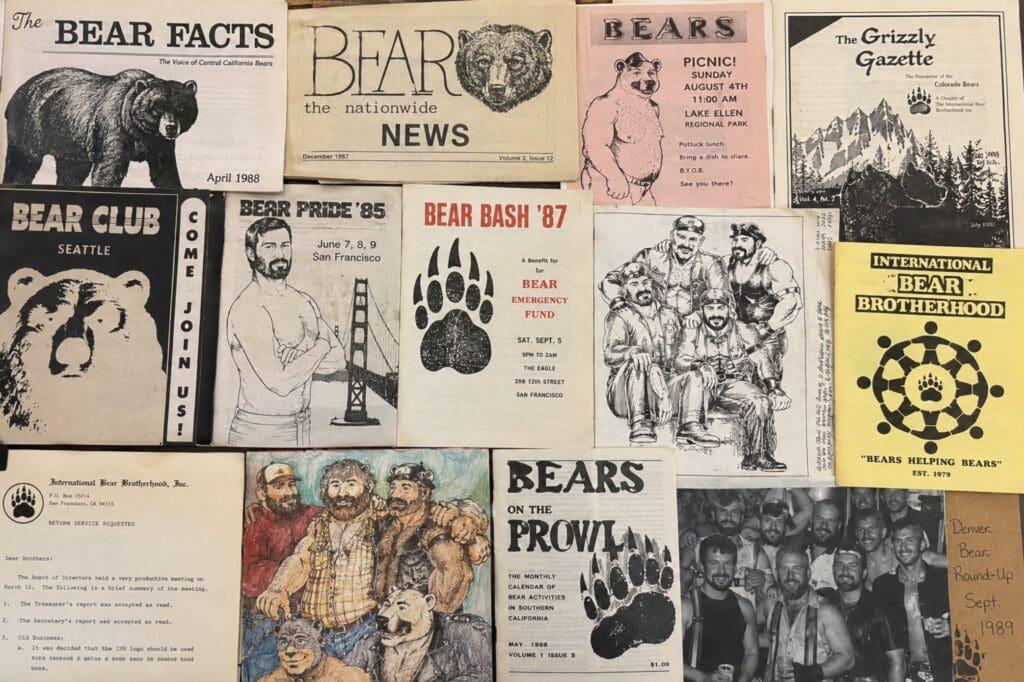
Before social media, communities were built through local clubs, newsletters, personal correspondence, bars, events, magazines and word of mouth. Later, bulletin boards, mailing lists, forums and early websites helped people find one another across cities and national borders.
Cornell University Library’s Les K. Wright papers and Bear History Project preserve newsletters, flyers, correspondence from Bear clubs, event records and printouts from early electronic discussion lists. The collection shows that Bear culture was not an isolated trend, but an organised social world with publications, archives, gatherings and international connections.
This history also explains why community memory remains important. Many early Bear organisations were informal or volunteer-led. Without archivists, artists, club members and cultural historians saving their materials, much of that history could easily have disappeared.
A Rebellion Against Narrow Beauty Standards
Bear culture is sometimes described as a rebellion against toxic aesthetic standards. That description is useful, provided it is understood carefully.
The movement did not reject grooming, fitness, style or physical attraction. It rejected the idea that only one kind of gay body deserved admiration.
A peer-reviewed qualitative study of Bear-identified men found that participants associated Bear identity with self-acceptance and maturity. They also described the acceptance of different body shapes and ages as beneficial to self-esteem and body image.
That cultural shift can be profound. A trait that once generated embarrassment can become a point of connection. A man who spent years feeling too heavy, too hairy, too old or insufficiently polished may enter a Bear space and discover that the qualities he was encouraged to conceal are ordinary, familiar or celebrated.
The deeper value is not that every body must be declared attractive by everyone. It is that dignity should not depend on conformity.
Body Positivity in Bear Culture
More Than “Bigger Is Better”
Bear body positivity is often misunderstood as simply reversing the old hierarchy and placing larger or hairier bodies at the top. At its best, it does something more constructive: it questions why bodies need to be ranked so aggressively in the first place.
A genuinely body-positive Bear community makes room for:
- larger and smaller bodies;
- muscular and non-muscular bodies;
- hairy and less-hairy people;
- younger adults and older adults;
- people with visible disabilities;
- different racial and ethnic backgrounds;
- trans men and nonbinary people who identify with Bear culture;
- those who are confident about their appearance and those still learning self-acceptance.
Contemporary LGBTQ+ coverage has noted that the meaning of “bear” has broadened in some communities, with trans, nonbinary and other queer people finding a place within the identity. This expansion is not identical in every country, event or social group, but it reflects the continuing evolution of Bear culture.
Body Positivity Is an Aspiration, Not a Guarantee
No LGBTQ+ subculture is automatically free from prejudice. Bear communities can reproduce some of the same problems found elsewhere: racism, ageism, fatphobia, ableism, class prejudice, hostility toward femininity or narrow ideas about masculinity.
Research into stigma among gay and bisexual men has documented intracommunity judgement related to body size, race, ethnicity and gender expression. Academic reviews of Bear-related research have also pointed out that racial-minority experiences have often been underrepresented in studies of the community.
Acknowledging this does not diminish Bear culture. It takes its values seriously.
If inclusion is one of the community’s founding ideals, then members, organisers and platforms must continually ask who is being welcomed, who is being overlooked and whose comfort is treated as optional.
The Core Values of Bear Culture
Bear communities vary widely, but several values appear repeatedly in their history and social life.
Inclusivity
The Bear movement grew because many people did not feel represented elsewhere. Inclusion is therefore not an added marketing message; it is closely tied to the community’s reason for existing.
True inclusion means more than allowing someone through the door. It means creating an environment where people do not have to apologise for their body, age, voice, disability, race, gender expression or level of social confidence.
Warmth
The “bear hug” is an obvious symbol, but warmth is broader than physical affection. It can mean being introduced to a group rather than left standing alone, seeing different generations socialise together or finding events where friendship matters as much as dating.
For newcomers, this quality can be especially meaningful. Many LGBTQ+ people arrive in community spaces carrying years of caution. A relaxed welcome, a conversation without judgement or a simple introduction can change the entire experience.
Authenticity
Bear culture often celebrates a less polished kind of visibility. This does not mean rejecting fashion or presentation. It means that people should not have to manufacture a completely different body or personality to participate.
Authenticity might look like posting a recent photograph, being honest about one’s age, stating what kind of connection one is seeking or refusing to treat vulnerability as weakness.
Chosen Family and Intergenerational Connection
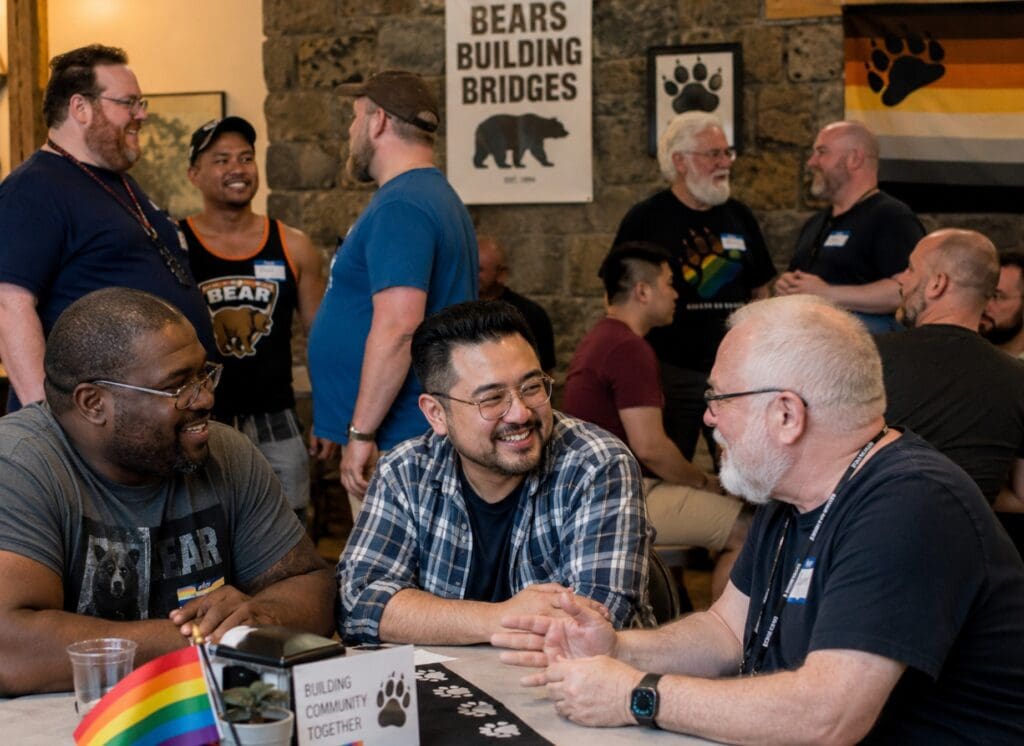
Bear clubs and events have often brought together people of different ages and life histories. That can create a form of informal cultural transmission: older members share memories and context, while younger members bring new language, politics and expectations.
This intergenerational exchange helps preserve history while preventing the community from becoming frozen in nostalgia.
Common Bear Community Terms
Bear vocabulary can be playful and useful, but it should never be treated as a scientific classification system. Meanings vary by location, generation and personal preference.
Bear
A self-identified member of the community, traditionally associated with a larger, hairier, mature or rugged masculine appearance. None of those characteristics is mandatory in every context.
Cub
Often used for a younger Bear-identified man or someone with a smaller or younger-looking build. The term describes a community role or style, not immaturity.
Otter
Otter : Usually refers to a slimmer or leaner hairy man. Some otters feel part of Bear culture; others simply use the term as a physical description.
Chub
A person who positively identifies with having a larger or fuller body. “Chub” and “bear” may overlap, but they are not automatically interchangeable.
Muscle Bear
A Bear-identified person with a visibly muscular build. The term reflects the fact that Bear culture contains many different body types rather than a single silhouette.
Daddy or Silver Daddy
Terms commonly connected to maturity, confidence, greying hair or an older masculine presentation. Not every older gay man uses them, and they should not be imposed on someone without their consent.
Admirer or Chaser
Someone who is attracted to bears or enjoys the community without identifying as a bear. Some people prefer “admirer” because it sounds more relational and respectful, while “chaser” remains common in dating culture.
The most respectful approach is simple: use the words people choose for themselves.
The International Bear Brotherhood Flag
The best-known symbol of the community is the International Bear Brotherhood Flag, recognisable by its horizontal earth-toned stripes and paw print.
developed the flag while researching Bear identity and communicating with community members through early online forums. Mary Baldwin University’s account of the project explains that he designed several prototypes and later copyrighted the design under the name “International Bear Brotherhood Flag.” By the late 1990s, it had become the de facto international Bear Pride flag and was appearing at events around the world.
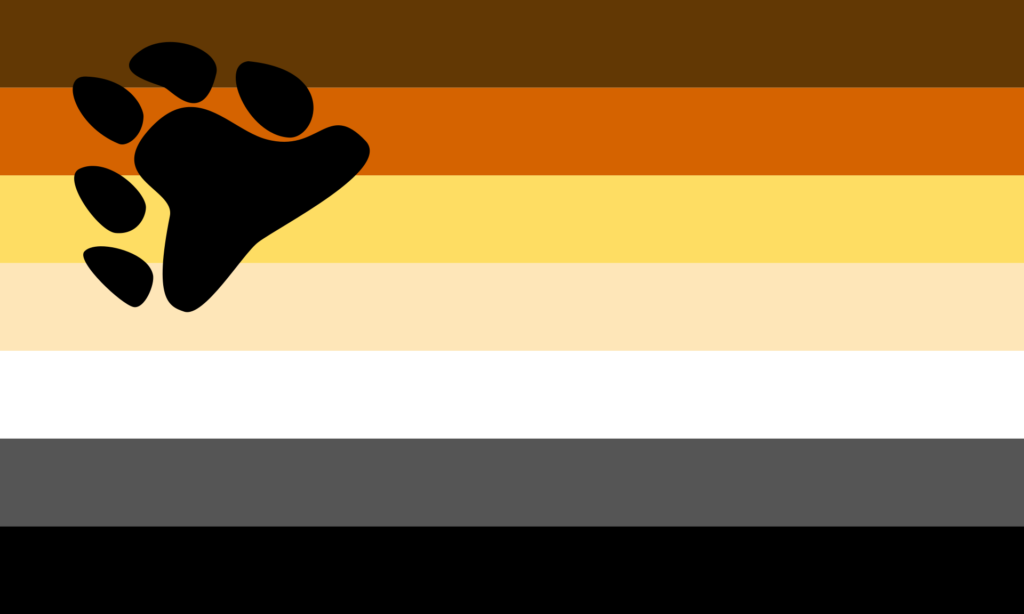
The flag’s importance lies less in rigidly assigning each colour to a human category than in its overall visual message: variety, kinship and belonging. The paw print gives the community an instantly recognisable emblem, while the range of tones resists the idea of a single correct Bear appearance.
For many people, seeing the flag outside a venue, on a profile or at Pride communicates something immediate: there may be people like me here.
The Modern Bear: Events, Friendship and Everyday Community
Bear culture is not limited to nightlife or dating. Its social life can include:
- community dinners and brunches;
- Pride groups;
- travel gatherings;
- charity fundraisers;
- walking, hiking or sports groups;
- film and cultural events;
- online discussion communities;
- local clubs and informal friendship circles.
The atmosphere varies. Some events are large and highly social; others are quiet and community-oriented. A person who dislikes crowded venues may still find a place through a small online group, a daytime gathering or a shared-interest activity.
This breadth is important because not everyone enters LGBTQ+ life in the same way. Some people are looking for romance. Others want friendship, cultural belonging, emotional support or simply the relief of being in a room where their body is not treated as an exception.
Dating Apps and Digital Bear Communities
Why Niche Platforms Matter
Digital platforms have become a major part of queer social life, particularly for people who live outside large cities, have limited access to LGBTQ+ venues or feel anxious entering unfamiliar spaces.
Gay-specific social apps can offer access to a broader community beyond physical venues, although the quality of the experience depends heavily on design, moderation and user behaviour. Research on gay social and dating platforms has long recognised their role as alternative points of entry into LGBTQ+ community life.
Niche apps add another layer: users arrive with at least some shared cultural vocabulary. A person does not have to explain from the beginning what a bear, cub, daddy or admirer is. They are also less likely to be the only larger, hairier or mature person visible in the space.
That familiarity can reduce one common source of dating fatigue: the repeated feeling that one must justify one’s body before starting a conversation.
Dating Fatigue Is Real
Dating-app burnout is not simply frustration after a few disappointing conversations. Longitudinal research has associated app use over time with growing emotional exhaustion and feelings of inefficacy among some users. Researchers describe burnout in terms that include exhaustion, depersonalisation and the sense that meaningful progress is becoming harder. (Sage Journals)
Niche apps do not remove those risks. They can still involve rejection, silence, comparison and excessive scrolling. What they may do is reduce cultural mismatch.
When the platform already recognises Bear identities, users spend less time searching through environments where their body type or community is barely represented.
SCRUFF and Bear Mode
SCRUFF serves a broad population of gay, bisexual, trans and queer users, but it also offers a specific “Bear Mode.” According to SCRUFF’s official support documentation, the feature applies community-interest filters so users can view bears and people interested in bears within its discovery grids. (SCRUFF Support)
That kind of feature matters because it makes community affiliation visible. It allows someone to enter a broader queer platform while still locating a more specific social world.
BEARWWW and a Dedicated Bear Environment
BEARWWW positions itself as a dating and chat platform for gay and bisexual men seeking friendships, conversations, dates and other meaningful connections in an inclusive space. Its official website highlights detailed profiles, community filters, local search, international connections and privacy or verification tools. (Bearwww)
Its published community standards describe the service as dedicated to Gay bears, chubs, muscle bears, cubs, daddies, silver daddies and their admirers, while also setting behavioural and profile rules intended to keep the space safe and respectful. (Bearwww Support)
Those are platform-stated aims rather than a guarantee that every interaction will be positive. No dating service can eliminate prejudice or risk. Still, specialised design can help establish clearer expectations: this is a place where diverse Bear-associated bodies are not peripheral to the experience.
What a Meaningful Digital Safe Space Requires
A Bear-focused app becomes safer and more welcoming when it combines community identity with practical protections. Useful elements include:
- visible reporting and blocking tools;
- active moderation;
- profile verification;
- privacy controls;
- clear rules against harassment and discriminatory abuse;
- recent, honest profiles;
- educational safety information;
- respectful community language;
- mechanisms for challenging fake accounts and scams.
Safety is not created by branding alone. It is produced through platform policy, technical design, enforcement and everyday user conduct.
Who Can Be Part of the Bear Community?
Historically, Bear culture centred gay and bisexual men, particularly those who felt excluded by narrow male beauty standards. Today, the boundaries can be broader, depending on the community.
Some spaces explicitly welcome trans men, nonbinary people and other queer people who identify with Bear culture. Others retain a more traditionally gay male focus. Local customs, generational differences and event policies all influence how the term is used. Contemporary LGBTQ+ reporting reflects this ongoing expansion and debate.
The best principle is self-identification combined with respect. People should be able to choose the label that fits them, but they should also listen to the history and norms of the communities they enter.
An ally, friend or admirer does not need to call themselves a bear to participate respectfully. Belonging does not require claiming every identity present in the room.
What Bear Culture Is Not
It Is Not a Medical Category
“Bear” is a cultural identity, not a diagnosis, body-mass classification or health status. People of similar size may have completely different health experiences, abilities and lifestyles.
It Is Not a Single Personality Type
Bears are not automatically loud, dominant, shy, gentle, masculine or extroverted. Those are personality stereotypes, not cultural definitions.
It Is Not Permission to Comment on Someone’s Body
A body-positive environment should reduce unsolicited judgement, not simply replace negative comments with supposedly flattering ones. Even praise can feel invasive when it reduces someone to size, hair or age.
It Is Not Automatically Inclusive
The community’s history of resisting exclusion does not make every Bear venue or user inclusive by default. Inclusion must be practised through policies, representation, accessibility, accountability and respectful behaviour.
It Is Not Only About Dating
Romance is one part of Bear culture, but friendship, history, art, activism, travel, mutual support and chosen family are equally important.
How Allies and Newcomers Can Engage Respectfully
The most useful approach is curiosity without entitlement.
Learn the vocabulary, but do not interrogate people about their bodies. Attend public community events without treating participants as attractions. Support Bear artists, organisers, archives and charities. Avoid assuming that all bears share the same politics, preferences or experiences.
When entering a new space:
- read the event or platform rules;
- introduce yourself rather than waiting to be invited into every conversation;
- respect personal boundaries;
- avoid jokes based on weight, age or body hair;
- do not assume someone’s identity from appearance;
- challenge discriminatory language when it appears;
- remember that friendliness is not an obligation to date.
Respectful participation is less about mastering every term and more about treating people as complete human beings.
Why Bear Culture Still Matters
Bear culture matters because exclusion can occur even within marginalised communities.
LGBTQ+ liberation created spaces where people could reject heterosexual expectations, but that did not automatically remove every hierarchy related to age, race, masculinity, disability or body size. Bear culture emerged as one answer to that contradiction: a community built by people who wanted queer freedom to include bodies like theirs.
Its continuing relevance lies in the permission it offers.
Permission to age visibly.
Permission to take up space.
Permission to be soft, sturdy, hairy, muscular, round, greying, quiet, flamboyant, masculine or difficult to classify.
Permission to seek connection without first transforming oneself into a more marketable image.
At its strongest, Bear culture does not ask everyone to look the same. It asks why similarity was ever treated as the price of belonging.
Frequently Asked Questions
No universal rule exists. Size and body hair are historically associated with the identity, but self-identification, cultural connection and community participation also matter. Some bears are slimmer, less hairy, younger or less traditionally masculine than the stereotype suggests.
No. Bears exist across adult age groups. “Cub” is often used for younger members, while terms such as “daddy” or “silver daddy” may be used by some older men.
Generally, no. Within LGBTQ+ culture, it is usually a positive self-chosen identity. It can become disrespectful when imposed on someone who does not use it or when spoken mockingly.
Its history is primarily connected to gay and bisexual men. Some contemporary spaces also include trans men, nonbinary people and other queer individuals who identify with Bear culture. Policies and social norms vary by group and location.
A bear identifies with the community or label. An admirer is someone who appreciates bears or participates socially without personally identifying as one.
A specialised platform may offer better cultural recognition, clearer filters and community-specific moderation. It cannot guarantee safety. Users should still protect personal information, use reporting tools and take normal precautions before meeting anyone.
Bear Community Full Documentary
About the Author
This guide was developed from LGBTQ+ historical archives, peer-reviewed research, contemporary queer journalism and official community-platform documentation.
Publication note: Before assigning a personal byline, replace this section with the named author’s verified biography, including their genuine connection to the Bear community, community organisations, events or cultural reporting. Lived experience should be represented truthfully rather than invented.