Gay cruising is more than a hidden chapter of LGBTQ+ history. For generations, gay, bi, curious, and queer men have used discreet ways to find connection, desire, recognition, and community in societies that often did not allow them to live openly.
Table of Contents
Before gay dating apps, men relied on glances, coded gestures, bars, bathhouses, parks, streets, public spaces, and community knowledge. Cruising could be exciting, intimate, discreet, risky, liberating, or all of these at once.
Today, gay cruising has changed. It has moved partly from physical spaces into digital ones: apps, chats, private profiles, anonymous conversations, and location-based platforms. But the central idea remains the same: men looking for other men, often with a mix of curiosity, attraction, discretion, and freedom.
This guide explains what gay cruising means, where it comes from, how it evolved, how it connects to modern dating apps, and how to approach it today with consent, privacy, sexual health awareness, and safety in mind.
What Is Gay Cruising
Gay cruising refers to the practice of looking for romantic, sexual, or intimate encounters with other men, often in public, semi-public, discreet, or digital spaces.
Traditionally, cruising has been associated with places such as:
- parks;
- streets;
- public squares;
- beaches;
- bars;
- bathhouses;
- saunas;
- cinemas;
- restrooms;
- train stations;
- known LGBTQ+ neighborhoods.
In the digital era, cruising can also happen through:
- gay dating apps;
- anonymous gay chat platforms;
- location-based apps;
- private profiles;
- online communities;
- direct messages;
- travel dating features.
Cruising is not only about sex. For many men, it has also been about visibility, recognition, curiosity, flirtation, and the thrill of finding someone who understands an unspoken code.
At its best, gay cruising is based on mutual interest, consent, discretion, and respect. At its worst, it can become unsafe when boundaries, privacy, law, or consent are ignored.
Why Gay Cruising Has Mattered in LGBTQ+ History
For much of modern history, gay and bisexual men could not openly meet each other without fear of rejection, arrest, violence, blackmail, or public exposure.
In that context, cruising became a survival language. It allowed men to communicate interest without saying too much. A glance, a pause, a repeated walk, a familiar location, or a coded sign could create a moment of recognition.
Cruising spaces often existed because LGBTQ+ people were excluded from mainstream social life. When society denied gay men public visibility, they created alternative ways to meet.
That is why gay cruising should not be reduced to secrecy or scandal. It is also part of queer resilience, urban history, sexual freedom, and community memory.
Community Perspective: Why This Topic Matters
Gay cruising has meant different things to different generations. For some men, it was the only way to meet others like themselves. For others, it represented risk, silence, secrecy, or fear. Today, many gay and bi men see cruising as part of a wider history of LGBTQ+ survival, desire, and self-expression.
At Bearwww, we believe this history deserves to be discussed with honesty, respect, and care. Gay cruising should not be romanticized without acknowledging its risks. It should also not be reduced to shame. Understanding this history helps explain why privacy, discretion, consent, and safety still matter in gay dating today.
Anonymous community perspectives
“Before apps, you had to understand signs, places, and timing. It was exciting, but you also had to be careful.”
“Digital dating made things easier for me. I could chat first, stay discreet, and decide when I felt ready to meet.”
“For older gay men, cruising is not just about hookups. It is part of how we found each other when there were fewer safe spaces.”
These anonymous perspectives reflect recurring themes shared by members of the gay, bi, bear, and queer community. They are included to illustrate different experiences of cruising across generations while preserving privacy.
A Short History of Gay Cruising
1. Early Hidden Networks and Queer Codes
Long before the word “cruising” became common, men who desired other men found discreet ways to meet.
In different cities and periods, certain streets, taverns, parks, public gardens, waterfronts, and public spaces became known as places where men could encounter other men. These meeting places were rarely officially recognized, but they were often understood within local communities.
Because same-sex desire was criminalized or socially condemned in many places, discretion became essential. This led to coded behavior: subtle looks, repeated movement, gestures, clothing choices, and shared knowledge of specific locations.
Cruising was not always safe, but it created possibilities in environments where open gay dating was impossible.
2. Molly Houses, Taverns, and Early Urban Queer Spaces
In 18th-century London, “molly houses” were private or semi-private spaces where men could meet, socialize, perform gender play, and form networks outside mainstream society.
These spaces were frequently targeted by authorities, but they also show that queer social life existed long before modern LGBTQ+ identity labels.
The existence of molly houses reminds us that gay cruising and gay meeting culture did not appear suddenly in the 20th century. They are part of a much longer history of hidden community-building.
3. Parks, Streets, and the Rise of Urban Cruising
As cities grew, urban spaces became central to gay life.
Parks, waterfronts, train stations, public gardens, public toilets, and certain streets became informal meeting points. These spaces allowed anonymity, movement, and chance encounters. They also created risk, especially when police surveillance or social hostility was strong.
Cruising in these spaces was often shaped by class, race, age, local law, and geography. A wealthy man, a working-class man, a closeted married man, a migrant, or a young queer person might all use the same space for different reasons.
The city became both a danger zone and a place of possibility.
4. Bathhouses, Bars, and Queer Nightlife
By the 20th century, bathhouses, bars, clubs, saunas, and adult venues played a major role in gay male social life.
For many men, these places offered more than anonymous encounters. They provided escape, friendship, community, and a feeling of belonging. In cities where public gay life was limited, bathhouses and bars were among the few places where men could meet others like themselves.
However, these venues were also frequently policed, stigmatized, or forced to operate under pressure.
The history of gay bars and bathhouses is therefore deeply connected to the history of LGBTQ+ rights, public morality, health debates, and urban policing.
5. Stonewall and the Politics of Queer Space
The Stonewall Uprising began on June 28, 1969, after a police raid at the Stonewall Inn in New York City. The protests continued over several days and became a major turning point in modern LGBTQ+ activism. The Library of Congress describes Stonewall as a key event in LGBTQ+ history. (The Library of Congress)
Stonewall was not simply about one bar. It was about the right of LGBTQ+ people to gather, flirt, dance, meet, dress, exist, and occupy public space without constant police harassment.
That is why the history of cruising cannot be separated from the history of queer space. Where gay men meet has always been political, because visibility itself has often been contested.
6. The Hanky Code and Cruising Signals
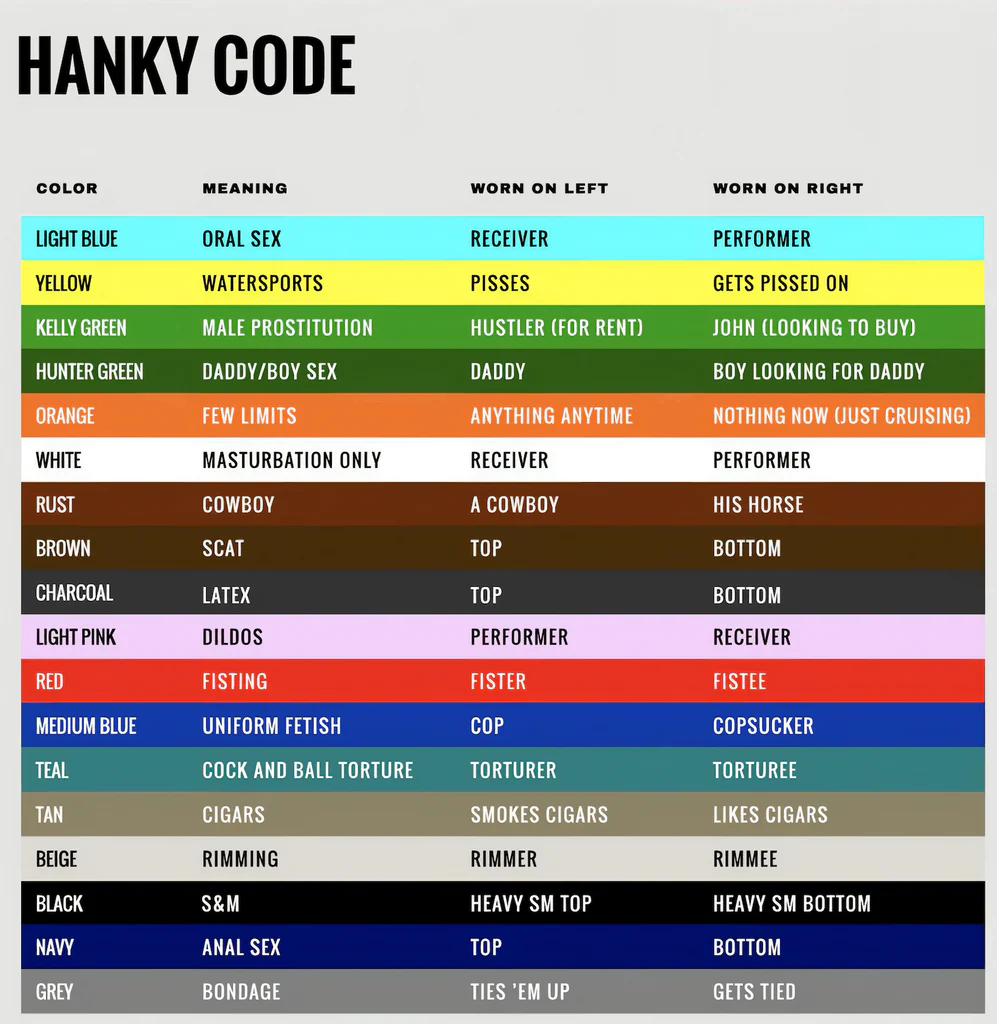
In the 1970s and 1980s, the hanky code became one of the most recognizable examples of gay cruising communication.
Different colored handkerchiefs, worn in different pockets, were used by some men to signal specific interests. Not every gay man used or understood the code, but it became an important part of gay male subculture.
The hanky code shows how cruising often depended on shared language. It also shows how humor, style, and creativity helped men communicate desire in ways that were both discreet and direct.
7. The AIDS Crisis and the Transformation of Cruising
The HIV/AIDS crisis profoundly changed gay male life, including cruising culture.
In the 1980s and 1990s, fear, grief, stigma, public health campaigns, activism, and community care reshaped how men thought about sex, risk, intimacy, and responsibility.
Cruising did not disappear, but conversations around condoms, HIV testing, PrEP, PEP, and sexual health became increasingly important.
Today, the CDC describes PrEP as medicine that reduces the chance of getting HIV for people who may be exposed through sex or injection drug use. (CDC) The WHO also states that condoms, when used correctly and consistently, are among the most effective ways to reduce the risk of sexually transmitted infections, including HIV.
This is why any modern article about gay cruising should include not only history, but also consent, health awareness, privacy, and safety.
Gay Cruising Today: From Public Spaces to Digital Apps
The arrival of the internet changed cruising forever.
First came forums, chatrooms, personal ads, and gay websites. Then came mobile apps, geolocation, private albums, profile filters, and instant messaging.
Digital cruising allows users to:
- chat before meeting;
- control what they reveal;
- use nicknames or discreet profiles;
- block unwanted users;
- report harassment;
- explore nearby profiles;
- meet while traveling;
- move at their own pace.
This does not mean digital cruising is automatically safer. Apps can reduce some risks, but they can also create new ones: fake profiles, screenshots, privacy leaks, scams, pressure, harassment, and overexposure.
The best digital cruising experience combines freedom with boundaries.
Gay Cruising vs. Gay Dating Apps
Gay cruising and gay dating apps overlap, but they are not exactly the same.
| Gay cruising | Gay dating apps |
|---|---|
| Often spontaneous | Can be spontaneous or planned |
| Traditionally linked to public or semi-public spaces | Mostly digital-first |
| Based on signals, location, and discretion | Based on profiles, filters, and messages |
| May involve anonymity | Can be anonymous, semi-private, or public |
| Often associated with desire and curiosity | Can include friendship, dating, chat, hookups, or relationships |
| Safety depends heavily on context | Safety depends on platform tools and user behavior |
Modern gay apps have transformed cruising into a more controlled experience. Users can talk first, set expectations, share photos privately, and decide whether they want to meet.
For many men, this digital layer makes cruising less intimidating.
Consent: The Most Important Rule of Modern Gay Cruising
Consent is the foundation of any respectful encounter.
In cruising, consent must be clear, mutual, and ongoing. Silence, proximity, location, clothing, or presence in a cruising space should never be treated as automatic permission.
Good cruising etiquette includes:
- respecting “no” immediately;
- not following someone who moves away;
- not touching without permission;
- not pressuring someone to share photos;
- not exposing someone publicly;
- not outing anyone;
- not recording or taking screenshots without consent;
- not assuming that interest online means consent in person.
Cruising can be discreet and exciting, but it must never ignore boundaries.
Safety Tips for Gay Cruising
Whether cruising happens online or offline, safety matters.
Before meeting someone:
- chat enough to understand expectations;
- choose a place where you feel in control;
- avoid pressure or rushed decisions;
- tell a trusted person where you are going if appropriate;
- keep your phone charged;
- protect your personal information;
- do not share your address too early;
- trust your instincts;
- leave if something feels wrong.
For sexual health, consider prevention tools that match your situation, such as condoms, HIV testing, PrEP, or PEP guidance from a qualified health professional. The CDC provides current information about PrEP, and the WHO provides public health guidance on condoms and STI prevention. (CDC)
Medical disclaimer:
This section is informational only. It does not replace advice from a doctor, pharmacist, sexual health clinic, or qualified healthcare provider. If you have questions about HIV, PrEP, PEP, condoms, STI testing, symptoms, exposure, or treatment, seek professional medical advice.
Legal Awareness: Cruising Laws Vary by Location
Laws vary by country and city; avoid illegal public sexual activity.
Some places are tolerant. Others may criminalize public sexual activity, same-sex relations, loitering, solicitation, indecent exposure, or behavior interpreted as public nuisance. Even in countries where homosexuality is legal, public sexual activity may still create legal risk.
Before meeting in any public or semi-public space, understand the local context. A safer approach is to move from public discovery to private, consensual, and legal spaces whenever possible.
Legal disclaimer:
This article does not provide legal advice. Laws and enforcement vary by jurisdiction. If you are unsure about local rules, consult reliable local legal resources or a qualified legal professional.
Privacy and Discretion in the Digital Era
Many men use cruising apps or gay dating platforms because they want discretion.
Privacy-conscious users should consider:
- using a nickname;
- avoiding full-face public photos if they are not ready;
- keeping workplace details private;
- not linking social media accounts;
- avoiding identifiable backgrounds in photos;
- checking app location settings;
- using private albums carefully;
- blocking and reporting users who violate boundaries.
Discretion is not shame. For many men, it is a reasonable way to protect their personal, professional, or family life.
A good gay dating platform should let users control how much they reveal.
Why Some Men Still Prefer Cruising
Even with modern apps, cruising remains meaningful for many gay and bi men.
Some enjoy the spontaneity. Others like the anonymity. Some feel more comfortable with body language than long messaging. Others see cruising as part of gay culture, history, and erotic freedom.
Common reasons include:
- curiosity;
- discretion;
- attraction to spontaneity;
- travel;
- lack of local gay venues;
- desire for real-world connection;
- interest in anonymous or semi-anonymous encounters;
- rejection of mainstream dating pressure.
Cruising is not one single behavior. It means different things to different men.
Common Misconceptions About Gay Cruising
“Cruising is only about sex.”
Sex can be part of cruising, but cruising is also about recognition, curiosity, flirtation, desire, community, and queer space.
“Cruising is always unsafe.”
Cruising can involve risk, but risk depends on context, consent, location, communication, and preparation.
“Only closeted men cruise.”
Many closeted men cruise, but so do openly gay, bi, queer, single, partnered, young, mature, bear, and curious men.
“Apps killed cruising.”
Apps changed cruising. They did not erase it. Digital platforms created new forms of cruising through profiles, location, chat, and private messaging.
“Cruising belongs to the past.”
Cruising is still part of gay life, but it now exists across both physical and digital spaces.
Gay Cruising and Bear Culture
Bear culture has its own relationship with cruising, dating, and gay social spaces.
For bears, mature men, daddies, chasers, and admirers, cruising can offer a way to connect beyond mainstream beauty standards. Many men in bear communities value directness, body positivity, masculinity in different forms, and relaxed social interaction.
Digital platforms like Bearwww can help users meet men who appreciate bigger bodies, mature men, hairy men, and diverse forms of attraction.
For users who prefer discretion, online gay dating can offer a softer entry point than traditional public cruising.
About Bearwww: A Community for Gay, Bi, Bear, and Queer Men
Bearwww is a dating app dedicated to gay and bisexual men, including bears, chasers, daddies, otters, hairy men, cubs, chubs, mature men, and other queer identities. Its app store listings describe Bearwww as an inclusive space focused on connections ranging from friendship to serious relationships. (Google Play)
The App Store listing says Bearwww has a global community of more than one million gay, bi, trans, and queer members. (App Store)
Bearwww’s mission is to create a more relaxed and inclusive space for men who want to meet, chat, flirt, and connect at their own pace.
For digital cruising and discreet dating, Bearwww can support:
- chat before meeting;
- local and international connections;
- bear and mature gay communities;
- gradual sharing of personal information;
- a less mainstream dating environment;
- community-oriented discovery;
- safer online interactions through moderation and support tools.
Before publication, this section should link to:
- Bearwww safety page;
- Bearwww privacy policy;
- Bearwww support center;
- Bearwww community guidelines;
- Bearwww reporting and moderation page.
Digital Cruising on Bearwww
Bearwww is designed for gay, bi, bear, mature, and queer men who want to meet, chat, flirt, and connect at their own pace.
For users interested in digital cruising, Bearwww can support:
- discreet profiles;
- chat before meeting;
- local and international connections;
- bear and mature gay communities;
- a relaxed alternative to mainstream dating apps;
- gradual sharing of personal information;
- connections based on attraction, personality, and proximity.
Digital cruising should give users more control, not less. The goal is to create space for curiosity, connection, and respect.
How to Start Cruising Online Respectfully
A good first message should be simple, respectful, and clear.
Examples:
“Hey, I like your profile. How’s your day going?”
“Hi, I’m discreet and prefer chatting a bit first. Is that okay with you?”
“Hey, I’m interested. What are you looking for here?”
“Hi, I’m new to this and taking things slowly. Happy to chat?”
Avoid messages that are aggressive, demanding, or overly explicit without invitation.
Respectful cruising begins with reading the other person’s boundaries.
Red Flags to Watch For
Be cautious if someone:
- pressures you to meet immediately;
- refuses to respect your boundaries;
- asks for money;
- sends suspicious links;
- tries to move too quickly off-platform;
- threatens to expose you;
- demands face photos without trust;
- avoids basic questions;
- changes their story repeatedly;
- makes you feel unsafe or manipulated.
You do not owe anyone your body, your photos, your real name, your address, or your time.
Use block and report tools when necessary.
FAQ About Gay Cruising
Gay cruising means looking for romantic, sexual, or intimate encounters with other men, often through discreet signals, public or semi-public spaces, or digital platforms.
Yes. Gay cruising still exists, but it has changed. Today, it happens both in physical spaces and through apps, chats, private profiles, and online communities.
It depends on the country, city, and context. Same-sex relationships may be legal in some places, but public sexual activity, solicitation, loitering, or indecent exposure may still be illegal. Laws vary by country and city; avoid illegal public sexual activity.
It can be safer when people communicate clearly, respect consent, protect privacy, avoid pressure, and make thoughtful decisions about where and how they meet. However, cruising can involve risks, especially when meeting strangers or using public spaces.
Digital cruising is the modern version of cruising through apps, dating platforms, chat, private profiles, and location-based tools.
Dating usually implies more conversation, planning, and emotional connection. Cruising is often more spontaneous, discreet, and attraction-driven. However, the two can overlap.
No. Many users prefer discretion. You can choose when and with whom to share face photos. However, honesty about your level of discretion helps avoid misunderstandings.
Respect boundaries, ask before assuming, accept rejection immediately, avoid pressure, protect privacy, and never expose or shame another person.
No. Cruising can involve hookups, but it can also involve flirtation, curiosity, chat, friendship, self-discovery, and community.
Yes. Bearwww can help gay, bi, bear, mature, and queer men chat, connect, and meet at their own pace, including users who prefer discreet or semi-anonymous interactions.
Consider regular STI testing, condoms, PrEP or PEP when appropriate, and advice from a qualified sexual health professional. The CDC provides guidance on PrEP, and the WHO provides information about condoms and STI prevention. (CDC)
Conclusion
Gay cruising has always been part of queer history. It grew from hidden codes, urban meeting places, bars, bathhouses, public spaces, and the need for discretion. It survived policing, stigma, public health crises, and social change.
Today, cruising continues in new forms. Apps and online platforms have transformed how men meet, giving users more ways to chat, filter, block, share, and decide what feels right.
But the most important principles remain the same: consent, respect, privacy, safety, and freedom.
Gay cruising is not just about the past. It is part of how many men continue to explore connection today — whether in a city, while traveling, through a private message, or on a platform like Bearwww.
Meet at your own pace. Respect others. Protect your privacy. Choose spaces where desire and safety can exist together.
Sources and Further Reading
Public health and safety sources
- CDC — PrEP and HIV prevention guidance. (CDC)
- WHO — Condoms and STI prevention. (who.int)
- HIV.gov — PrEP information and HIV prevention basics. (HIV.gov)
LGBTQ+ history sources
- Library of Congress — Stonewall Uprising and LGBTQ+ history resources. (The Library of Congress)
- Michael Rocke — Forbidden Friendships: Homosexuality and Male Culture in Renaissance Florence
- George Chauncey — Gay New York: Gender, Urban Culture, and the Making of the Gay Male World
- Martin Duberman — Stonewall
- Hugh Ryan — When Brooklyn Was Queer
- Rictor Norton — historical research on molly houses and early queer networks
Bearwww sources
- Bearwww Google Play listing. (Google Play)
- Bearwww App Store listing. (App Store)
- Bearwww support, privacy, safety, moderation, and terms pages.
Editorial note:
This article was created by the Bearwww Editorial Team for gay, bi, bear, mature, curious, and queer men looking to understand gay cruising from a historical, cultural, digital, and safety-focused perspective. It has been reviewed for accuracy, safety, and sensitivity by a qualified LGBTQ+ community, sexual health, or queer history reviewer before publication.
Important:
This article is for informational purposes only. It is not medical, legal, or mental health advice. For personal health decisions, including HIV prevention, PrEP, PEP, STI testing, or treatment, speak with a qualified healthcare professional or sexual health clinic. For legal questions, check local laws or consult a qualified legal professional.