Birmingham’s Gay Village is not hidden on the edge of the city. It occupies a compact section of Southside, centred on Hurst Street and positioned between Birmingham New Street station, Chinatown and the creative neighbourhoods leading towards Digbeth.
Table of Contents
That centrality shapes the experience. You can arrive by train, walk through Chinatown, visit a community organisation, see a major theatre production, have a quiet afternoon drink and finish the night in one of Britain’s longest-running LGBTQ+ clubs without needing a car.
However, the neighbourhood is more than its nightlife. Hurst Street is also home to Birmingham LGBT’s new community centre, Birmingham Hippodrome and the National Trust’s Back to Backs. Meanwhile, social groups, sports clubs, queer arts events and seasonal markets provide ways to meet people without relying entirely on Gay dating applications. (Visit Birmingham)
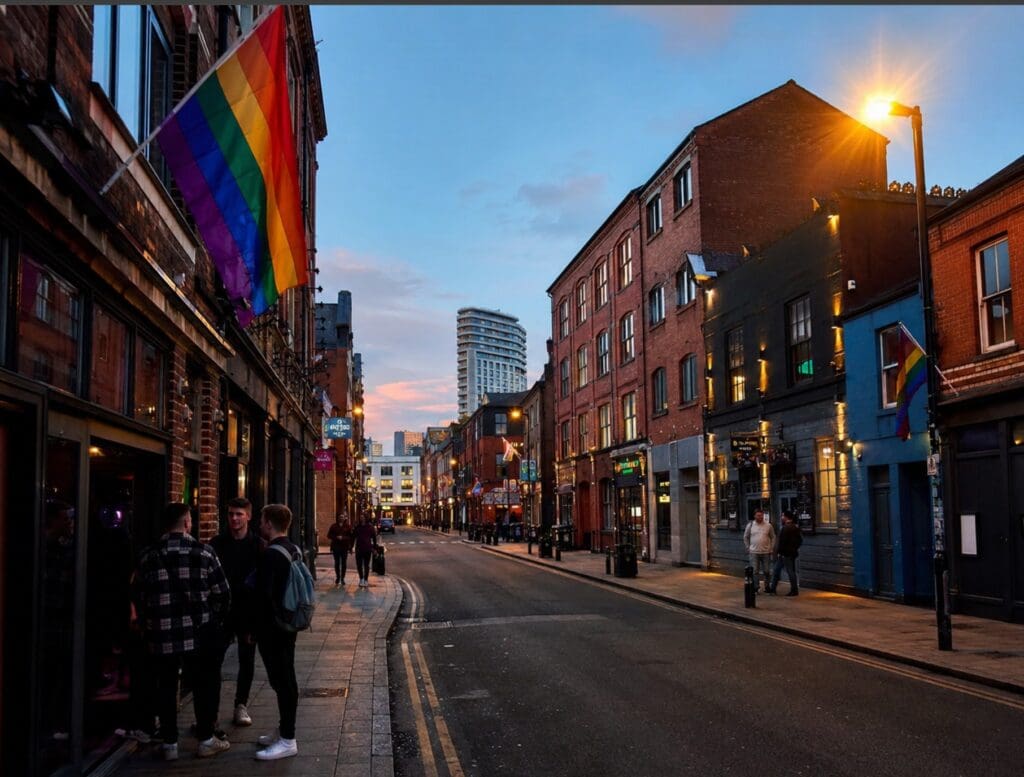
Gay Birmingham at a glance
Best area for a first stay: Southside, Chinatown or the streets around New Street station.
Historic centre of LGBTQ+ nightlife: Hurst Street, Bromsgrove Street, Kent Street, Lower Essex Street and the surrounding Gay Village.
Main community organisation: Birmingham LGBT Centre, 151 Hurst Street.
Best major nightclub: The Nightingale Club, 18 Kent Street.
Good choices for a quieter first drink: Equator Bar, The Fox or Missing Bar during its daytime hours.
Best annual LGBTQ+ weekend: Birmingham Pride, traditionally held around the late-May bank holiday.
Bear community highlight: Bear Brum, taking place from 25 to 27 September in 2026.
Is a car necessary? No. The Gay Village is approximately a ten-minute walk from Birmingham New Street station, while buses, trains and trams cover the wider city. (Brum Outloud)
The Gay Village: the historic heart on Hurst Street
A neighbourhood that changes with the hour
Hurst Street has several distinct rhythms.
During the day, the most useful stops are Birmingham LGBT Centre, the Back to Backs, Birmingham Hippodrome and the quieter bars that open for coffee or afternoon drinks. Chinatown’s restaurants are only a few minutes away, making it easy to combine the Village with lunch or an early dinner. Visit Birmingham describes Chinatown as the link between Grand Central station and the Gay Village rather than as a completely separate destination. (Visit Birmingham)
Later, the balance changes. Music becomes more noticeable around Bromsgrove Street and Kent Street, outdoor areas fill up and the crowd begins moving between bars rather than remaining in one venue. The Nightingale tends to function as the late-night destination, whereas Equator, The Fox and Missing can work as earlier meeting points.
The neighbourhood remains compact enough to explore on foot. Nevertheless, the venues do not all sit on one continuous strip. Check the route between Hurst Street, Kent Street, Lower Essex Street, Wrentham Street and Gooch Street before leaving your hotel.
🏳️🌈 Birmingham Gay Village
Hurst Street, Kent Street, Lower Essex Street, Gooch Street et Bromsgrove Street. Tracés colorés et principaux bars/clubs LGBTQ+.
Why Hurst Street matters historically
The Gay Village grew around venues that offered community at a time when being openly LGBTQ+ carried far greater social and legal risk.
The Nightingale was founded in 1967 by Laurie Williams and Derek Pemberton, who converted a former Indian restaurant in Camp Hill into an LGBTQ+ meeting place. The club later occupied several locations before establishing itself on Kent Street. Birmingham Museums’ LGBTQ+ history timeline places its opening alongside the partial decriminalisation of sex between men in England and Wales, making the venue part of the city’s wider social history rather than simply a nightclub. (The Historic England Blog)
The present-day village also overlaps with layers of working-class, migrant and theatrical history. The Back to Backs preserve domestic and working spaces linked to residents from the nineteenth and twentieth centuries, including Jewish families and a tailor who came to Birmingham from the Caribbean. (national trust collections)
Consequently, a thoughtful visit should not treat Hurst Street as an isolated entertainment zone. Its importance comes from the way housing, migration, performance, activism and queer social life occupy the same few streets.
Daytime culture in Southside
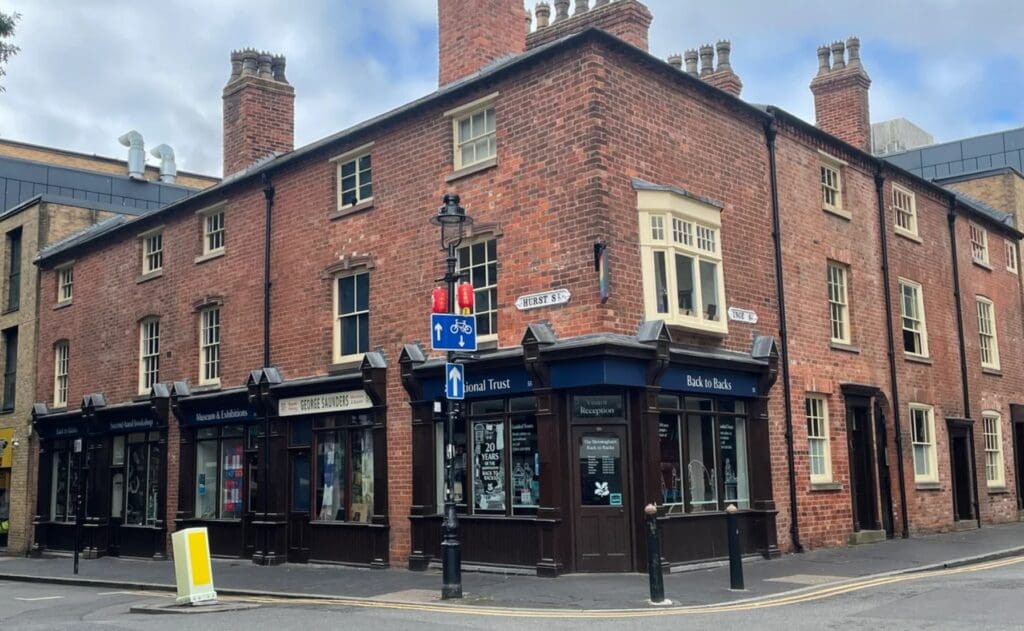
Birmingham Back to Backs
At the corner of Hurst Street and Inge Street, the Birmingham Back to Backs provide one of the clearest ways to understand the living conditions that shaped the industrial city.
Visits to the houses are available only through guided tours and should be booked in advance. The National Trust also operates a second-hand bookshop on Hurst Street that can be entered without taking the full tour. Accessible ground-floor tours are offered on selected dates, although the historic stairs and narrow spaces make advance planning important. (National Trust)
Practical address: 55–63 Hurst Street and 50–54 Inge Street.
Allow: Approximately 90 minutes for the tour, plus time for the bookshop.
Best strategy: Book the earliest convenient tour, then continue along Hurst Street for lunch or a visit to Birmingham LGBT Centre.
Birmingham Hippodrome
The Hippodrome gives Southside a cultural identity that extends far beyond clubs and bars. Its programme encompasses major musicals, dance, ballet, opera, family productions and accessible performances.
The theatre’s main entrance is on Hurst Street, with an additional entrance on Thorp Street. It also operates an access service and publishes detailed information for visitors requiring step-free routes, accessible seating, audio description, captioning or British Sign Language support. (birminghamhippodrome.com)
A theatre evening pairs naturally with the Gay Village. Equator or Missing works for an earlier drink, while Chinatown provides numerous pre-performance dining choices. After the show, most of the principal LGBTQ+ venues remain within walking distance.
Chinatown and the Arcadian area
Chinatown sits immediately beside the Gay Village, rather than across the city. Its restaurants, bakeries, supermarkets and late-opening dining rooms make it particularly useful before or after an event.
The area developed as Chinese communities settled around Hurst Street during the 1960s and 1970s and was formally recognised as Birmingham’s Chinese Quarter in the 1980s. Today it forms a physical and social bridge between Grand Central, Southside and the Gay Village. (Visit Birmingham)
For visitors, the main advantage is choice. Instead of treating food as an afterthought between bars, plan dinner in Chinatown and enter the Village later. This also makes a first night feel less pressured for anyone who is uncertain about arriving alone at a busy LGBTQ+ venue.
Nightlife and the character of each venue
Birmingham has a genuine cluster of permanent LGBTQ+ venues. Even so, they are not interchangeable. A quiet afternoon drink at Equator, a cabaret evening at The Village and a late night at The Nightingale create very different experiences.
Venue names, locations and concepts have also changed quickly since 2025. Therefore, check the official social account or event page on the day of your visit rather than relying on an old city guide.
Missing Bar: daytime sociability that becomes a party
Address: 48 Bromsgrove Street, Birmingham B5 6NU.
Missing is one of the easiest venues for a first-time visitor to approach. Its official site describes a two-floor format: a more relaxed downstairs bar suitable for daytime socialising, followed by music, drag, karaoke and cabaret later in the day. It opens from midday throughout the week, although closing times differ by night. (Missing Bar)
The earlier hours are particularly useful when travelling alone. You can sit down, understand the room and speak to staff before the weekend crowd arrives. By contrast, Friday and Saturday become much more nightlife-focused.
Best for: An accessible introduction to the Village, afternoon drinks, drag and karaoke.
Check before visiting: The current upstairs programme and any ticketed event in Studio 48.
Equator Bar: the quieter social hub
Address: 123 Hurst Street, Birmingham B5 6SE.
Equator describes itself as an all-day social hub and has occupied Hurst Street for more than two decades. Its regular hours begin in the afternoon, with later closing on Friday and Saturday. (Equator Bar)
The venue suits visitors looking for conversation rather than a large dancefloor. It is a useful meeting point before the theatre, dinner or a longer night elsewhere in the Village.
Equator is also one of the clearest reminders that gay districts need daytime spaces. Not everyone wants to meet the community at midnight, around loud music or in an environment centred on dancing.
Best for: Coffee, a quieter drink, meeting someone for the first time and beginning a night without rushing.
The Fox: a small venue with a long community history
Address: 17 Lower Essex Street, Birmingham B5 6SN.
The Fox has operated as an LGBTQ+ bar for almost three decades and is especially important to Birmingham’s lesbian community, while remaining welcoming to a wider respectful clientele. The official venue site lists Friday karaoke, a pool room and a private beer garden that hosts summer entertainment. (MorningAdvertiser.co.uk)
Because the room is smaller and more pub-like than a superclub, it can be easier to speak to people. Its beer garden also provides breathing space during busy weekends.
Best for: Lesbian and mixed LGBTQ+ groups, karaoke, pool and a traditional pub atmosphere.
Accessibility note: Published information has described the venue as partially accessible. Contact the bar directly about the entrance, toilets and garden before relying on an older listing. (birminghampride.com)
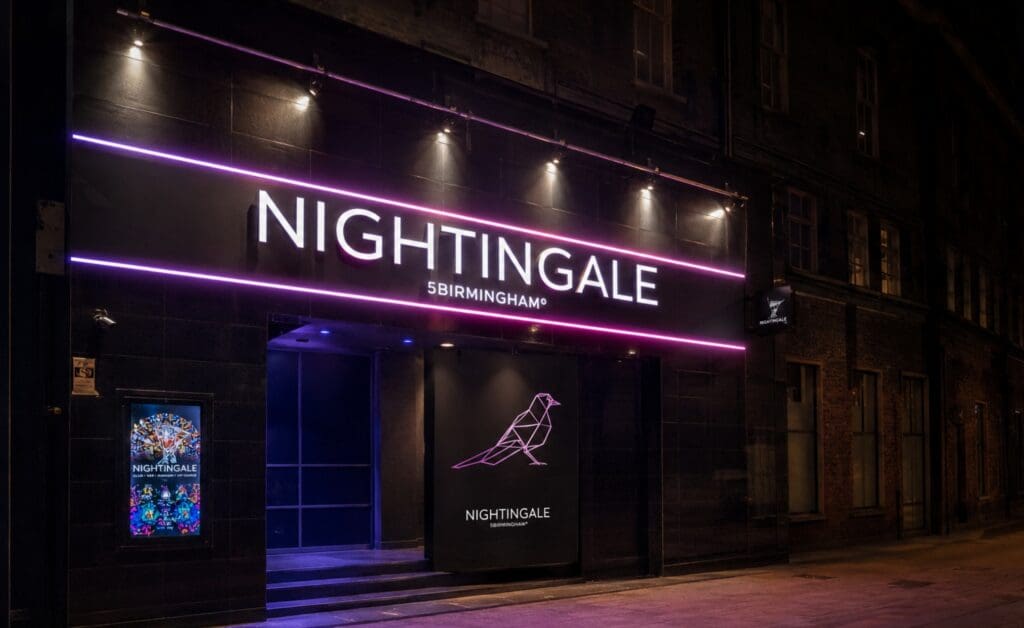
The Nightingale Club: Birmingham’s major LGBTQ+ institution
Address: 18 Kent Street, Birmingham B5 6RD.
The Nightingale is both a working nightclub and a historic queer landmark. Its current website describes a venue with capacity for approximately 2,000 people, three floors and four rooms. Regular programming includes Thursday and Saturday nights, alongside special events. (nightingaleclub.co.uk)
This is the place to choose when the priority is a large dancefloor, multiple music areas and a full club experience. However, its scale also means that it is not necessarily the best first stop for someone arriving alone. Beginning at Equator, Missing or The Fox can make the transition into a large club feel more comfortable.
Check the specific event before leaving. Entry prices, opening hours, ticket requirements and music policies may differ significantly from one night to another. Bring accepted photo identification even when you have purchased a ticket in advance.
The Village and The Loft inside the Nightingale complex
Birmingham’s venue map changed substantially in 2025. The Village Inn and The Loft announced moves from their former premises into the Nightingale site on Kent Street, creating a multi-venue entertainment complex. (Instagram)
The Village continues to operate as a distinct LGBTQ+ venue with drag, cabaret and weekend programming. Its downstairs Village Underground focuses on R&B, garage and bashment on Friday and Saturday nights. (The Village Inn)
This arrangement is useful because visitors can experience several types of evening without travelling across the city. Nevertheless, confirm which entrance, room or ticket applies to the event you have selected.
Eden and The Hub
Eden reopened in newer premises around the Gooch Street and Sherlock Street area, a short walk from the central Hurst Street cluster. Its current identity combines an inclusive LGBTQ+ bar with live cabaret and several event spaces. The Hub within Eden hosts larger club events, community markets and a roof terrace. (Instagram)
The programme can move from quiz nights and drag to women-focused daytime dances or late-night parties. For example, The Hub hosted an LGBT+ Market and Arts Fayre in March 2026 and a women’s daytime disco in May. (Facebook)
Best for: Event-led visits, cabaret, community markets and larger themed nights.
Important: Do not assume that every space in the complex follows the same timetable or admission policy.
The Fountain Inn
Address: 102 Wrentham Street, Birmingham B5 6QL.
The Fountain is a traditional gay bar with letting rooms, positioned slightly away from the busiest section of Hurst Street. Its official site continues to describe it as a bar and accommodation venue, while CAMRA listed regular opening hours in 2026. (The Fountain Inn)
Because it offers rooms, some visitors consider it for a nightlife-focused stay. Check recent room information carefully, including sound levels, accessibility and cancellation terms, rather than choosing solely because it is inside the Village.
A warning about old venue directories
Birmingham’s LGBTQ+ scene remains active, but its businesses evolve.
Sidewalk, for example, announced a closure in September 2025 to make way for a new Hurst Street concept. Yet the Birmingham Pride 2026 programme continued to list Sidewalk among participating Village venues. That contradiction shows why a search result, archived guide or old venue page should not be treated as proof of current everyday opening. (Instagram)
The practical rule is simple: use an official account with a recent post, confirm the address and look for an event dated within the current week.
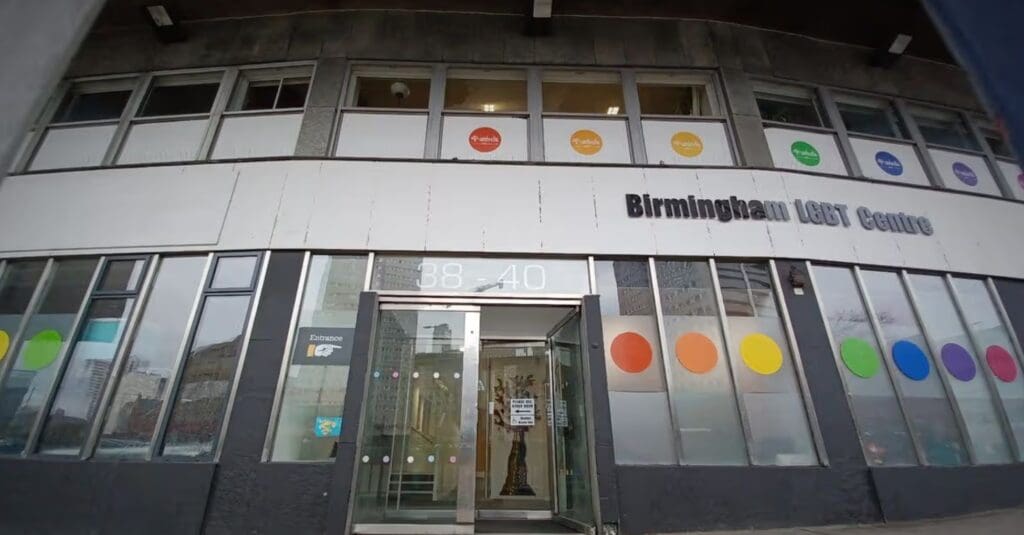
Birmingham LGBT Centre: community beyond nightlife
A new centre in the middle of the Village
Birmingham LGBT moved to 151 Hurst Street in late 2025 and formally opened its new centre in early 2026. The ground-floor facility includes meeting rooms, consultation and clinical spaces, as well as a communal area for events and social connection. (Birmingham LGBT)
Published opening hours in 2026 were:
- Monday to Wednesday: 10 a.m. to 6 p.m.
- Thursday and Friday: 10 a.m. to 9 p.m.
- Saturday: 10:30 a.m. to 6 p.m.
Opening arrangements can change around public holidays or building work, so check the organisation’s latest access notice before travelling. (Birmingham LGBT)
Services that make the Village more than a commercial district
Birmingham LGBT offers sexual-health services, counselling, wellbeing support, domestic- and sexual-violence support, hate-crime assistance, services for asylum seekers and refugees, and community activities. (Birmingham LGBT)
This work is central to understanding the neighbourhood. A gay village is not sustained solely by licensed premises. It also needs places where people can seek confidential advice, make friends without buying alcohol and receive help during difficult periods.
Visitors should treat the Centre respectfully. Some people may be attending confidential appointments or seeking support. Do not photograph anyone, turn a support group into a tourism experience or assume every meeting is open to drop-in visitors.
Social groups at the Centre
The 2026 programme included Birmingham LGBTQ+ Writers, Golden Babs, Trans Masc Brum, Journey Film Club, Rainbow Spirit, TranSanctuary and Bards and Books. Some met weekly, while others operated monthly. (Birmingham LGBT)
These activities are especially valuable for new residents, solo travellers on longer stays and people who do not enjoy bar culture. Before attending, read the group description and contact the organiser when membership criteria are not clear.
Meeting people beyond dating apps
Queer arts through SHOUT
SHOUT is an all-year creative programme celebrating LGBTQIA+ lives and artists in Birmingham and the wider West Midlands. Its events include performance, dance, writing, workshops, discussion and participatory cultural projects rather than one single style of festival. (Shout)
The programme often reaches beyond the Village into theatres, galleries and independent cultural spaces. That makes it useful for meeting people through a shared interest rather than through nightlife alone.
Check the current schedule before planning a trip specifically around SHOUT. The organisation publishes events throughout the year rather than guaranteeing the same dates and venues every season.
Sport and regular social contact
The Birmingham Bulls are an inclusive rugby team based in the Gay Village and welcome new players, including those trying the sport for the first time. (Birmingham Bulls RFC)
Moseley Shoals is an LGBTQ+ swimming club offering mixed-ability sessions. Published community information lists twice-weekly swims at Aston University’s Woodcock Street pool, with private changing cubicles and accessible changing facilities. Confirm the present timetable before attending. (Moseley Shoals)
Birmingham also has LGBTQ+ running, football, bowling, creative and social groups. The advantage of joining a recurring activity is straightforward: seeing the same people each week usually creates stronger connections than repeatedly starting from zero in a crowded bar. (Brum Outloud)
Bear Brum
Bear Brum is Birmingham’s dedicated Bear-community weekend. The 2026 edition is scheduled for 25–27 September, with daytime activities and evening events involving venues such as The Village, Eden, Missing and The Fox. (BEAR BRUM)
The weekend provides a useful alternative to Pride for Bears, Cubs, admirers and friends who prefer a smaller community-focused event. Purchase separate tickets for headline club nights where required; the weekend pass does not automatically include every event.
Connect with Birmingham’s Bear community on BEARWWW
A city guide can identify the streets, but local people often know which event will suit your mood, access needs or travel dates. BEARWWW helps Bears, Cubs and admirers connect with Birmingham residents before arrival, exchange recommendations about Hurst Street or Bear Brum and arrange a first meeting in a public venue. It is a practical way to move beyond repetitive, impersonal conversations while keeping the pace comfortable and respectful.
Discover Gay Birmingham on BEARWWW
Finding and supporting queer-led businesses
“Queer-owned” should not be used as a casual marketing label. Business ownership can change, and an owner’s identity should never be assumed.
The Fox is one of the clearest publicly documented examples of a long-term owner-operated LGBTQ+ venue: its official site credits Andrew King, while a hospitality-industry profile reported that he had been running the bar since 1997. (the-fox-bar)
Equator publicly identifies as a long-running LGBTQ+ social hub, while Missing and The Nightingale explicitly position themselves as established LGBTQ+ venues. Supporting these businesses helps maintain permanent spaces rather than visibility that appears only during Pride. (Equator Bar)
For smaller queer-owned makers, artists and traders, look for:
- Birmingham Pride’s community and business stalls;
- LGBT+ markets hosted at Eden or other Village venues;
- SHOUT events and artist programmes;
- pop-up markets advertised by Birmingham LGBT.
Always verify how the organiser selects or describes traders rather than assuming every seller at an inclusive market is LGBTQ+ owned. (birminghampride.com)
🏳️🌈 Birmingham LGBTQ+ Map
Venues vérifiés · Organisations queer-led · Marchés communautaires actuels
Birmingham Pride
When Pride takes place
Birmingham Pride 2026 was held on Saturday 23 and Sunday 24 May in the Gay Village.
The parade gathered at Victoria Square from 11 a.m. on Saturday and departed at noon before finishing in the Hurst Street area. The festival included performance stages, cabaret, dance events, community stalls and food vendors. (birminghampride.com)
For later editions, confirm the dates before booking. Pride is normally associated with the late-May bank-holiday weekend, but programming, ticketing and street layouts can change.
Pride as both a parade and a neighbourhood event
The parade is only one part of the experience. Throughout the weekend, bars run their own programming, community organisations host stalls and the narrow streets become substantially busier than on an ordinary weekend.
Reserve accommodation early and do not assume that a standard venue ticket includes the entire festival. Pride wristbands, individual club events and VIP areas may operate separately.
The 2026 event also offered a low-income ticket scheme with a 50% discount for eligible applicants. Applications closed in advance, so visitors requiring the scheme should monitor the official site well before the festival. (birminghampride.com)
Accessibility at Pride
Published accessibility arrangements included a wheelchair-accessible parade route, lowered kerbs, accessible toilets, assistance-dog admission, quiet or sensory-friendly spaces and access support within the festival site. (birminghampride.com)
Contact the access team before travelling when you need a personal assistant ticket, viewing platform, shorter route or specific sensory provision. Do not rely solely on arrangements from a previous year.
[Insert a high-quality original photograph of the street life during Birmingham Pride, showing the scale of the event without isolating individual attendees]
Where to stay
Southside and the Gay Village: best for nightlife
Staying around Southside places Hurst Street, Chinatown, the Hippodrome and most LGBTQ+ venues within walking distance. Visit Birmingham describes the district as a combined cultural, nightlife and food destination rather than a nightlife-only zone. (Visit Birmingham)
Choose Southside for:
- Pride weekend;
- late nights at the Nightingale;
- minimal reliance on taxis;
- theatre and Chinatown;
- a short first visit.
Consider before booking:
- Street noise can continue well into the night.
- Pride road closures may affect drop-offs.
- A room overlooking an internal courtyard may be quieter than one facing Hurst Street.
- Apartment listings should be checked for reception hours and luggage storage.
New Street, Chinatown and the city centre: best overall convenience
Hotels around New Street station give easy access to trains, shops, Chinatown and the Gay Village. Hurst Street is roughly a ten-minute walk away, depending on the station exit and the exact venue. (Brum Outloud)
This is usually the best choice for a first-time visitor who also wants to explore the wider city. It avoids the loudest nightlife streets while keeping the Village close enough to walk home.
Jewellery Quarter: best for a quieter, creative stay
The Jewellery Quarter combines historic workshops, independent retailers, galleries and restaurants. Visit Birmingham identifies more than 150 independent retailers in the area, many of them connected to jewellery, metalwork and design. (Visit Birmingham)
It is quieter than Hurst Street and connected to the centre by tram and train. However, it is not the best option for walking home alone after a very late club night. Check the final public-transport departure or budget for a licensed taxi.
Digbeth: best for alternative culture
Digbeth is Birmingham’s principal creative quarter, with street art, former industrial buildings, independent venues and cultural businesses around the Custard Factory and surrounding streets. (Visit Birmingham)
It suits visitors whose plans include live music, street art and independent events. The Gay Village is reasonably close, but the route is less direct than from New Street or Chinatown.
Edgbaston: best for calm
Edgbaston offers a more residential base and a tram link towards the city centre. It is suitable for visitors prioritising sleep, green space or a longer stay.
The compromise is distance: returning from Hurst Street after the final tram will usually require a taxi.
Navigating Birmingham
Walking
The city centre is compact enough for most visitors to walk between:
- New Street station;
- the Gay Village;
- Chinatown;
- the Bullring;
- the Hippodrome;
- Digbeth;
- the Mailbox.
The Village itself is best explored on foot. Attempting to move between Hurst Street and Kent Street by taxi would usually take longer than walking once traffic and pick-up restrictions are considered.
From Birmingham Airport
The free Air-Rail Link connects the airport terminal with Birmingham International station. From there, direct trains reach Birmingham New Street in approximately ten minutes, with frequent services during normal operating hours. (Birmingham Airport)
After arriving at New Street, follow signs for the Southside or Hill Street side of the station and continue on foot towards Chinatown and Hurst Street.
Buses, trains and trams
Transport for West Midlands coordinates journey information across the bus, train and tram network. From 28 June 2026, the standard adult all-day bus ticket was priced at £5.50; fares can change, so use the official ticket finder rather than copying a price from an old article. (tfwm.org.uk)
West Midlands Metro is useful for the Jewellery Quarter, Westside, Edgbaston and Eastside. Trams generally operate every 10–12 minutes during Monday-to-Saturday daytime periods and every 15 minutes in the evening and on Sundays. (West Midlands Metro)
The tram is less important for Hurst Street itself because the Village is already close to New Street and Grand Central.
Getting home after a late night
Club closing hours may extend beyond the final train, tram or bus.
Before entering a venue:
- Check the final service to your accommodation.
- Save the hotel address offline.
- Keep enough battery and money for a licensed taxi or private-hire vehicle.
- Agree on a meeting point when travelling with friends.
- Avoid accepting informal rides from strangers outside venues.
When to visit
Late May for Birmingham Pride
This is the busiest and most visible LGBTQ+ weekend. Choose it for the parade, large-scale entertainment and community stalls, but expect higher accommodation prices, queues and street closures. (birminghampride.com)
September for Bear Brum
The 2026 Bear Brum weekend runs from 25 to 27 September. It offers a more targeted community programme and may suit visitors who find the size of Pride overwhelming. (BEAR BRUM)
Spring and early autumn for a balanced city break
These periods are well suited to walking between Southside, Digbeth, the Jewellery Quarter and the canals without the largest festival crowds.
Check SHOUT, Birmingham LGBT and individual venue calendars before selecting dates. A strong event can make an ordinary weekend much more rewarding than arriving during a major festival without a plan.
December for the wider city atmosphere
Birmingham becomes exceptionally busy during its Christmas season. Southside remains open, but hotels, trains and central streets are more crowded.
Choose December for theatre, shopping and a festive city break rather than for the easiest introduction to the Gay Village.
Safety, consent and respectful travel
Birmingham has a visible, organised LGBTQ+ community, but no district is free from harassment, discrimination or ordinary city-centre crime.
Use the same precautions that would apply in any large nightlife area:
- Meet online contacts in a public venue first.
- Tell someone where you are going.
- Keep control of your drink.
- Respect personal boundaries and venue rules.
- Do not photograph drag performers or other guests without consent.
- Plan the return journey before the final public-transport service.
- Ask bar staff or security for assistance when a situation feels unsafe.
Birmingham LGBT provides support connected with hate crime, domestic abuse, sexual violence and wellbeing. Its services can offer confidential guidance when an incident affects a visitor or resident. (Birmingham LGBT)
Accessibility
The new Birmingham LGBT Centre is entirely on the ground floor with step-free access from Hurst Street. The organisation describes the building as fully accessible and includes clinical, consultation and community rooms. (Birmingham LGBT)
Birmingham Hippodrome operates an access-registration system and publishes accessible-performance information. (birminghamhippodrome.com)
The Back to Backs can provide sensory bags, written guides and a wheelchair at reception, although the historic structure contains steep stairs. Ask about the ground-floor accessible tour. (National Trust)
Accessibility varies considerably among bars, especially older pubs. Contact the venue directly to confirm:
- step-free entrance;
- accessible toilets;
- seating;
- lighting and strobe effects;
- quiet space;
- assistance-dog policy;
- personal-assistant arrangements.
A three-day LGBTQ+ Birmingham itinerary
Day one: understand Southside before the nightlife
Arrive at New Street and walk through Chinatown towards Hurst Street.
Begin with a pre-booked Back to Backs tour. Afterwards, visit the free second-hand bookshop and continue to Birmingham LGBT Centre during an open public event.
Have an early drink at Equator or Missing, followed by dinner in Chinatown. Then choose a Hippodrome performance, cabaret at The Village or a relaxed evening at The Fox.
Day two: Birmingham beyond the Village
Spend the morning in the Jewellery Quarter or around Birmingham’s central museums and galleries.
In the afternoon, check for a SHOUT performance, writers’ meeting, film club or community event. Alternatively, explore Digbeth’s street art and independent cultural spaces.
Return to Southside for dinner. Begin the evening in a smaller bar before moving to The Nightingale or a ticketed event at Eden.
Day three: community, canals and a slower final evening
Join an appropriate LGBTQ+ sport or social group when advance contact confirms that visitors are welcome.
Otherwise, walk towards the Mailbox and the city-centre canals before returning through Southside.
Finish with a Sunday afternoon at Equator, The Fox or a scheduled community event. This slower final day often provides a better opportunity to speak with local people than another rushed club night.
🗓️ 3-Day LGBTQ+ Birmingham Itinerary
Walking routes, tram/train links and late-night taxi points. Click days in layer control.
Common mistakes to avoid
Treating every venue as the same experience
A café-style afternoon bar, a traditional pub, a cabaret room and a 2,000-capacity club serve different needs. Choose the atmosphere before choosing the address.
Using an old list of bars
Venue closures, relocations and rebrands have been substantial since 2025. Confirm every opening through a recent official post.
Visiting only after dark
The community centre, Back to Backs, Hippodrome, SHOUT events and daytime social groups provide much of the neighbourhood’s cultural value.
Assuming Pride is entirely free
The parade can be watched publicly, but sections of the festival, individual venues and special events may require separate tickets or wristbands.
Booking a noisy room without checking its position
Being close to Hurst Street is useful until music and street activity continue past the time you intended to sleep.
Relying on dating apps as the only source of local knowledge
Community events, sports teams, film clubs, writing groups and regular venues offer lower-pressure ways to meet people.
Frequently asked questions
It is in Southside, centred on Hurst Street and the surrounding sections of Bromsgrove Street, Kent Street, Lower Essex Street and Gooch Street. It is approximately a ten-minute walk from Birmingham New Street station. (Brum Outloud)
Equator is suitable for a quiet afternoon or early drink. Missing offers a gradual transition from daytime socialising to entertainment. The Nightingale is the better choice for a large late-night club.
The Fox has a particularly important relationship with Birmingham’s lesbian community while welcoming a broader respectful LGBTQ+ clientele. (Brum Outloud)
Birmingham LGBT Centre runs social and wellbeing groups, while SHOUT, Moseley Shoals and the Birmingham Bulls provide cultural or sporting alternatives. (Birmingham LGBT)
The 2026 event took place on 23 and 24 May. Future dates should be confirmed on the official Pride calendar before booking. (birminghampride.com)
Yes. Bear Brum organises a dedicated annual weekend, with the 2026 programme scheduled for 25–27 September. BEARWWW can also help Bears, Cubs and admirers connect with local people before travelling. (BEAR BRUM)
Yes. New Street station is close to the Village, Birmingham Airport has a rapid rail connection to the centre and the wider urban area is covered by buses, local trains and the West Midlands Metro. (Birmingham airport)
The real heart of Birmingham’s Southside
The Gay Village remains one of Birmingham’s strongest examples of a neighbourhood where nightlife and community infrastructure occupy the same streets.
The Nightingale represents continuity. The new Birmingham LGBT Centre represents investment in the community’s future. The Fox, Equator, Missing, Eden and The Village each provide a different form of sociability. Meanwhile, the Back to Backs and Hippodrome prevent Hurst Street from being understood only through its bars.
The most rewarding visit therefore moves between these worlds.
Come for the club if dancing is the priority. However, also visit the Centre, book a heritage tour, attend a queer arts event, eat in Chinatown and spend time in a smaller venue where conversation is possible.
That combination reveals the real character of Southside: not a manufactured nightlife district, but a living piece of Birmingham shaped by performance, migration, activism, hospitality and generations of LGBTQ+ people creating space for one another.
About the Author
Alain VEST s an LGBTQ+ travel and lifestyle journalist.