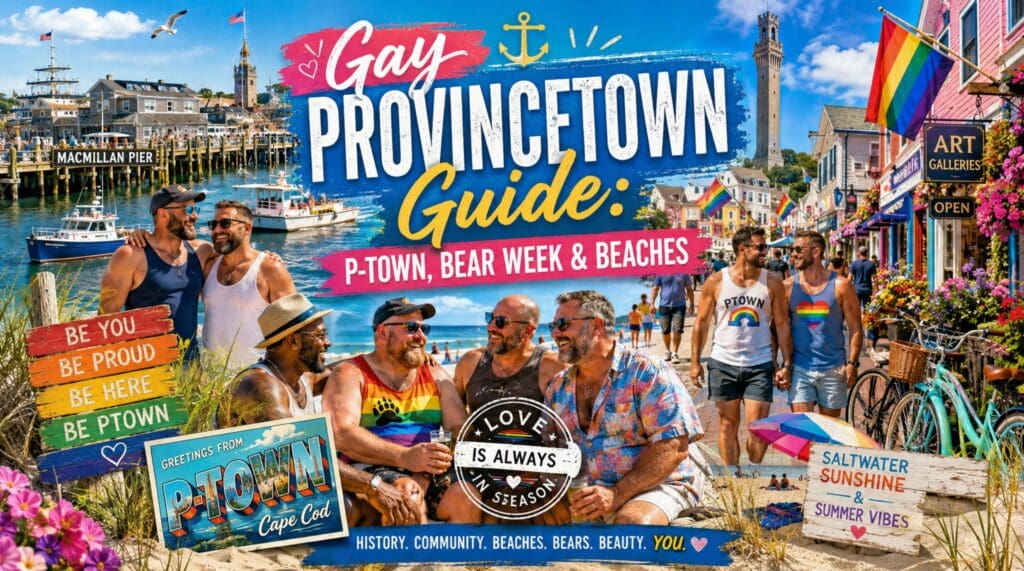
Provincetown announces itself from the water.
Table of Contents
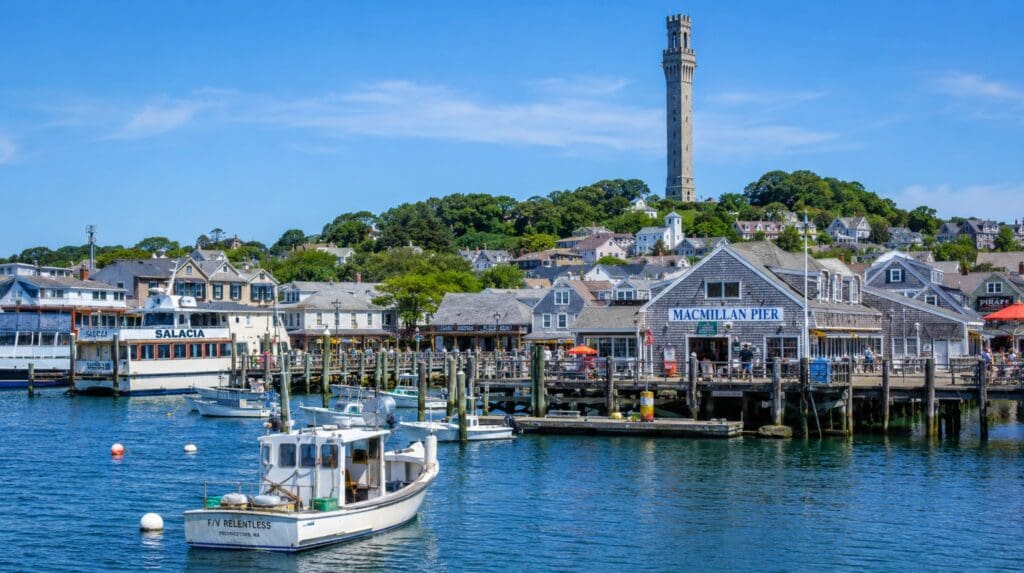
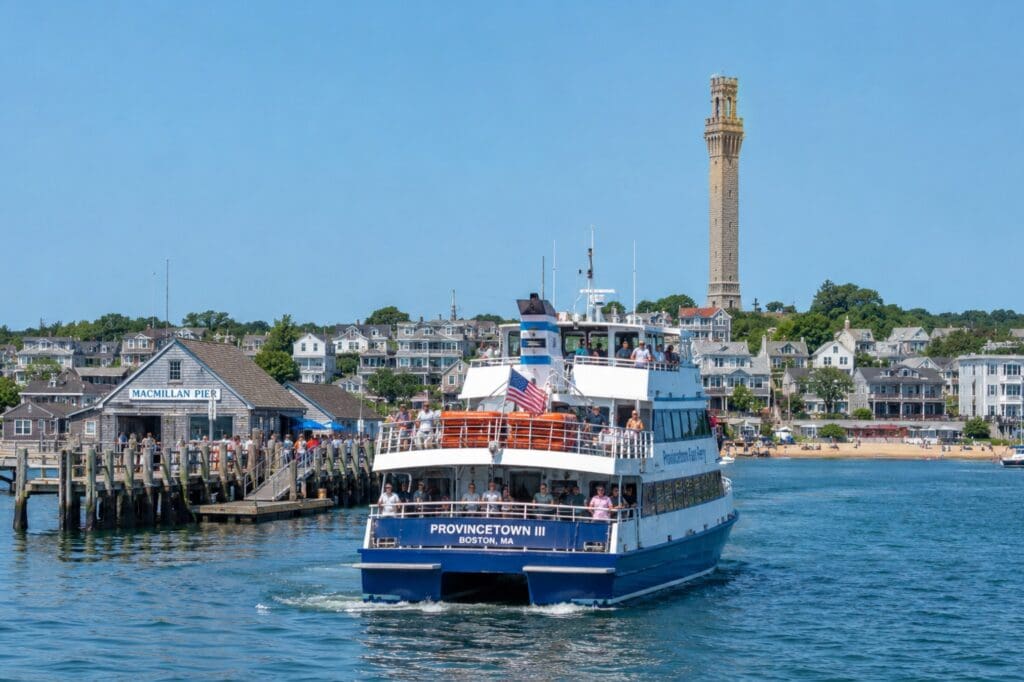
As the fast ferry leaves Boston Harbor, glass towers gradually give way to open sea. Then, roughly 90 minutes later, the hooked tip of Cape Cod comes into view. The Pilgrim Monument rises above a low strip of shingled houses, church towers, galleries, and waterfront decks. Finally, the boat turns toward MacMillan Pier, placing passengers almost directly in the middle of town.
From there, Provincetown feels improbably compact.
Commercial Street curves along the harbor for roughly a mile and a half, yet it contains an entire vacation ecosystem: Portuguese bakeries, queer-owned shops, weathered cottages, art galleries, cabaret rooms, restaurants, guesthouses, historic bars, and afternoon dance floors overlooking the bay. More importantly, LGBTQ+ life is not hidden inside one designated entertainment district. It shapes the public personality of the town itself. (Provincetown Business Guild)
That visibility creates a rare feeling. Couples stroll without first checking who is watching. Older gay travelers share patios with first-time visitors. Bears, lesbians, trans travelers, families, artists, fishermen, performers, and year-round residents move through the same narrow streets.
Nevertheless, Provincetown is not a theme park built solely for tourists. It is a historic fishing community, a living art colony, a fragile coastal environment, and a small town managing enormous seasonal crowds. The best visit therefore combines celebration with curiosity and a little logistical discipline.
Provincetown in 60 seconds
| You are looking for… | Start here |
|---|---|
| The easiest arrival from Boston | The seasonal fast ferry |
| The heart of town | Commercial Street and MacMillan Pier |
| Art galleries and quieter daytime walks | The East End |
| Tea Dance and sunset socializing | The West End |
| Major clubs and cabaret | Central Commercial Street |
| A scenic beach bike ride | Herring Cove via the Province Lands |
| Bigger Atlantic scenery | Race Point Beach |
| Bear community and events | Bear Week, held July 11–18 in 2026 |
| A trip without a car | Ferry, walking, bicycle, and CCRTA shuttle |
| The calmest season | Late spring or September |
| The largest summer gatherings | Pride, Bear Week, Family Week, and Carnival |
Bear Week’s 2026 edition ran from July 11 through July 18. Meanwhile, Provincetown’s wider annual calendar includes community-specific celebrations serving bears, women, families, trans visitors, queer people of color, and other parts of the LGBTQ+ population. (Provincetown Business Guild)
Why Provincetown became America’s original gay getaway
Provincetown’s LGBTQ+ identity did not appear overnight.
During the late 19th and early 20th centuries, the town’s fishing economy changed while tourism, theater, and visual art became increasingly important. Writers, painters, performers, political radicals, and other unconventional residents were drawn to the Outer Cape’s isolation, natural light, and relative social freedom.
Consequently, Provincetown developed a reputation for experimentation. Queer artists and visitors became increasingly visible during the early 20th century; afterward, the growth of gay tourism accelerated during the mid-century and especially the 1970s. Historical scholarship describes the town’s evolution as the result of overlapping communities Portuguese fishing families, artists, tourists, LGBTQ+ residents, and business ownersrather than a simple transformation from a “straight town” into a “gay resort.” (De Gruyter Brill)
That layered history still matters.
The fishing fleet, Portuguese heritage, art colony, theater tradition, and queer community continue to occupy the same physical space. Thus, a morning may begin with boats unloading near the pier, continue through a contemporary exhibition, and end at a dance event that has been part of LGBTQ+ vacation culture for decades.
For a deeper introduction, the Pilgrim Monument and Provincetown Museum hosts an exhibition built around documented LGBTQ+ accounts from the last century. It covers personal lives, community milestones, the AIDS crisis, and celebrations that shaped modern Provincetown. (Pilgrim Monument and Provincetown Museum)
Planning Your Arrival: The Fast Ferry From Boston
Why the ferry is usually the best choice
The ferry creates the cleanest possible transition from Boston to P-Town.
There is no Cape traffic, no search for parking, and no need to navigate Route 6 after a flight or long train journey. Instead, passengers disembark at MacMillan Pier with Commercial Street, Town Hall, restaurants, and many central guesthouses within walking distance.
Two operators provide seasonal high-speed service from Boston.
Bay State Cruise Company
Bay State operates from Boston’s Seaport District. In 2026, its main season ran daily from May 16 through October 18, followed by weekend service into mid-November.
The crossing takes approximately 95 minutes. During the core season, three daily departures were scheduled in each direction. At the time of review, adult fares ranged from $87 to $102 one way, with a $128 round-trip fare plus a $5 fuel surcharge per journey segment. Bicycles cost an additional $10 each way. (Bay State Cruise Company)
Boston Harbor City Cruises
City Cruises departs from Long Wharf, which is convenient for travelers staying near Downtown Boston or arriving via the MBTA Blue Line.
Its crossing also takes approximately 95 minutes. The 2026 schedule ranged from one to three departures per direction, depending on the month and day of the week. Friday and Saturday evening sailings were added during the busiest summer period. (City Experiences™)
Which operator should you choose?
Choose Bay State when the Seaport departure point or its timetable better suits your plans.
Choose City Cruises when Long Wharf is easier to reach from your Boston hotel, Logan Airport, or public transportation.
Ultimately, the best boat is the one that gets you into Provincetown early enough to settle in without sacrificing half the day.
Ferry advice that prevents a grumpy beginning
Reserve as early as possible for Bear Week, Carnival, holiday weekends, and Friday departures. Moreover, arrive before the stated boarding deadline rather than at the exact departure time.
The crossing is usually straightforward; however, Cape Cod Bay can become rough. Travelers prone to motion sickness should choose a seat near the vessel’s center, look toward the horizon, and follow medical advice regarding any motion-sickness treatment.
Finally, do not schedule a nonrefundable flight immediately after the return ferry. Weather and sea conditions can change sailing times.
Reaching P-Town by air, bus, or car
Cape Air provides seasonal nonstop service between Boston Logan and Provincetown Municipal Airport. For 2026, daily seasonal operations were scheduled from May 14 through November 2. The airport lies approximately 2.5 miles from the town center, with seasonal shuttle and taxi connections available. (capeair.com)
Bus travel is slower, although it can be useful outside ferry season. Peter Pan serves Provincetown from Boston, Logan Airport, Hyannis, and several Outer Cape communities. The regional Flex route also connects Provincetown with Truro, Wellfleet, Eastham, Orleans, Brewster, and Harwich. (provincetown-ma.gov)
Driving provides flexibility for exploring the wider Cape. On the other hand, it introduces summer traffic and parking costs. Paid parking operates seasonally, and parking is prohibited on the central section of Commercial Street between Pearl and Central Streets from April through October. (provincetown-ma.gov)
For a trip focused primarily on Provincetown, the car often spends more time resting than you do.
Commercial Street: The Historic Heart of P-Town
Commercial Street is not merely a road between attractions. It is the town’s communal living room.
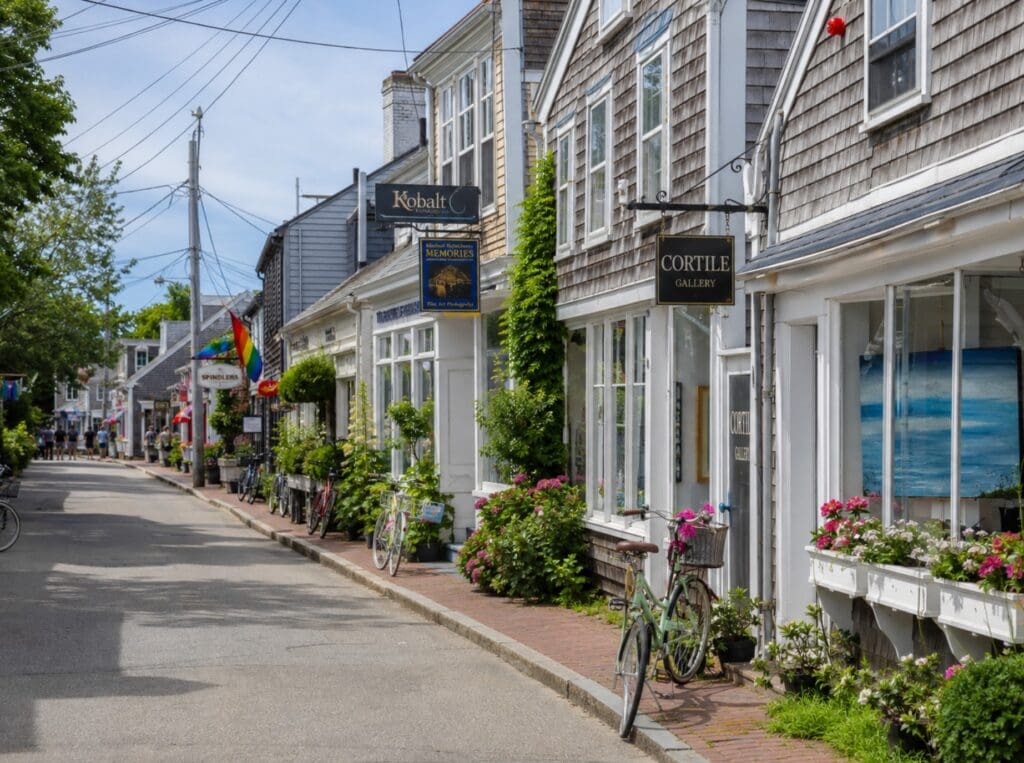
The experience changes every few blocks. In the East End, galleries and cottages create a quieter, more contemplative atmosphere. Around MacMillan Pier and Town Hall, the street becomes dense with shops, food counters, performers, and visitors. Farther west, waterfront decks and guesthouses shift the mood toward sunset drinks, Tea Dance, and an unhurried walk home.
Morning: the town before the crowds arrive
Before 10 a.m., Commercial Street feels almost private.
Delivery vans briefly occupy the road. Bakery doors open. Cyclists head toward the Province Lands, while gallery staff prepare windows for the day. The harbor remains visible through narrow passages between buildings.
This is the best time to notice Provincetown’s physical character. Houses lean close to the street. Small gardens spill over fences. Old commercial buildings stand beside modern restaurants, yet the scale remains human.
A walk from the West End toward the East End takes longer than the map suggests not because of distance, but because almost everything invites a pause.
Afternoon: galleries, shops, and people-watching
By midday, Commercial Street becomes a slow-moving procession.
Visitors enter galleries, compare restaurant menus, queue for ice cream, and stop every few steps to greet someone. During a theme week, the street also functions as an informal reunion route. The same people encountered at breakfast reappear outside a gallery, beside Town Hall, and later on a waterfront deck.
Provincetown’s concentration of art is not decorative branding. It is rooted in one of the country’s oldest continuously operating art colonies. The Provincetown Art Association and Museum has served the local arts community for more than a century and maintains five exhibition galleries combining historic and contemporary work. In summer 2026, it was open daily from 11 a.m. to 5 p.m., with extended Friday hours until 8 p.m. (Provincetown Art Association and Museum)
Independent galleries continue eastward along Commercial Street and around Bradford Street. Rather than trying to visit every space, choose four or five and leave time to speak with staff. Provincetown’s gallery culture is refreshingly conversational; the person explaining a painting may be the artist, curator, or neighbor who watched it being made.
Evening: when the sidewalk becomes the event
Around 4 p.m., the social center begins shifting westward.
Beachgoers return, gallery visitors change for dinner, and the first Tea Dance crowd moves toward the Boatslip. At the same time, restaurants fill and performers distribute cards for evening shows.
Later, the sidewalk itself becomes part of nightlife. Friends move between cabaret, dinner, cocktails, and dancing without relying on a car. Because the street is narrow, nearly everyone passes through the same public corridor.
That intimacy is one of Provincetown’s greatest strengths. Nevertheless, it also requires awareness. Pedestrians, bicycles, delivery vehicles, wheelchairs, and e-bikes share limited space.
In July 2026, the town increased enforcement of Commercial Street traffic rules. Pedal bicycles may travel in either direction, whereas e-bikes, motorized scooters, and other powered vehicles must follow the designated one-way direction. Riders must slow down, yield to pedestrians, and use proper lighting after dark. (provincetown-ma.gov)
The local rule of thumb is simple: during the busiest hours, walking the bike is often faster and considerably more charming than trying to weave through the crowd.
Biking to Herring Cove: The Classic P-Town Beach Day
The ride to Herring Cove begins with the practical business of leaving town.
Commercial Street gives way to quieter roads. Houses thin out. Then, almost abruptly, the landscape opens into the Province Lands: pine forest, dune grass, sandy rises, cranberry bogs, and broad Cape sky.
This is where Provincetown’s built-up summer energy falls away.
The Province Lands Bike Trail
The paved Province Lands Bike Trail forms a 5.45-mile loop. Separate spurs connect it with Herring Cove Beach, Race Point Beach, Bennett Pond, the visitor center, and Beech Forest.
Although the surroundings appear serene, the trail is not a completely gentle boardwalk. The National Park Service classifies it as intermediate to advanced because of steep grades, sharp turns, tunnels, sand, and occasional standing water. Riders should keep their speed low, stay to the right, and walk bicycles through tunnels. (Parc national américain)
An electric bike can make the hills more manageable. However, assistance does not eliminate the need for control on descents. A helmet, front light, rear light, water, and a small repair kit remain sensible.
Moreover, bicycles are not permitted on beaches or dune areas. Lock the bike at an authorized rack and continue across the sand on foot. (Parc national américain)
What the ride actually feels like
The first climb is the moment when many casual riders realize that “Cape Cod” does not always mean “flat.”
The trail rises and falls across the dunes, sometimes hiding the next section completely. Pine shade offers brief relief; afterward, the path emerges into exposed sun. At a crest, the Atlantic suddenly appears beyond the grass, immense and startlingly close.
Therefore, do not plan the trip as a quick commute. Treat it as an activity in its own right.
A confident rider can complete the main loop relatively quickly. Nevertheless, stops at the visitor center, Beech Forest, Race Point, and Herring Cove can turn it into a half-day outing.
Herring Cove Beach
Herring Cove sits on the Cape Cod Bay side of the peninsula. As a result, the waves are generally gentler and the water somewhat warmer than at the Atlantic-facing beaches.
The beach offers seasonal restrooms, showers, food service, picnic facilities, accessible paths, and beach wheelchairs available through lifeguards. It is also one of the Cape’s best-known sunset locations. (Parc national américain)
During the morning, Herring Cove feels spacious and restorative. Toward afternoon, more groups arrive with chairs, coolers, and bicycles. During Bear Week, familiar faces spread across the sand, yet the shoreline is large enough to step away from the busiest clusters.
At sunset, the mood changes again. Conversation quiets, people turn toward the horizon, and the light shifts from silver to orange across Cape Cod Bay.
The spectacle is wonderfully democratic. No reservation is required, and the dress code is whatever survived the bike ride.
Getting there without cycling
The seasonal Provincetown shuttle connects MacMillan Pier with Herring Cove, Race Point, the Province Lands Visitor Center, the airport, and several points around town.
During the main summer period, the town reports service approximately every 20 minutes, seven days a week, from early morning until after midnight. Exact times and seasonal changes should be checked before departure. (provincetown-ma.gov)
The shuttle is especially useful when carrying beach equipment, traveling with mobility limitations, or returning after sunset.
Race Point Beach: wilder water and bigger horizons
Race Point faces the Atlantic.
Consequently, it feels more exposed than Herring Cove. The ocean appears larger, the wind often feels stronger, and conditions can change quickly.
The beach sits at the end of Race Point Road and is linked to the Province Lands trail by a half-mile spur. Nearby, the Old Harbor Life-Saving Station preserves part of the Outer Cape’s maritime rescue history. During the 2026 summer season, the National Park Service scheduled daily station access and periodic demonstrations of early lifesaving equipment. (Parc national américain)
Choose Race Point when you want a more dramatic coastal landscape. Choose Herring Cove when gentler water, accessibility, sunset, or an easier social beach day matters more.
At either beach, follow lifeguard instructions and wildlife closures. Seals, whales, sharks, nesting birds, ticks, and poison ivy are part of the ecosystem not optional scenery placed there for vacation photographs. (Parc national américain)
Bear Week: Community, Celebration, and Chosen Family
Bear Week changes Provincetown’s center of gravity.
The 2026 gathering took place from July 11 through July 18, with some venue programming continuing into the following day. The official calendar included daytime pool gatherings, bingo, live music, community meals, beach time, dances, fundraisers, and evening entertainment. (Provincetown Business Guild)
However, the heart of Bear Week is not the number of events.
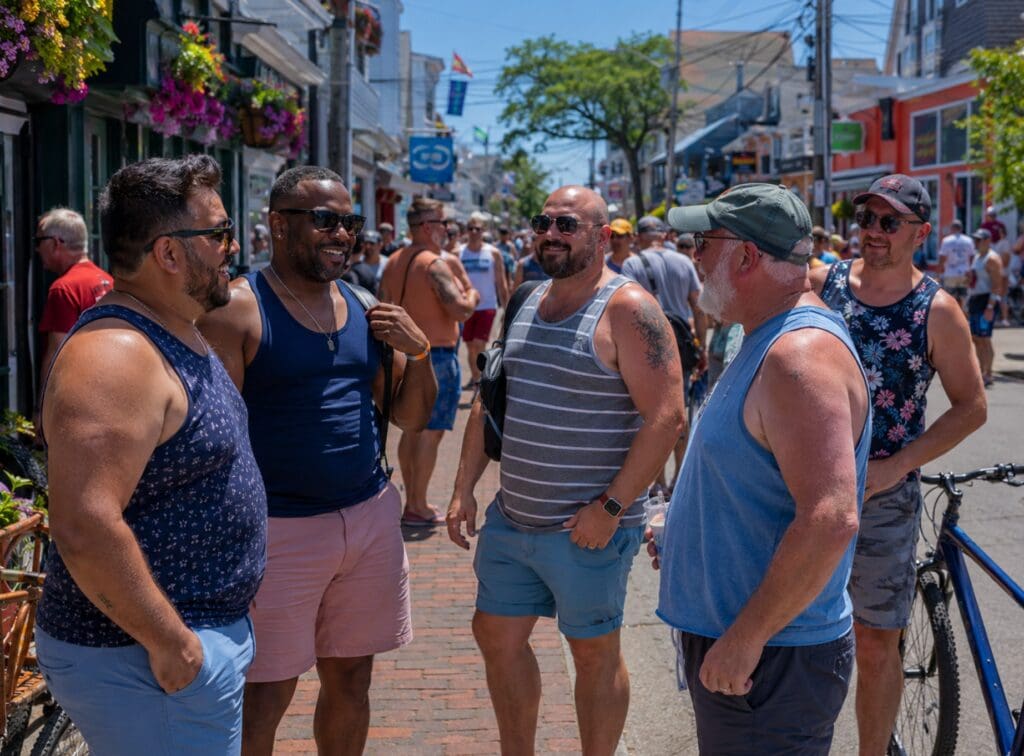
It is the sensation of walking down Commercial Street and seeing a community represented at full scale: large bodies, slim bodies, gray beards, no beards, bears, cubs, otters, admirers, trans participants, disabled travelers, couples, solo visitors, and friendship groups arriving from several countries.
The Provincetown Bears state that diversity and inclusion are central to the event, explicitly welcoming people regardless of body size, body hair, physical shape, age, race, ethnicity, nationality, gender, sexual orientation, identity, religion, or disability. (ptownchamber.com)
That mission matters because bear culture is sometimes reduced to a narrow physical stereotype. In Provincetown, the most valuable version of Bear Week is broader: body affirmation, friendship, humor, visibility, and the freedom to take up space without apology.
What a Bear Week day feels like
Morning: recovery and recognition
Morning begins slowly.
Breakfast tables fill with people reconstructing the previous evening and comparing plans. Others collect coffee and head directly to the beach. The street is quieter, yet Bear Week is already visible through event shirts, flags, and frequent sidewalk reunions.
This is the easiest time for a solo traveler to begin conversations. A question about the bike route, breakfast, or the day’s schedule feels natural and low pressure.
Midday: pools, beach, and smaller gatherings
Around midday, attention divides between Herring Cove, hotel pools, community meals, and ticketed events.
Large pool programs can be energetic. On the other hand, bingo, live music, barbecues, and daytime socials provide gentler entry points for visitors who prefer conversation over spectacle.
In 2026, the Provincetown Business Guild also included a trans-inclusive Bear Week pool gathering in its official programming, reflecting ongoing efforts to broaden participation. (Provincetown Business Guild)
Late afternoon: Tea Dance
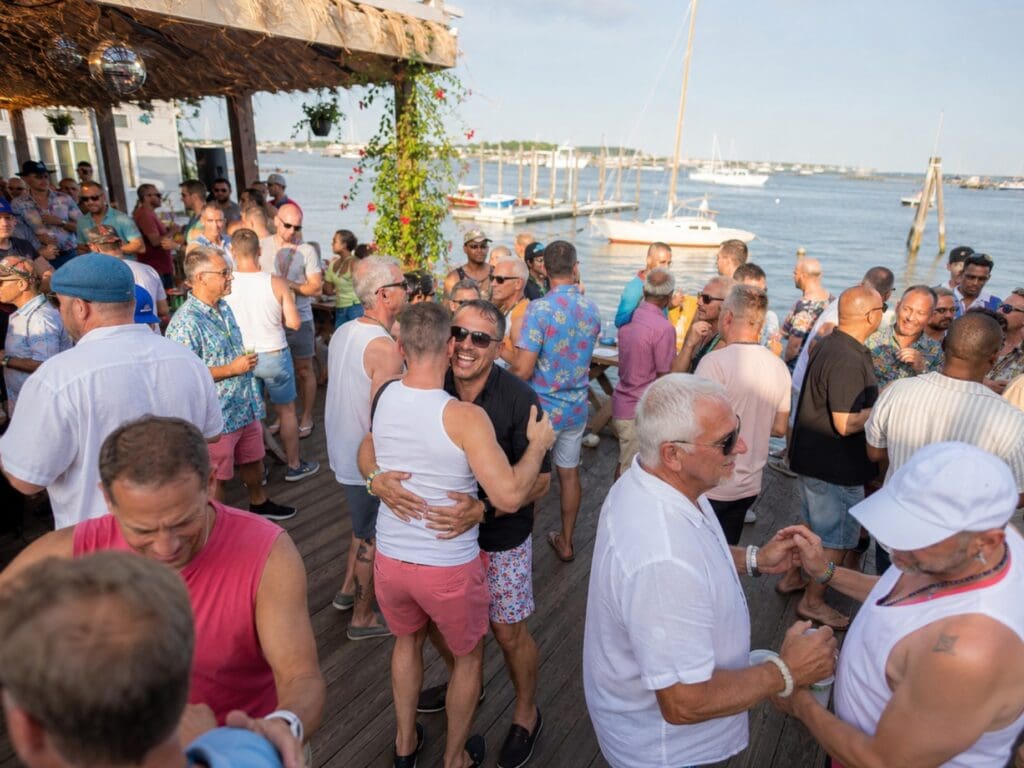
By 4 p.m., a large portion of town begins moving toward the Boatslip.
People arrive directly from the beach, from guesthouses, or after a hurried shower and change of clothes. The harbor glows behind the deck while DJ music establishes a collective rhythm.
The atmosphere is celebratory without requiring everyone to dance continuously. Some people remain near the water, others find friends, and many simply watch the crowd assemble.
Evening: dinner, shows, and another decision
Dinner during Bear Week requires strategy.
Restaurants become busy, and an evening event may begin before a long meal finishes. Therefore, reserve when possible, eat early, or accept a casual dinner rather than attempting a three-course production every night.
Afterward, the town divides among live performances, cabaret, bars, outdoor gatherings, and dance venues. Because everything is close, plans tend to remain flexible.
That flexibility is useful but constantly chasing a “better” event can make the week strangely unsatisfying. Choose one or two priorities each day and leave space for chance encounters.
Bear Week advice for first-time visitors
Book accommodation before building the event schedule
Provincetown has limited lodging inventory, while Bear Week attracts a major seasonal crowd. Therefore, secure a room first and examine individual tickets afterward.
A refundable reservation made months ahead is more useful than a perfect party pass without anywhere to sleep.
Stay within walking distance when possible
Central, West End, and inner East End accommodations reduce dependence on late-night taxis.
Moreover, walking home along Commercial Street is part of the experience. Conversations continue, pizza counters draw small crowds, and the night gradually disperses rather than ending abruptly in a parking garage.
Do not measure the week by popularity
Some visitors know dozens of people before arriving. Others know no one.
Neither experience is more authentic. Attend a daytime gathering, introduce yourself honestly, and return to the same places more than once. Provincetown’s compact layout does much of the social work for you.
Pace yourself
Bear Week is a week, not a single Saturday stretched across seven days.
Schedule a quiet breakfast, a gallery afternoon, or a solo bike ride. Ultimately, the moments between official events often become the ones people remember.
Tea Dance: Provincetown’s Four O’Clock Ritual
“Tea” in Provincetown does not involve porcelain cups.
At approximately 4 p.m., the Boatslip removes the day’s deck arrangement and turns its waterfront space into a three-hour afternoon dance gathering. The venue describes Tea Dance as a nearly 50-year institution, with DJ Maryalice serving as a central musical presence for more than 25 years. (The Boatslip)
The timing is part of its appeal.
Because Tea runs in the late afternoon, it connects beach life with evening entertainment. Visitors can dance, watch the harbor, meet friends, and still leave in time for dinner or theater.
During major theme weeks, the crowd becomes dense and exuberant. On an ordinary weekday, however, the mood can feel more spacious. Themed editions invite costumes and color, although participating in the theme is rarely necessary.
How to enjoy Tea without overthinking it
Arrive near the beginning when you want room to look around.
Come later for the fullest atmosphere.
Wear comfortable footwear, particularly after a day of walking or cycling. Furthermore, bring a light layer for the waterfront breeze, even when the afternoon has been hot.
Most importantly, Tea Dance is not an audition. Some visitors dress elaborately; others arrive in simple summer clothing. The shared ritual matters more than the outfit.
Nightlife by Mood: Where to Go After Dinner
Provincetown nightlife is concentrated, but it is not interchangeable.
One venue may suit conversation and show tunes. Another centers on cabaret. A third exists for dancing late. Therefore, begin by choosing the experience rather than the most famous address.
Atlantic House: history and late-night dancing
The Atlantic House usually called the A-House operates at 4–6 Masonic Place.
Its building dates to 1798, while the venue identifies itself as Cape Cod’s only year-round gay nightclub and one of the oldest continuously operating gay bars in the United States. The property contains three distinct spaces, including the historic Little Bar and the larger dance room. (ahouse.com)
The Little Bar works well earlier in the evening, when conversation and the building’s old-tavern character remain noticeable.
Later, the Big Room becomes the main attraction. During Bear Week, holiday weekends, and Carnival, expect a busier dance environment and possible lines.
A-House is particularly useful for visitors staying near the town center because it sits just off Commercial Street. Nevertheless, its entrance can be easy to pass the first time. Look for Masonic Place rather than expecting a large waterfront façade.
Crown & Anchor: a full entertainment complex
The Crown & Anchor occupies a prominent central location at 247 Commercial Street.
Rather than functioning as a single bar, it includes several spaces with different identities. The Wave Bar emphasizes harbor views, conversation, music videos, and recurring show-tune gatherings. The Crown Cabaret presents drag, comedy, live music, and theatrical performers. Meanwhile, the Paramount operates as a large dance club, and the renovated Tryst Beach Club hosts daytime pool programming during major summer weeks. (onlyatthecrown.com)
This range makes the Crown useful for mixed groups. One person can attend cabaret while another prefers a drink overlooking the harbor; afterward, everyone can regroup without crossing town.
However, large events may use separate tickets and entrances. Read the listing carefully rather than assuming one admission provides access to the entire property.
Provincetown Theater: an evening without a nightclub
Not every Provincetown night needs a dance floor.
The nonprofit Provincetown Theater operates a 110-seat venue in the East End and produces new work, reimagined classics, solo performances, readings, and community programs. Its 2026 season included The Jack of Hearts Club, a musical centered on chosen family and community inside a queer Provincetown bar. (Provincetown Theater)
Theater is also an effective social reset during a busy trip. You sit down, put the phone away, and allow someone else to organize the next two hours.
After the performance, the walk back along Bradford or Commercial Street provides a quieter view of town before the late-night crowds peak.
Art, History, and a Different Kind of P-Town Day
A visitor who sees only bars and beaches misses the structure holding Provincetown together.
Art helped create the town’s reputation for openness, while theater and writing attracted generations of people who did not fit comfortably elsewhere.
Provincetown Art Association and Museum
PAAM stands at 460 Commercial Street in the East End.
Its exhibitions regularly combine historical artists with contemporary work, thereby showing Provincetown as an active creative community rather than a preserved colony from the early 1900s. The institution also runs workshops, lectures, jazz, screenings, and public receptions. (Provincetown Art Association and Museum)
Visit on a hot or rainy afternoon. Alternatively, use the museum as the beginning of an East End gallery walk.
Friday evenings are particularly useful because PAAM has offered extended hours and free public admission during the final three hours of the day, subject to the current calendar. (Provincetown Art Association and Museum)
Pilgrim Monument and Provincetown Museum
The Pilgrim Monument stands on High Pole Hill above the center of town.
In 2026, the site reopened for the season on April 4, with published hours from 10 a.m. to 4 p.m. The climb rewards visitors with broad views over the harbor, town, dunes, and Cape Cod Bay. (Pilgrim Monument and Provincetown Museum)
The museum below the monument expands the experience beyond the Mayflower story. Its LGBTQ+ history exhibition uses documented personal accounts to examine Provincetown during the last century. (Pilgrim Monument and Provincetown Museum)
Visit early in the day before the summer heat becomes tiring. Then, descend toward Commercial Street for lunch.
Gallery browsing without exhaustion
Provincetown has enough galleries to turn appreciation into an endurance event.
Avoid that fate.
Start in the East End and select spaces based on the work visible through the window. Enter without feeling obligated to buy. Ask one specific question. Then, continue until visual fatigue begins.
A three-gallery afternoon often creates stronger memories than a fifteen-gallery sprint.
Where to Stay: West End, Center, or East End?
West End: Tea Dance, sunsets, and easier beach access
The West End is the strongest choice for travelers who expect to attend Tea Dance, spend time near Herring Cove, or return to a quieter guesthouse after socializing.
The streets become increasingly residential as Commercial Street approaches the Provincetown Inn and First Landing Park. Moreover, the West End provides convenient access toward the Province Lands and Herring Cove.
However, walking to East End galleries or Provincetown Theater can take time. The distance is manageable, although repeated crossings in summer heat may become tiresome.
Choose the West End for: Bear Week, Tea Dance, cycling, harbor sunsets, and guesthouse atmosphere.
Town center: maximum convenience
The center surrounds MacMillan Pier, Town Hall, Lopes Square, Crown & Anchor, and the busiest commercial blocks.
This is the easiest base for a brief visit. Ferries arrive nearby, restaurants surround the area, and major nightlife venues remain within a short walk.
The trade-off is noise. Central Commercial Street stays active well into the evening during the main season.
Choose the center for: first visits, short stays, nightlife, theater tickets, and travelers arriving without a car.
East End: galleries and quieter mornings
The East End becomes progressively calmer beyond the densest shopping area.
PAAM, independent galleries, the Provincetown Theater, waterfront cottages, and quieter lanes create a more residential atmosphere. Morning walks are especially attractive before traffic increases.
On the other hand, the walk home from the West End feels considerably longer after an active day.
Choose the East End for: art, quiet accommodation, longer stays, and visitors who do not need to be beside every evening event.
Staying outside Provincetown
North Truro may offer additional lodging and a calmer environment. Seasonal CCRTA service connects it with Provincetown, while taxis provide another option.
Nevertheless, check the last return carefully. Saving money on accommodation loses some charm when every evening concludes with a transportation puzzle.
Getting Around Without Losing Your Patience
Walking
Most central trips are best completed on foot.
Commercial Street is flat in many sections, although surfaces can become uneven and sidewalks narrow or disappear. Bradford Street offers a more direct route for some journeys, but it carries faster traffic and includes hills.
Allow extra time. Provincetown has a habit of placing three acquaintances and an interesting shop between you and every reservation.
Bicycles
The town provides more than 700 bicycle parking spaces across over 100 locations.
Bikes may be secured to designated racks and certain street-sign poles, provided they do not block pedestrian access. They may not be locked to trees, fences, benches, railings, or other street furniture. (provincetown-ma.gov)
Reserve a rental ahead of Bear Week or Carnival. Before leaving the shop, test the brakes, saddle height, lights, lock, and gears.
Furthermore, photograph the bicycle and rental number. This saves considerable confusion when a rack contains twenty nearly identical cruisers.
Seasonal shuttle
The CCRTA shuttle serves MacMillan Pier, Herring Cove, Race Point, Beech Forest, the Province Lands Visitor Center, the airport, and North Truro.
It is wheelchair accessible, and riders may board at designated stops or flag it along portions of the route. Seasonal schedules and service levels vary, so consult the current timetable rather than relying on last summer’s screenshot. (provincetown-ma.gov)
Waterfront access
Provincetown maintains public shoreline access points between Commercial Street and the harbor.
Some are obvious parks; others are narrow passages between buildings. The town’s Shared Shore initiative maps these points and identifies amenities and accessibility conditions. Visitors should follow signs and respect adjacent homes and businesses. (provincetown-ma.gov)
These small openings are worth noticing. They offer benches, harbor views, and moments of quiet only a few steps from Commercial Street.
Accessibility and Comfort
Provincetown’s compact geography helps, but historic buildings and narrow streets create inconsistent accessibility.
Herring Cove provides accessible restrooms, paths, seating, and beach wheelchairs through lifeguard services. The Province Lands Visitor Center is wheelchair accessible and offers accessible restrooms, assistive listening, captioned media, tactile features, and wheelchairs. (Parc national américain)
Nevertheless, individual guesthouses, galleries, restaurants, and entertainment venues vary considerably. Contact the property directly when step-free access, elevator service, accessible bathrooms, seating, or hearing accommodations are essential.
The same principle applies to sensory comfort. Bear Week and Carnival can produce intense crowds, music, heat, and waiting lines. A quiet East End afternoon or early dinner can make the overall trip much more enjoyable.
What to Pack
Provincetown is casual, yet the weather rewards preparation.
Bring:
- Comfortable walking shoes;
- A light waterproof layer;
- A warmer layer for ferry decks and evening waterfront wind;
- Sunscreen, sunglasses, and a hat;
- Refillable water bottle;
- Small day bag for cycling;
- Portable phone charger;
- Bike lights when riding after dark;
- Swimsuit and quick-drying towel;
- Any necessary medication in its original packaging;
- One outfit suitable for theater or a special dinner;
- Flexible clothing for themed events, only when the theme genuinely appeals to you.
Cape weather can move from humid sunshine to fog or wind surprisingly quickly. Layers are therefore more useful than an ambitious suitcase of single-purpose outfits.
When to Visit
Late May and June
Late spring brings longer days, active arts programming, Pride, and cooler biking conditions.
The town is already lively, yet the densest summer crowds have not always arrived. Ocean water remains cold, however, and some seasonal businesses may still operate limited schedules.
Bear Week in July
Come during Bear Week for maximum bear visibility, international community, and a packed event calendar.
Book accommodation and transportation far ahead. Furthermore, expect higher costs, lines, and busy restaurants.
August and Carnival
August is peak summer.
Carnival draws a large, visually spectacular crowd and includes a major parade. Beaches, ferries, and accommodation operate under significant demand. The experience is joyful but not peaceful.
September
September is a particularly attractive compromise.
The town remains active, the sea has retained summer warmth, and gallery or restaurant visits may feel less pressured. Weekends can still be busy, while weekdays gradually become quieter.
October and winter
Women’s Week, TransWeek, Halloween, Spooky Bear, Holly Folly, and First Light extend the calendar beyond summer.
However, transportation and business hours become more limited. Check every essential service rather than assuming the summer routine continues. The Provincetown Business Guild maintains an annual schedule of theme weeks and major events. (Provincetown Business Guild)
A Three-Day Gay Provincetown Itinerary
Day 1: arrive by water and follow Commercial Street west
Take a morning fast ferry from Boston.
After arriving at MacMillan Pier, leave luggage at the accommodation and have lunch near the center. Then, walk west along Commercial Street without rushing.
Pause at waterfront access points, browse independent shops, and continue toward the West End. Around 4 p.m., attend Tea Dance at the Boatslip.
Afterward, choose an early dinner. Finish with cabaret, show tunes at the Crown, or a quieter harbor drink rather than attempting every nightlife option immediately.
Day 2: bicycle, dunes, and Bear Week socializing
Collect a bicycle early.
Enter the Province Lands and stop at the visitor center before continuing toward Race Point or Herring Cove. The visitor center operates seasonally and provides exhibits, maps, restrooms, water, and observation decks overlooking the dunes and ocean. (Parc national américain)
Spend the afternoon at Herring Cove. Then, either cycle back before sunset or use the shuttle when bicycle arrangements permit.
During Bear Week, choose one evening event with a format that suits you live music, bingo, a community meal, a benefit, cabaret, or dancing. The goal is connection, not event accumulation.
Day 3: history, art, and the East End
Begin at the Pilgrim Monument and Provincetown Museum.
Afterward, walk toward the East End for PAAM and several galleries. Have lunch somewhere that allows enough time to sit rather than eating while walking.
Later, see a performance at Provincetown Theater or return to the harbor for a final sunset.
When leaving by ferry, reach MacMillan Pier early. Provincetown’s farewell ritual frequently includes one last acquaintance, one last purchase, and an urgent walk toward a boat that is not interested in your emotional closure.
Solo Travel, Couples, and First-Time Bear Week Visitors
Traveling alone
Provincetown is unusually suitable for solo LGBTQ+ travel because its social life occupies public space.
Start with daytime activities. Gallery receptions, Bear Week bingo, beach shuttles, walking tours, and Tea Dance provide clear reasons to be present without arriving as part of a group.
Sit at a bar rather than an isolated table. Ask practical questions. Return to the same coffee shop. Familiarity develops quickly in a town this small.
Traveling as a couple
Couples should decide how much of the trip will be shared.
One person may want the beach while the other wants galleries. Likewise, one may enjoy late dancing while the other prefers morning cycling.
Provincetown works well when each partner can spend a few hours independently and reunite for dinner or sunset.
Visiting Bear Week for the first time
Do not worry about whether you are “bear enough.”
The event’s stated mission emphasizes diversity across bodies, identities, ages, backgrounds, and abilities. (ptownchamber.com)
Wear what feels comfortable. Attend events whose format interests you. Introduce yourself without performing a caricature of bear culture.
Belonging grows through participation, not costume accuracy.
Meet the Community Through BEARWWW
Provincetown becomes more welcoming once a few profiles turn into familiar faces.
Join the Bear community in Provincetown 🔥




Before arriving, open BEARWWW and explore members in Provincetown, Truro, Boston, and the wider New England region. Mention the dates of your visit and the parts of P-Town you genuinely want to experience: Bear Week, Herring Cove, galleries, cycling, cabaret, seafood, or local history.
A useful opening message is specific:
“It’s my first Bear Week. Which daytime event is easiest for meeting people?”
Or:
“I’m planning to bike to Herring Cove. Is morning or late afternoon better?”
Moreover, a first meeting does not need to begin inside a crowded event. Coffee near Town Hall, a walk along Commercial Street, an exhibition at PAAM, or sunset at Herring Cove creates a public and low-pressure setting.
Meet publicly, communicate expectations clearly, retain control of your transportation, and avoid sharing accommodation details before trust is established.
Use BEARWWW to connect before the ferry arrives and turn P-Town from a famous destination into an actual community.
Why Provincetown Still Matters
Provincetown’s beauty is obvious.
The harbor shines. The dunes appear almost unreal. Commercial Street delivers more character within a mile and a half than many destinations manage across an entire city.
However, scenery alone does not explain why LGBTQ+ travelers return.
P-Town offers the experience of visibility without constant negotiation. Queer life is not restricted to a few businesses after dark. It appears at breakfast, in the museum, on bicycles, in gallery windows, at the beach, on Town Hall steps, and across generations sharing the same afternoon dance floor.
Bear Week intensifies that experience.
For several days, people who may feel physically overlooked elsewhere become part of the dominant public image. Bodies age openly. Friendships occupy space. Strangers become recurring acquaintances because every route eventually returns to Commercial Street.
Nevertheless, the town’s warmth works best when visitors recognize what sustains it: year-round residents, independent businesses, artists, nonprofit organizations, municipal services, historic institutions, and a vulnerable national seashore.
Ride carefully. Support local establishments. Respect wildlife and dunes. Attend a performance. Learn the town’s history. Give people room on the sidewalk.
Then, around four in the afternoon, follow the movement toward the harbor.
The music will tell you where everyone went.
About the Author
Alain VEST is an LGBTQ+ travel journalist and New England lifestyle writer
