Choosing a gay dating app in the United States is no longer a matter of downloading the platform with the biggest name. Instead, the right choice depends on how you prefer to meet people, where you live, how much profile detail you want, and whether your priority is dating, friendship, travel connections, or broader LGBTQ+ community.
Table of Contents
In Manhattan, West Hollywood, Chicago’s Northalsted, or central San Francisco, a location-based grid can change after a short subway ride or a few city blocks. In suburban America, however, the same grid may stretch across several towns. Meanwhile, in rural areas, an app’s travel search, regional filters, and willingness to show profiles farther away can matter considerably more than its interface design.
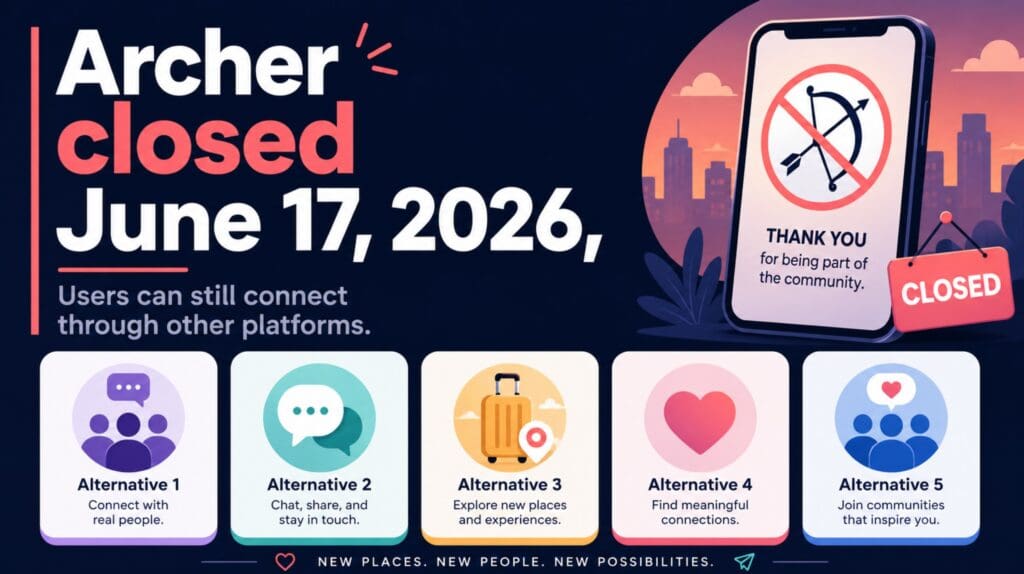
There is also one major update that makes many earlier “best apps of 2026” lists inaccurate: Archer officially shut down on June 17, 2026. Therefore, although this dossier examines what Archer offered and why some users still search for it, it is no longer a usable dating app and should not appear in a current recommendation list as an active option. (Archer)
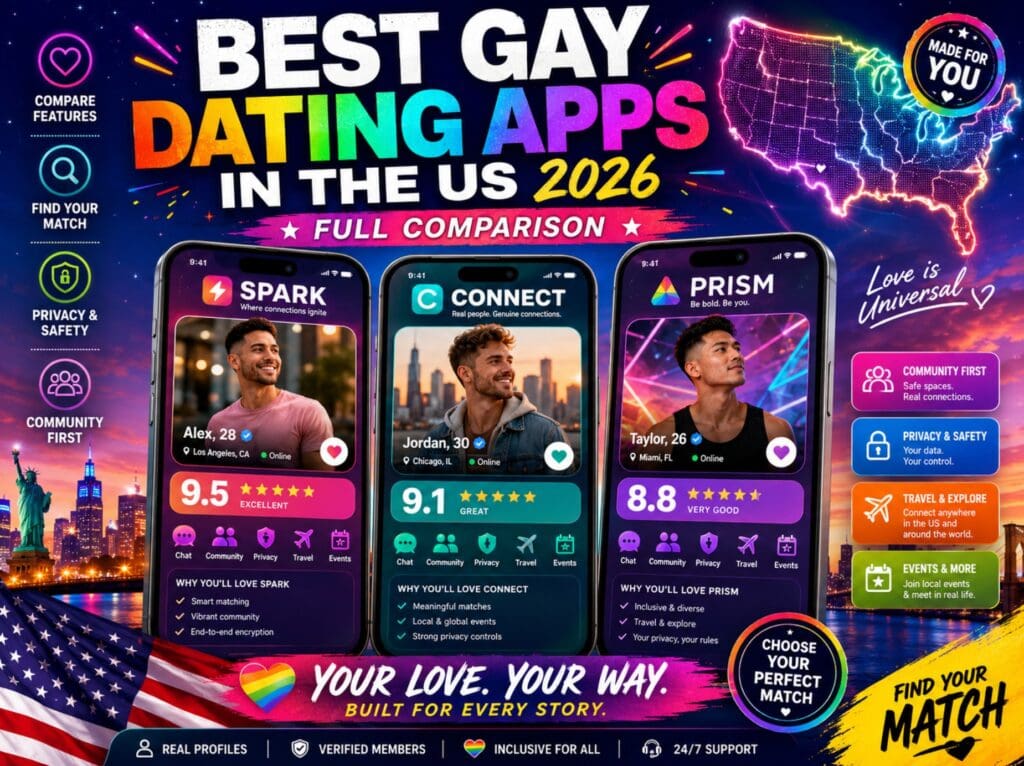
This guide compares BEARWWW, Grindr, SCRUFF, Hinge, and the discontinued Archer through the factors that make the greatest practical difference: discovery mechanics, community positioning, profile quality, pricing, safety tools, and usefulness across urban, suburban, and rural America.
The quick answer: which gay dating app should you choose?
BEARWWW offers the clearest value for bears, daddies, cubs, chubs, otters, mature men, and admirers. Moreover, free messaging, detailed profiles, local and international discovery, and a body-positive community make it useful for people who feel overlooked on faster, more appearance-driven platforms. (Bearwww)
Grindr remains the most direct choice for seeing LGBTQ+ people nearby. Its distance-ordered Grid works especially well in dense urban areas, although its location-first design can feel repetitive or geographically broad in suburbs and rural counties. (help Grindr)
SCRUFF is particularly strong for travelers, eventgoers, users who enjoy richer profiles, and people who want more developed location-privacy tools. Its combination of Nearby, Match, Venture, and event discovery gives it a broader networking function than a basic proximity grid. (SCRUFF Support)
Hinge is the strongest option in this comparison for relationship-focused dating. It is not exclusively an LGBTQ+ app; nevertheless, gay, bi, trans, and nonbinary users can configure gender preferences, profile identity, relationship type, and dealbreakers. Its prompt-led profiles also make it easier to begin conversations around personality rather than proximity alone. (Hinge)
Archer is no longer available. Its face-first and social-first design had interesting ideas, but accounts, messages, and connections became inaccessible when the service closed in June 2026. (Archer)
How this comparison was evaluated
No major dating company publishes reliable, independently audited counts of active gay users by American city, suburb, county, or state. Consequently, claims such as “App A has the most users in Dallas” or “App B is best in rural Ohio” should be treated cautiously unless supported by credible local data.
The geographic observations in this dossier are therefore editorial assessments based on each app’s mechanics. A distance-sorted grid, for example, behaves differently in Brooklyn than in western Kansas. Similarly, an app with city search, travel planning, or worldwide browsing offers more flexibility when the next compatible profile may be 30 or 60 miles away.
Pricing also changes frequently. Apple and Google may display different packages, taxes, introductory offers, renewal periods, and personalized promotions. Therefore, the dollar figures below are current U.S. App Store purchase points, not guaranteed standardized monthly prices. Always verify the billing period and renewal total inside the app before subscribing.
Comparison table: the best gay dating apps in the US
| App | Discovery model | Community positioning | Free experience | Premium pricing shown in the US App Store | Privacy and trust tools | Best practical fit |
|---|---|---|---|---|---|---|
| BEARWWW | Nearby search, detailed filters, worldwide browsing, travel-style discovery | Bears, daddies, cubs, chubs, otters, mature men, admirers, and broader gay/bi community | Profile creation, browsing, and unlimited messaging are promoted as free | Priority Access listings from $1.99 to $79.99; Boost $2.99; Shoutouts from $3.99 to $16.99 | Profile review or verification, blocking, reporting, privacy controls; no criminal-background or identity guarantee | Body-positive dating, free conversations, mature users, niche community, local and long-distance connections |
| Grindr | Proximity-ordered Grid, tags, filters, Fresh, Explore | Broad gay, bi, trans, queer, and LGBTQ+ audience | Nearby profiles, chat, tags, albums, basic filters | XTRA purchase points around $14.99–$22.99; Unlimited around $27.99–$44.99; Day Pass $9.99; Boost $11.99 | Distance toggle, approximate location controls, PIN, discreet icon, blocking, reporting, Incognito on Unlimited | Dense cities, travel, quick local discovery |
| SCRUFF | Nearby, Search, Match, Venture, events | Gay, bi, trans, and queer community; particularly recognizable among mature, rugged, and travel-oriented users | Browsing, profiles, messaging, basic Match and search | SCRUFF Pro listings of $9.99, $12.99, and $14.99 | Profile verification, distance hiding and server-side location randomization, screenshot restrictions, Stealth with Pro | Travelers, eventgoers, privacy-conscious users, detailed searching |
| Hinge | Curated Discover feed, likes on individual profile elements, Most Compatible recommendations | Mainstream relationship app with LGBTQ+ identity and preference options | Matching and messaging; limited outgoing likes and one incoming like viewed at a time | Subscription purchase points currently listed from approximately $14.99 to $29.99; three Roses $9.99; Boost listings from $9.99 | Selfie Verification, reporting, Safe Message Filters, advanced preferences, Face Check in certain regions | Relationship-focused dating, conversation-led profiles, metro and suburban users |
| Archer | Former map and social discovery experience | Formerly designed for gay and queer men | Unavailable | No active subscriptions; service closed June 17, 2026 | Accounts closed and most data deleted or retained only where legally necessary | Not recommended because the app has shut down |
The current U.S. App Store listings provide the purchase points shown for BEARWWW, Grindr, SCRUFF, and Hinge. However, several prices may represent different durations or promotional packages, so they should not be interpreted as directly equivalent monthly fees. (App Store)
BEARWWW: the strongest community fit for bears, daddies, mature men, and admirers
BEARWWW is the most specialized app in this comparison. Whereas mainstream platforms may include “bear” or “daddy” as a tag, filter, or profile word, BEARWWW places those identities near the center of its product and community positioning.
The platform welcomes bears, cubs, daddies, chubs, otters, chasers, and admirers, while also stating that it is not exclusively for bears. Its official materials emphasize different ages, bodies, backgrounds, and styles, together with friendship, dating, and meaningful relationships. (Bearwww)
That difference is more important than it initially appears. On a generalized app, a mature or larger-bodied man may spend valuable profile space explaining that he belongs on the platform. On BEARWWW, however, maturity, body hair, softness, size, gray hair, and bear-community identities are treated as ordinary parts of the membership rather than deviations from a narrow visual norm.
What the BEARWWW experience feels like
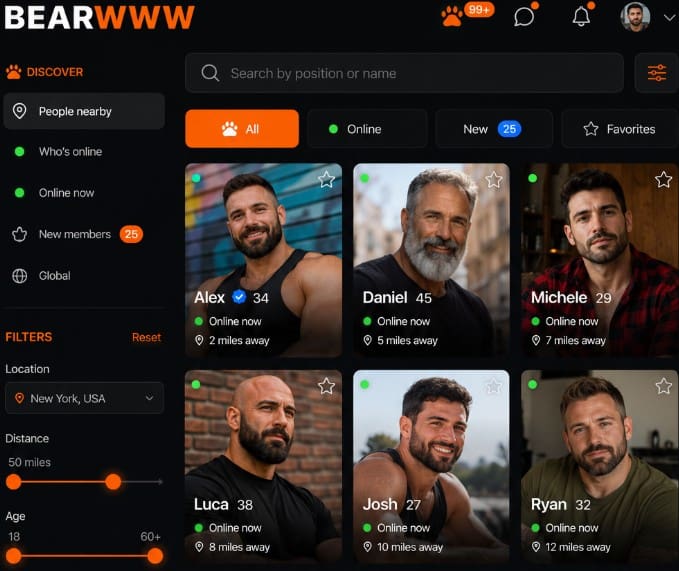
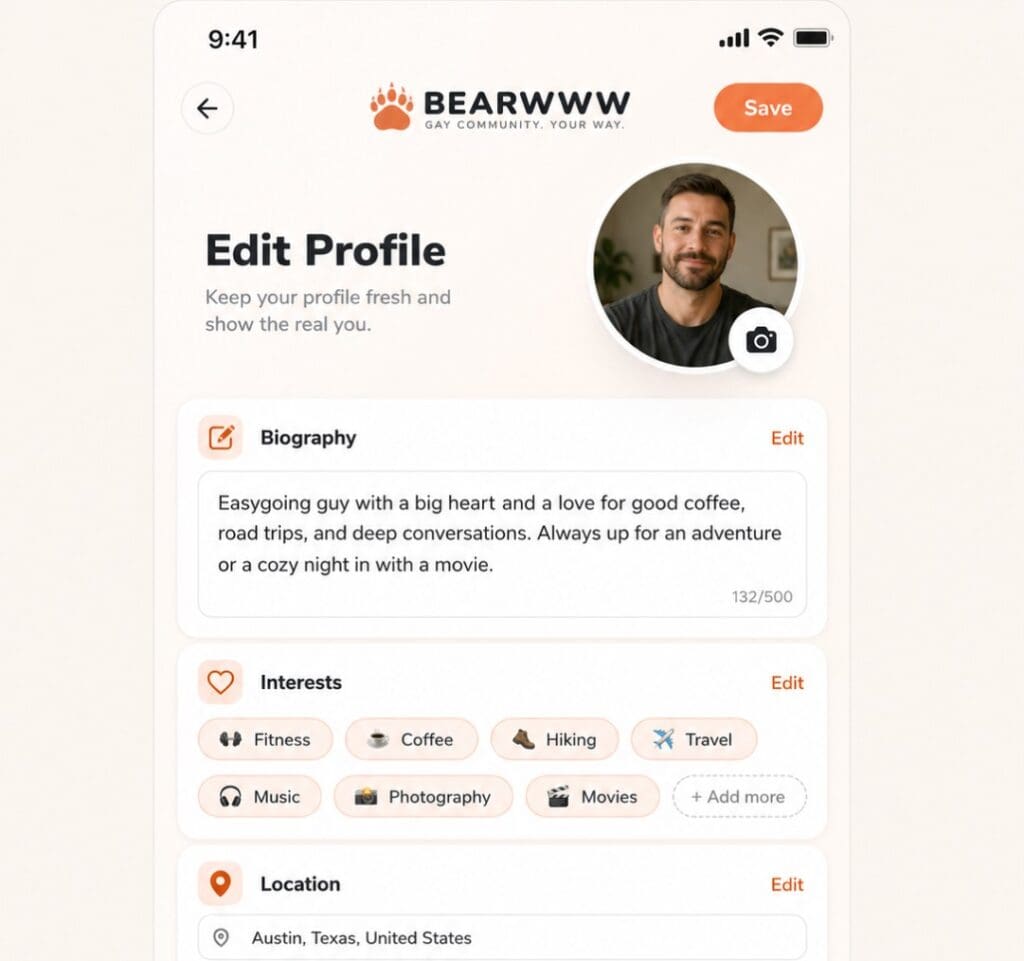
The central experience is based on browsing, searching, and messaging rather than an endless sequence of binary swipe decisions. Profiles can contain photographs, a biography, interests, preferences, location, and information about the kind of connection the member wants.
Consequently, BEARWWW works best when users actually complete their profiles. A clear main photograph may create initial interest; however, a thoughtful biography makes it easier to distinguish a relationship-minded daddy in Boston from a traveler visiting Boston for three days, or a bear in Phoenix seeking local friends from someone preparing to relocate.
BEARWWW promotes detailed profiles, local discovery, international browsing, advanced filters, visitor information, travel tools, and unlimited messaging. Its June 2026 product guide also describes private photographs, travel or vacation features, profile visibility tools, and premium search options. (Bearwww)
The free version is unusually practical
BEARWWW states that users can create a profile, browse other profiles, and message without paying. The platform also promotes unlimited free chat rather than restricting basic communication to premium subscribers. (Bearwww)
That free-chat model has a meaningful effect on the user experience. On some services, a free user can technically create an account but encounters restrictions before a substantial conversation begins. On BEARWWW, however, the basic path from viewing a profile to beginning a conversation remains available without an immediate subscription.
Premium purchases focus more heavily on visibility and convenience. The U.S. App Store currently lists several Priority Access purchase points, beginning at $1.99 and extending to $79.99, together with a $2.99 Boost and geographically scaled Shoutouts at $3.99, $8.99, and $16.99. The precise duration or quantity attached to each Priority Access package should be checked in the purchase screen. (App Store)
The app’s terminology can also vary between surfaces. For example, official editorial materials refer to BEARWWW PLUS, while the App Store lists Priority Access, Boost, and Shoutout purchases. Therefore, users should judge the exact offer displayed in their current app version rather than assuming that every webpage describes the same package. (Bearwww)
BEARWWW in New York and Los Angeles
In New York City, BEARWWW’s filters can be more useful than raw distance alone. A grid covering Chelsea, Hell’s Kitchen, Harlem, Brooklyn, and Queens can produce a large number of possible profiles, yet borough boundaries and transit time matter more than a straight-line distance.
Therefore, mentioning a borough, neighborhood, or preferred meeting area in conversation is usually more useful than relying on an estimated number of miles. At the same time, the app’s community specialization helps users narrow a large metropolitan pool according to identity, age, style, and intention.
Los Angeles presents a different challenge. A profile may appear geographically close while still requiring a lengthy drive because of freeways, traffic, and neighborhood separation. Consequently, BEARWWW’s profile detail and search functions are valuable when deciding whether someone is realistically available in West Hollywood, Silver Lake, Long Beach, the Valley, or another part of the region.
These are editorial applications of the app’s location and filtering mechanics, not official measurements of active users in either city.
BEARWWW in suburbs and rural America
The app becomes particularly interesting outside dense coastal neighborhoods. On a pure proximity platform, a user in a smaller town may see the same limited set of profiles repeatedly. BEARWWW, by contrast, supports local and worldwide browsing, destination searching, and travel-oriented discovery. (Bearwww)
For someone living 40 miles from the nearest mid-sized city, the sensible approach is often to use broader geographic settings and fewer simultaneous filters. A highly specific combination of age, tribe, distance, and intention may remove otherwise compatible users simply because the regional pool is smaller.
Moreover, long-distance conversation can have more practical value in rural areas. Two people may need to communicate for several days before deciding whether a drive is worthwhile. Free messaging therefore becomes more significant than it is in a dense neighborhood where a coffee meeting can be arranged within an hour.
Safety and verification: an important distinction
BEARWWW’s marketing pages describe profile verification, moderation, anti-fake systems, blocking, reporting, and privacy controls. (Bearwww)
However, its Terms of Use make an essential qualification: BEARWWW states that it does not currently conduct criminal-background checks and does not guarantee the identity, intentions, legitimacy, or truthfulness of users. It also warns that location data may sometimes be used by sophisticated actors to infer a person’s location. (Bearwww Support)
Therefore, a verified or reviewed profile should be understood as an additional signal not proof of character, background, or safety. This distinction applies across the dating-app industry, but it is especially important whenever a platform uses “verified” language prominently.
Who should choose BEARWWW?
BEARWWW is the strongest choice for users who:
- identify as bears, daddies, cubs, chubs, otters, or mature men;
- are attracted to those communities;
- prefer body diversity and intergenerational visibility;
- want to message without immediately paying;
- value profile search more than continuous swiping;
- want local discovery alongside international or travel connections;
- feel invisible or overly categorized on generalized apps.
Its main limitation is the same one faced by any specialized platform: local density will vary. Nevertheless, because the free experience includes conversation and wider discovery, users can evaluate the actual community in their region without first committing to a recurring subscription.
Grindr: the fastest way to understand who is nearby
Grindr’s defining feature remains the Grid, a location-based home screen that primarily orders profiles by proximity, with some additional visibility from features such as Boost. Users can apply tags, filters, Fresh, and Explore to modify what they see. (Help Grindr)
The result is an interface that communicates local activity almost instantly. Open the app in Midtown Manhattan, downtown Austin, Miami Beach, or central Seattle, and the Grid can provide an immediate impression of nearby LGBTQ+ users.
However, the same speed also shapes how people behave. Because many profiles appear together and can change quickly, users often make decisions based on a main image, headline, tags, and a small amount of profile information. Consequently, Grindr rewards clarity more than literary detail.
The user experience: fast, dense, and highly location-driven
The interface begins with nearby people rather than a compatibility questionnaire or curated daily selection. Selecting a profile opens its photographs and details, after which a user can send a message or Tap.
Grindr also supports tags, private albums, voice and video messages, favorites, blocking, and reporting. Therefore, the experience is more developed than a simple map of faces, even though proximity remains its organizing principle. (App Store)
For a new user, this immediacy can feel efficient. There is no need to wait for a mutual match before beginning a conversation. On the other hand, the volume of incoming and outgoing messages in dense markets can make exchanges brief, inconsistent, or difficult to track.
A profile that states a neighborhood, schedule, and intention such as “visiting Chicago through Sunday, interested in coffee and architecture” will usually perform better than an empty profile that requires every visitor to ask the same introductory questions.
How Grindr geolocation works
Grindr says it collects location information within approximately a 100-meter radius of accuracy. Users can turn off Show Distance, but their profile may still be ordered according to relative proximity, which means others may infer an approximate location from the Grid.
This distinction matters. Hiding the displayed distance is not the same as hiding from nearby users. Someone who needs greater privacy can remove precise-location permission at the operating-system level, turn off location sharing, limit appearance in Explore searches, or use Incognito with an Unlimited subscription.
Grindr Web also offers an Approximate Location function that randomizes the shown location within roughly 500 to 1,500 meters, together with an Escape Hatch that rapidly exits the desktop experience and clears the relevant browsing history. (Help Grindr)
Grindr in New York, Los Angeles, and other major hubs
In central New York, the Grid may refresh significantly after crossing from Manhattan into Brooklyn or moving between neighborhoods. Therefore, it is excellent for highly local discovery, especially when a person wants to know who is active near a hotel, workplace, cultural venue, or transit hub.
Nevertheless, the closest profile in a straight line may be separated by a river, tunnel, express train, or inconvenient transfer. Consequently, neighborhood information remains essential.
In Los Angeles, distance can be even more misleading because two people may be separated by only several miles but face a substantial drive. A practical conversation should therefore establish neighborhood and transportation expectations early.
In smaller but active hubs such as Denver, Minneapolis, Atlanta, or Portland, the Grid can still provide strong local variety. However, the number of visible profiles will naturally change according to neighborhood density, time of day, tourism, local events, and how many users have chosen to display themselves.
Grindr in suburban and rural America
In suburbs, the Grid may cover multiple municipalities, highway corridors, and residential areas. As a result, a profile that appears “nearby” may still be inconvenient to reach without a car.
In rural communities, profiles may be much farther apart, and users may see the same accounts repeatedly. Explore becomes valuable in this context because it allows people to search another location, such as the closest college town, metropolitan center, vacation destination, or Pride host city. Free users have limited daily interactions through Explore, while paid tiers expand global contact.
Nevertheless, rural users should be especially cautious about location inference. When only a small number of homes or workplaces exist within a geographic radius, even approximate ordering can disclose more than expected.
Free Grindr, XTRA, and Unlimited
Grindr’s free tier provides profile creation, the Grid, messaging, basic discovery, albums, tags, favorites, blocking, and reporting. Advertisements support the free service. (App Store)
XTRA removes third-party ads, expands the Grid, adds global Explore contacts, saved phrases, read receipts, expiring-photo allowances, and premium album features. Grindr’s official materials currently differ slightly on Grid size: the Help Center describes up to 500 nearest profiles, while the U.S. App Store listing says up to 600. Therefore, the number shown in the live purchase screen should be treated as authoritative for the current build.
Unlimited adds unlimited Grid profiles, the Viewed Me list, typing status, global Explore messaging, chat translations, message unsending, Incognito, and all XTRA functions.
The U.S. App Store currently lists XTRA purchase points of $14.99 and $22.99, Unlimited at $27.99 and $44.99, one-month purchases at $24.99 and $27.99, a $9.99 Unlimited Day Pass, and an $11.99 Boost. Because durations are not consistently identified in the listing, users must review the final checkout terms carefully. (App Store)
Safety and privacy
Grindr offers PIN protection, biometric access, discreet app icons, blocking, hiding, reporting, expiring photographs, certain screenshot restrictions, video chat, and a centralized Safety and Privacy Center. It also advises users to keep initial conversations on the platform, avoid sharing financial information, and meet in public.
The platform uses automated tools together with human moderators to detect fraud, scams, illegal activity, impersonation, and guideline violations. Suspected underage accounts may be blocked pending identification, while profiles suspected of impersonation can be required to complete photo verification. (
Who should choose Grindr?
Grindr is best for users who:
- want the fastest possible view of nearby LGBTQ+ activity;
- live in or regularly visit dense urban areas;
- prefer direct messaging without waiting for a match;
- frequently travel and want immediate local discovery;
- are comfortable managing a high-volume, fast-moving interface;
- understand the limitations of proximity-based privacy.
It is less ideal for users who want the app itself to create a slower, relationship-centered process. Those users may still find meaningful dates on Grindr, but they will need to communicate their intentions clearly and filter more actively.
SCRUFF: the best combination of travel, community, profiles, and location privacy
SCRUFF sits between a proximity app, a traditional profile directory, a matchmaking tool, and a queer travel network.
Its main sections include nearby browsing, detailed search, SCRUFF Match, Venture, and event discovery. Consequently, users can decide whether they want to explore the immediate area, review profiles according to specific criteria, receive swipe-style suggestions, or prepare for a future trip. (SCRUFF Support)
The company describes itself as independently LGBTQ+ owned and operated and says its global membership exceeds 30 million. That global figure does not reveal local active-user density, but it does help explain why SCRUFF’s travel and international functions are more substantial than a simple city selector. (App Store)
The interface: more information, more sections, more control
SCRUFF profiles can include multiple photographs, private albums, hashtags, identity information, relationship status, interests, and what the member is open to.
The interface is therefore denser than Grindr’s. Initially, this can require more attention; however, users who enjoy comparing profile details may find it more informative.
Nearby browsing serves the immediate local experience. Search and filters support targeted exploration. Match introduces a swiping system, while Venture and Events extend the product into travel and community planning.
That variety is one of SCRUFF’s strengths. Nevertheless, it also means that first-time users should configure their profile carefully. An incomplete “Relationship Status” or “Open To” field can affect the people shown in Match. (SCRUFF Support)
How SCRUFF Match works
SCRUFF Match requires a clear face photograph. Users swipe right when interested, left when not interested, and down when uncertain; a downward choice returns after 24 hours. (SCRUFF Support)
Recommendations are shaped primarily by the relationship-status and Open To fields. Users who identify as single or widowed and open to relationships are shown other members with compatible settings. Other combinations produce a broader pool that may include people seeking dates, conversations, friendship, or less formal connections. (SCRUFF Support)
This is not a mysterious black-box compatibility model. Instead, the matching logic relies heavily on explicit profile declarations. Consequently, SCRUFF rewards users who update their intentions honestly.
Venture is one of the best travel tools in the category
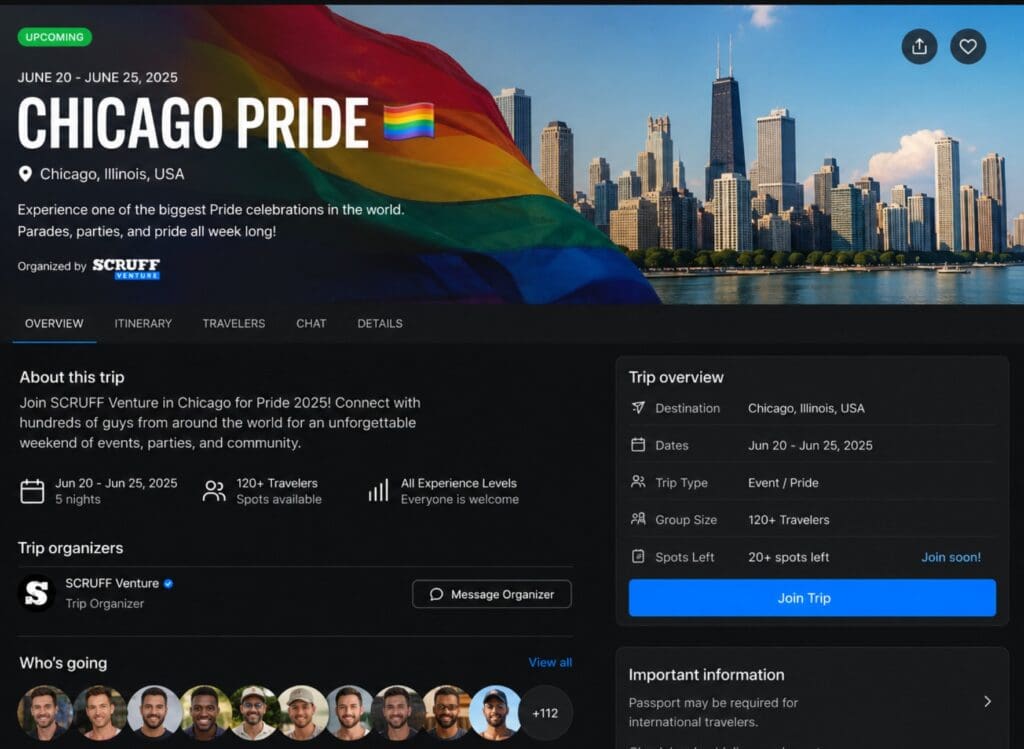
SCRUFF Venture covers more than 500 destinations and displays people currently visiting, people planning to arrive within the next 90 days, local events, and volunteer city ambassadors. Users can add trips, appear in a destination’s Visiting Soon area, and review upcoming community activity. (SCRUFF Support)
For a trip to New York, Los Angeles, Fort Lauderdale, Provincetown, Palm Springs, or a major Pride destination, this creates a more transparent context than simply changing a location setting. Other users can see that someone is planning a visit rather than pretending to be physically present.
Moreover, Venture works well for people who want recommendations and community context before traveling. A visitor can ask about neighborhoods, transportation, LGBTQ+-friendly cultural events, or accessible meeting places rather than limiting every conversation to dating.
SCRUFF in cities, suburbs, and rural areas
In a major city, Nearby provides quick geographic discovery, while Search can narrow a large population by relationship status, age, interests, activity, or other profile fields.
In suburbs, SCRUFF’s richer profiles make transportation expectations easier to evaluate. A user can describe whether he regularly visits the city, works in another county, or prefers weekend meetings rather than leaving every logistical question for the first message.
In rural areas, Venture and location-based search become more important than Nearby alone. A user can explore the nearest regional hub, indicate an upcoming trip, or build conversations before committing to a long drive.
SCRUFF’s location-privacy design is especially relevant outside cities. When a user hides distance, the company says it randomizes the location stored on its servers. The degree of randomization accounts for population density: several blocks in a city, but potentially several miles in the countryside. (SCRUFF Support)
Although the company’s detailed explanation originated years ago, the relevant privacy documentation remains available in its current support center. Users should still remember that no location-based system can provide perfect anonymity.
Free versus SCRUFF Pro
The free version supports the principal social experience, including nearby profiles, messaging, basic search, Match, and profile creation.
SCRUFF Pro substantially expands capacity and control. Officially listed features include:
- up to 1,000 Nearby profiles;
- up to 250 search results;
- combined advanced filters;
- up to 25,000 favorites in folders;
- expanded blocking and hiding;
- more Match suggestions;
- full chat history;
- message unsending;
- private-album expansion;
- notes on profiles;
- app PIN or biometric protection;
- Stealth browsing;
- reduced advertising and promotional interruptions. (SCRUFF Support)
The U.S. App Store currently lists SCRUFF Pro purchases at $9.99, $12.99, and $14.99. Because the listing does not identify all corresponding billing periods, the in-app confirmation page should be checked before purchase. (App Store)
Privacy and verification
SCRUFF offers profile verification based on a main face photograph and prompted poses. The moderation team compares the submitted images before adding a badge. (SCRUFF Support)
It also disables saving and forwarding another member’s privately shared photos or videos and blocks screenshots of chat conversations and private albums on supported devices. (SCRUFF Support)
However, technical protections can always be bypassed with another camera or device. Therefore, users should never share anything solely because an interface claims to block screenshots.
Stealth Mode allows Pro subscribers to view profiles without appearing in visitor history and to hide from the Global discovery section. It does not make the account invisible in Nearby, Search, or direct messaging. (SCRUFF Support)
Who should choose SCRUFF?
SCRUFF is the strongest choice for:
- frequent travelers;
- Pride and event attendees;
- users who want both proximity and detailed search;
- people who value profile depth;
- users who want explicit relationship-status matching;
- privacy-conscious people who want server-side distance randomization;
- those who enjoy a more mature or community-oriented atmosphere.
Its main drawback is interface complexity. Someone seeking the simplest possible path from opening an app to messaging a nearby person may prefer Grindr. Conversely, someone willing to configure filters and profile details can obtain a more deliberate experience from SCRUFF.
Hinge: the best relationship-focused option for gay men who want fuller profiles
Hinge differs fundamentally from BEARWWW, Grindr, and SCRUFF because it is not an exclusively gay or LGBTQ+ platform. Instead, it is a general dating app that supports gay, bisexual, trans, and nonbinary dating through gender preferences, gender identity, sexuality, pronouns, relationship type, and private dealbreakers. (Hinge)
That distinction affects the entire experience. Hinge is less focused on immediate local activity and more focused on curated profile review. Users respond to a particular photograph, written prompt, video, or voice element, which gives each Like a natural conversation topic.
Consequently, Hinge is usually the strongest option here for people who want dates to develop from personality and shared values rather than from proximity alone.
The profile is the product
A Hinge profile combines photographs with written prompts and can also include video and voice. Users may disclose religion, politics, education, height, relationship intentions, family plans, and other compatibility information. (App Store)
The advantage is immediate context. Instead of sending an unexplained greeting, someone can respond to a statement about cooking, a travel photograph, a story about family, or a voice prompt.
Moreover, the profile format encourages specificity. “I enjoy music and travel” is generic; “I will cross three boroughs for a great jazz set” gives another person something memorable to discuss.
The disadvantage is that Hinge requires more initial effort. A rushed profile with generic prompts will look weak beside users who have chosen varied photographs and written concrete answers.
LGBTQ+ identity and preference controls
Hinge allows users to select Man, Woman, or Nonbinary and then add a more specific gender identity. Users may choose whether that identity is publicly visible. They can also select a sexuality and decide whether to display it, although the app currently does not allow users to filter others by sexuality. (Hinge)
People can specify which genders they want to see and who should see their profile. Hinge says it developed gender-diversity features with support from GLAAD and states that discrimination or malicious reporting based on trans identity violates its rules. (Hinge)
The inability to filter by sexuality deserves attention. A gay man can configure the app to see men and to be shown to people seeking men; however, he cannot create a feed filter that displays only profiles using a particular sexuality label.
How Hinge recommendations work
Hinge’s Discover feed is not simply ordered by distance. Preferences and dealbreakers shape eligibility, while platform recommendations attempt to prioritize compatibility.
All users can filter by gender, distance, age range, ethnicity, religion, and relationship type. Subscribers gain additional filters for dating intentions, height, children, family plans, education, politics, drinking, smoking, and related lifestyle factors. (Hinge)
The Most Compatible recommendation is based on mutual dealbreakers, recent activity, and shared patterns in whom users tend to Like. Hinge aims to provide approximately one such recommendation daily, and it expires after 24 hours. (Hinge)
This is a recommendation system, not a guarantee. Nevertheless, it creates a different rhythm from a large location grid: fewer profiles receive more attention.
Hinge in New York and Los Angeles
In New York City, Hinge works particularly well when distance preferences are realistic. A five-mile radius can represent very different travel times depending on the boroughs involved. Therefore, users should consider whether they are genuinely willing to travel between Manhattan, Brooklyn, Queens, or farther areas before marking distance as a strict dealbreaker.
In Los Angeles, a small radius may improve logistical compatibility but reduce the available pool. Conversely, a large radius may produce appealing profiles who are separated by difficult traffic. A useful bio can mention the part of the metro area a person regularly visits without exposing a home address.
Because Hinge encourages planned dates rather than immediate proximity, these logistical details can be discussed before arranging a meeting.
Hinge in suburbs and rural areas
Hinge can work well in suburbs because users generally expect to plan a date rather than meet immediately. Its distance range and dealbreakers allow someone to decide whether crossing county lines is acceptable.
However, rural users can exhaust nearby recommendations faster. In that situation, loosening distance or age settings may be necessary. Since the app does not provide a worldwide travel directory comparable to SCRUFF Venture, it is less useful for casually browsing a distant destination long before a trip.
Nevertheless, Hinge may still outperform proximity apps for relationship-oriented rural users because profile compatibility can justify a longer drive.
Free Hinge, Hinge+, and HingeX
Free users can Like, match, and message, although outgoing Likes are limited and incoming Likes are generally reviewed one at a time. (Hinge)
Hinge+ adds unlimited Likes, the ability to view all incoming Likes together, and advanced dating preferences.
HingeX includes Hinge+ benefits together with enhanced recommendations, an always-on visibility advantage called Skip the Line, and Priority Likes. (Hinge)
The U.S. App Store currently displays several subscription purchase points between approximately $14.99 and $29.99, together with a $9.99 three-Rose bundle and Boost options beginning at $9.99. Exact Hinge+, HingeX, weekly, monthly, three-month, and six-month prices are shown in the app and can vary. (App Store)
Subscriptions renew automatically unless canceled according to the applicable billing terms, generally at least 24 hours before renewal. (Hinge)
Verification and safety
Hinge offers voluntary Selfie Verification using a video selfie, liveness detection, and facial comparison. A successful process produces a verification badge. The platform emphasizes that the badge does not guarantee a user’s identity, conduct, or safety. (Hinge)
In some regions, Hinge uses a mandatory Face Check for age estimation, profile-photo matching, fraud reduction, and duplicate-account detection. The original video is deleted, while certain verification information may be retained according to the stated policy. (Hinge)
Hinge also advises users to keep early conversations on the platform, avoid sending money, protect addresses and routines, use phone or video conversation when appropriate, meet publicly, and report suspicious behavior. (Hinge)
Who should choose Hinge?
Hinge is best for:
- gay and bi men seeking relationships or planned dates;
- people who enjoy writing and reading profiles;
- users who want conversations to start from a specific prompt or photograph;
- suburban daters willing to schedule travel;
- people who value lifestyle and relationship-intention filters;
- users who prefer curated recommendations to a constantly changing Grid.
It is less suitable for someone who wants a specialized bear community, broad international browsing, or an immediate directory of nearby LGBTQ+ activity.
Archer: an important 2026 update – the app has shut down
Archer once appeared to be one of the most promising newer gay dating apps in the United States. It positioned itself as a platform “for gay men, by gay men,” used face-forward profiles, and combined discovery with social features. Every profile was expected to show a face, while selfie-verified profiles received additional visibility.
However, any comparison that currently recommends downloading Archer is out of date. The company officially closed the service on June 17, 2026, after approximately three years of operation. The app is no longer accessible. (Archer)
What Archer was trying to do differently
Archer’s design attempted to bridge several product categories.
First, it adopted a face-first philosophy. The aim was to reduce blank or unrecognizable profiles and make the community feel more accountable. Second, it included social-discovery tools rather than focusing entirely on one-to-one dating. Third, later features included temporary statuses that allowed users to indicate their immediate availability for a limited period.
The app also developed a map experience with approximate rather than exact positioning. Archer said avatars appeared within a randomized radius of approximately 110 meters, users could disable map display, and the company applied anti-scraping and anti-triangulation measures.
These features were relevant because they addressed common weaknesses in gay dating products: anonymous-looking profiles, uncertainty about current intentions, and exposure of precise location.
Why Archer is no longer ranked
The shutdown was not a temporary service interruption. Archer’s FAQ states that accounts were closed, matches and messages became unavailable, and account data would be deleted or retained only where necessary for legal, regulatory, or fraud-prevention purposes.
The company also stopped new subscriptions, disabled renewal beyond the shutdown, and directed refund requests to Apple or Google according to the original purchase method.
Consequently, Archer cannot be described as one of the “best gay dating apps to use” in the second half of 2026. It is better understood as a discontinued product whose older reviews, press coverage, and search pages may remain visible online.
What former Archer users should consider
A former Archer user may have valued one of several things:
Face-forward authenticity. Hinge and SCRUFF both offer profile-verification systems, while SCRUFF Match requires a clear face photograph. (Hinge)
Map or proximity discovery. Grindr provides the most established proximity Grid, while SCRUFF and BEARWWW combine local browsing with broader search.
Social-first community. SCRUFF’s events and Venture functions provide travel and event context, whereas BEARWWW’s specialized community gives users a shared identity framework. (SCRUFF Support)
Relationship-oriented profiles. Hinge provides the most deliberate prompt-based experience and the strongest lifestyle preference system in this comparison. (Hinge)
A useful lesson from Archer’s closure
Dating apps can disappear, merge, restrict features, or change ownership. Therefore, users should not treat any platform as a permanent archive of meaningful conversations or contacts.
Once mutual trust has developed, it may be sensible to exchange another appropriate contact method. Nevertheless, that transition should happen voluntarily and only after both people feel comfortable. Archer’s closure is a practical reminder that conversations stored solely inside an app can become inaccessible with little long-term recourse.
Major cities versus suburban and rural America
The best app can change according to geography even when the user’s dating goals remain identical.
New York City
In New York, location-based apps offer tremendous apparent choice. However, borough, transit line, and meeting location matter more than a small mileage difference.
Best combination: Grindr for immediate local visibility, together with BEARWWW or Hinge for more targeted or relationship-oriented discovery.
SCRUFF is especially valuable for visitors attending Pride, cultural events, or major travel periods because Venture reveals current and upcoming visitors and destination events. (SCRUFF Support)
Los Angeles
Los Angeles rewards apps that support both geography and planning. A profile ten miles away may be impractical during heavy traffic, while someone farther away may regularly visit the same neighborhood.
Best combination: Hinge for planned dates and detailed compatibility, plus Grindr or BEARWWW for neighborhood-level and community-specific discovery.
Chicago, Atlanta, Dallas, Seattle, and other large metros
In large but less geographically fragmented cities, all four active apps can work effectively. The deciding factor is more likely to be intention:
- Grindr for nearby activity;
- Hinge for relationships;
- SCRUFF for travel, events, and detailed filters;
- BEARWWW for bears, daddies, mature men, and body-positive community.
Suburban America
Suburban users should pay close attention to transportation. “Five miles away” may mean a straightforward drive or a difficult route across highways and municipal boundaries.
Hinge performs well when people expect scheduled dates. BEARWWW works well when free conversation and community compatibility justify travel. SCRUFF is strong when users regularly move between a suburb and the nearest city.
Rural areas and small towns
In rural areas, over-filtering can make every platform appear empty. Start with essential criteria, expand the radius, and consider nearby college towns, regional centers, or travel destinations.
BEARWWW’s international and city discovery, Grindr’s Explore, and SCRUFF Venture are more useful here than a narrow local-only feed. (Bearwww)
Privacy also requires greater care. Avoid listing a small employer, highly specific routine, or recognizable property. A few geographic and biographical clues can identify someone more easily in a community of several thousand people than in a city of several million.
Which app has the best matching algorithm?
There is no universally best algorithm because the apps solve different problems.
Grindr begins with proximity. Tags, filters, Fresh, Explore, profile hiding, and optional AI-informed improvements modify the Grid, but location remains central.
SCRUFF Match relies strongly on explicit relationship status and the Open To field. It therefore works best when profiles accurately describe what their owners want.
Hinge uses preferences, dealbreakers, recent activity, and Like patterns to produce recommendations such as Most Compatible. (Hinge)
BEARWWW emphasizes search, community identities, local or worldwide browsing, detailed profiles, and advanced filtering rather than presenting itself primarily as a hidden compatibility algorithm. (Bearwww)
Therefore:
- choose proximity when timing and location matter most;
- choose profile search when you know the community or qualities you want;
- choose curated recommendations when you prefer fewer, more deliberate options;
- choose travel discovery when future location matters as much as current location.
Safety and privacy checklist for every dating app
No app can guarantee that another user is truthful, respectful, or safe. Verification badges, moderation, and automated fraud detection are useful, but they do not replace judgment.
Before meeting someone:
- Keep early conversations inside the app until the profile appears consistent.
- Never send money, gift cards, cryptocurrency, account credentials, or verification codes.
- Do not publish your home address, exact workplace, or predictable daily routine.
- Use video or voice communication when it would help confirm consistency.
- Choose a public first meeting.
- Arrange your own transportation.
- Tell a trusted person where you are going.
- Leave immediately when something feels wrong.
- Use blocking and reporting tools rather than arguing with an abusive account.
- Review location settings, especially in small communities.
These recommendations align with the safety guidance published by Grindr, Hinge, SCRUFF, and BEARWWW.
How to create a profile that performs well on every app
The platform matters, but profile quality often matters more.
Use a clear, current main photograph
A recognizable photograph increases trust and gives potential matches a realistic starting point. Heavy filters, old images, and group photographs create avoidable uncertainty.
Write a biography with usable details
Instead of:
Easygoing guy. Ask me anything.
Try:
Brooklyn-based museum educator who spends weekends looking for great diners and used bookstores. Interested in thoughtful dates, new friends, and meeting someone who enjoys city walks without treating them like a competitive sport.
Specific details create specific opening messages.
State your intention without sounding rigid
A profile can say:
Primarily interested in dating and a relationship, although I’m always happy to meet good people without forcing an outcome.
That statement is clearer and warmer than a long list of prohibitions.
Mention realistic geography
In a major metro, name a broad neighborhood or transit area rather than an exact address. In a rural region, explain whether you regularly visit the closest city.
Avoid turning preferences into insults
Preferences are legitimate. Nevertheless, a profile dominated by exclusions can make respectful people hesitate to write. Describe what you appreciate instead of demeaning those who do not fit it.
The best gay dating app for each user in 2026
Best overall for bears, daddies, mature men, and admirers: BEARWWW
BEARWWW has the most differentiated community proposition in this comparison. It combines free messaging, profile search, travel and worldwide discovery, body-positive representation, and specific visibility for communities that can be marginalized on mainstream platforms. (Bearwww)
Best for immediate nearby discovery: Grindr
Grindr remains the clearest choice when the primary question is, “Who is nearby right now?” Its Grid is especially effective in major cities and travel destinations. However, location privacy requires active management.
Best for travel, events, and developed privacy tools: SCRUFF
Venture, event discovery, detailed searching, profile verification, screenshot restrictions, and server-side distance randomization make SCRUFF particularly valuable for travelers and privacy-conscious users. (SCRUFF Support)
Best for relationships and conversation-led profiles: Hinge
Hinge’s prompts, relationship preferences, dealbreakers, and curated recommendations create the most relationship-oriented environment in this group. It is not gay-specific, but it provides substantial LGBTQ+ identity and preference support. (Hinge)
Not available: Archer
Archer closed permanently on June 17, 2026. It should not be downloaded, subscribed to, or listed as an active recommendation. (Archer)
The most useful two-app combinations
BEARWWW + Grindr: specialized community plus immediate local visibility.
BEARWWW + Hinge: body-positive gay community plus relationship-focused recommendations.
SCRUFF + Hinge: travel and events plus deliberate relationship dating.
SCRUFF + Grindr: detailed global planning plus fast local discovery.
Ultimately, using two complementary apps can be more effective than paying for the most expensive tier on one platform. First test the free experience in your actual location; subsequently, subscribe only when a premium feature solves a specific problem.
Try BEARWWW for free
BEARWWW allows users to create a profile, browse the community, and begin conversations without paying for basic messaging. Moreover, its emphasis on bears, daddies, mature men, cubs, chubs, otters, and admirers gives it a community identity that generalized dating apps cannot easily reproduce. (Bearwww)
Create your BEARWWW profile, describe what genuinely interests you, and discover people near your city or in your next travel destination.
About the Author
Alain VEST is a digital lifestyle and technology journalist specializing in LGBTQ+ social platforms, online dating, privacy, interface design, and community behavior. Their work examines how dating products operate across major American cities, suburban regions, travel destinations, and lower-density communities.
Frequently asked questions about gay dating apps in the US
There is no single best app for everyone. BEARWWW is particularly strong for bears, daddies, mature men, and admirers; Grindr is best for immediate nearby discovery; SCRUFF is excellent for travel and events; and Hinge is the strongest relationship-focused option.
BEARWWW, Grindr, SCRUFF, and Hinge all offer free access. However, the scope differs. BEARWWW promotes free profile browsing and unlimited messaging, while the other apps reserve various filters, visibility features, larger profile pools, or advanced recommendations for subscribers.
Yes. BEARWWW states that users can create profiles, browse, and message for free. Optional paid purchases include visibility and premium-access tools. (Bearwww)
Hinge is the most deliberately relationship-oriented app in this comparison because it uses detailed prompts, preferences, dealbreakers, and curated recommendations. BEARWWW is also a strong option for users seeking relationships within the bear, daddy, mature, and body-positive communities.
No app guarantees a large rural user pool. Nevertheless, BEARWWW’s wider search, Grindr Explore, and SCRUFF Venture can help users look beyond their immediate location. Reducing filters and expanding the geographic range is usually necessary.
SCRUFF provides the most developed travel-planning experience through Venture, destination visitors, events, and ambassadors. Grindr is effective after arrival, while BEARWWW supports advance discovery and international conversation.
No. Archer officially shut down on June 17, 2026. Accounts, matches, and messages are no longer accessible. (Archer)
There is no objective evidence that one app is safest in every respect. SCRUFF offers particularly notable location randomization and screenshot restrictions. Grindr provides detailed location controls, PIN protection, discreet icons, and Incognito on Unlimited. Hinge offers selfie verification and Safe Message Filters, while BEARWWW provides privacy controls, moderation, blocking, and reporting.
No. Verification may indicate that a photograph or video matched the profile, but it does not prove someone’s background, intentions, honesty, or future behavior. Users should still protect personal information and meet publicly.
Two complementary free apps often provide better coverage. For example, BEARWWW can provide community-specific profiles and longer conversations, while Grindr can show immediate nearby activity. Subscribe only after identifying a premium feature that would materially improve your experience.