Puerto Vallarta first makes sense at walking speed.
Table of Contents
Morning light catches the white façades and red-tile roofs above the bay. Delivery trucks rumble over the cobblestones. Restaurant staff sweep small sidewalks before the heat settles in. Meanwhile, in the Zona Romántica, locals carrying groceries share the street with beachgoers, retirees, Mexican weekend visitors, and Americans who appear to have successfully converted “one winter away” into a permanent address.
Later, the neighborhood changes without losing its character.
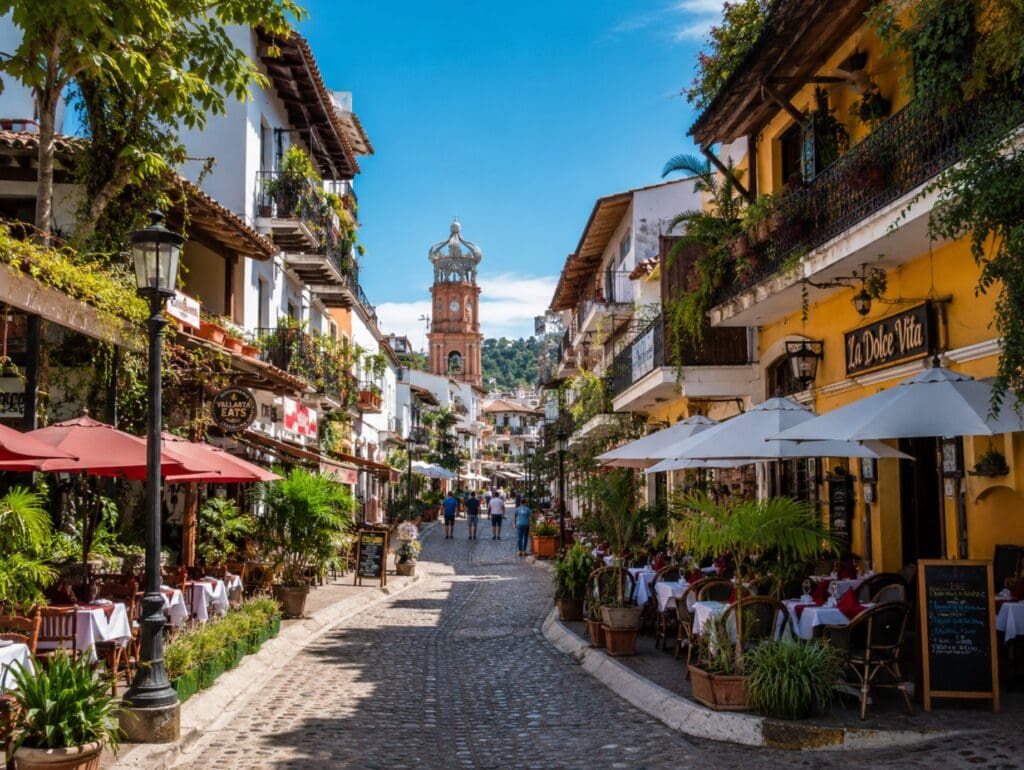
The same streets that held quiet breakfast tables begin filling with groups headed toward Los Muertos Beach. By late afternoon, the blue chairs at the southern end of the sand face a Pacific sky turning gold. Then, after dinner, music travels between open-air bars, rooftops, theaters, and clubs all within a few remarkably compact blocks.
That concentration helps explain Puerto Vallarta’s reputation. The city does not merely contain a few gay venues. Rather, LGBTQ+ visitors are woven into its beaches, hospitality industry, nightlife, events, and expatriate community. The local tourism board has promoted Vallarta as an LGBTQ+ destination for decades, while the southern end of Los Muertos Beach and the Zona Romántica remain its most visible gathering points. (visitpuertovallarta.com)
Nevertheless, Puerto Vallarta is not an American resort transplanted to Mexico.
It is a Mexican coastal city with its own residents, rhythms, language, consumer rules, public spaces, and social etiquette. Consequently, the most rewarding visit combines the comfort of an established gay destination with genuine curiosity about the place beyond its beach clubs.
Puerto Vallarta in 60 seconds
| You are looking for… | Start here |
|---|---|
| The easiest LGBTQ+ base | Zona Romántica |
| The best-known gay beach area | Southern Los Muertos Beach |
| A relaxed beach-club day | Blue Chairs |
| A more polished pool-and-beach experience | Mantamar |
| Cocktails and a rooftop | La Noche |
| Open-air socializing | Mr. Flamingo |
| Large-scale dancing | Industry |
| Cabaret and live entertainment | The Palm or ACT2PV |
| Bear-community events | BeefDip and seasonal bear weekends |
| Boat trips without crossing town | Los Muertos Pier |
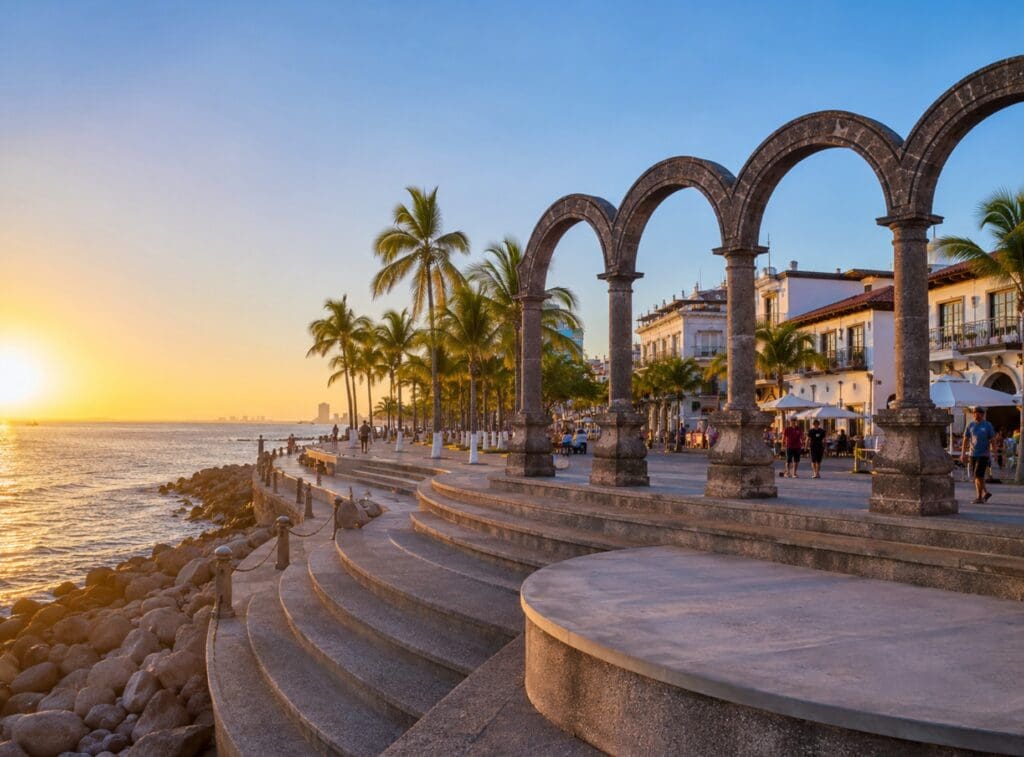
| Local art and evening walks | El Centro and the Malecón |
| The most comfortable weather | November through April |
| Pride season | May |
| The practical airport | PVR |
This guide uses “most gay-friendly” as an editorial description, not a measurable national ranking. Even so, Puerto Vallarta’s concentration of queer-welcoming accommodations, beach clubs, bars, entertainment venues, and annual events is exceptional by Mexican beach-destination standards. The tourism board has previously counted more than 70 queer-owned or queer-welcoming businesses across the destination. (visitpuertovallarta.com)
Before the Beach: Planning the Trip From the United States
Flying into PVR
Licenciado Gustavo Díaz Ordaz International Airport usually called PVR sits about 7.5 kilometers, or roughly 4.7 miles, from Puerto Vallarta proper. It handles domestic and international traffic for both Puerto Vallarta and the neighboring Riviera Nayarit. (Aéroports GAP)
For US travelers, that proximity is one of the destination’s great conveniences.
After immigration, baggage claim, and customs, a drive to the Zona Romántica commonly takes around 25 to 45 minutes, depending on traffic and the time of arrival. However, this is a practical estimate rather than a guaranteed transfer time; congestion along Avenida Francisco Medina Ascencio can increase it considerably.
PVR receives direct international service from numerous North American cities. In 2025, the official tourism board reported direct links with more than 40 international destinations, alongside Mexican domestic routes. Because airline schedules change seasonally, check nonstop availability from your home airport rather than assuming a route runs year-round. (visitpuertovallarta.com)
Passport and immigration basics
US citizens flying to Mexico need a valid passport book; a passport card cannot be used to board an international flight. Mexico requires the passport to be valid at the time of entry, and immigration officers determine the authorized length of stay. International airports now generate the digital immigration record, or FMMD, during the entry process. (Voyageauxétats-Unis)
Keep the passport stamp or electronic-gate receipt accessible until departure. Moreover, check the number of authorized days rather than automatically assuming that every visitor receives 180 days.
Leaving the airport without confusion
Official transportation counters operate inside the arrivals area. The airport lists authorized ground-transportation providers with service desks in the terminal, generally operating from morning until late evening. (Aéroports GAP)
For a first trip, the most straightforward choices are:
- An authorized airport taxi purchased at the terminal;
- A prearranged private transfer;
- A rideshare collected from its currently designated pickup point;
- Or a public bus for travelers carrying little luggage.
Airport pickup rules for app-based transportation can change. Therefore, consult the app after landing and follow the displayed meeting instructions instead of relying on advice from an old travel forum.
The least stressful option is often an official taxi or booked transfer, particularly after a long flight. On the other hand, a bus can be an inexpensive adventure for a lightly packed traveler who understands the route and does not mind standing in the tropical heat.
Do you need a rental car?
Usually, no.
The Zona Romántica, Los Muertos Beach, El Centro, the Malecón, and most gay nightlife can be explored on foot. Taxis and rideshares are widely used for longer urban trips, while buses and water taxis reach several beaches and communities outside the center.
A car becomes more useful when the itinerary emphasizes independent day trips, remote accommodations, or repeated travel north toward Riviera Nayarit. Otherwise, parking, steep streets, traffic, and the complete uselessness of a vehicle during cocktail hour may outweigh the freedom it provides.
Money in Mexico: USD, Pesos, Cards, and Tips
The current USD-to-MXN reference rate
On July 24, 2026, Banco de México published a FIX reference rate of approximately 17.46 Mexican pesos per US dollar. However, this is a wholesale reference not the exact rate a hotel, ATM, bank, card network, or exchange booth will provide. (Banxico)
Therefore, use the current rate only as a quick mental benchmark.
At that reference level:
| Mexican pesos | Approximate US-dollar value |
|---|---|
| MXN 100 | USD 5.73 |
| MXN 500 | USD 28.63 |
| MXN 1,000 | USD 57.26 |
| MXN 2,000 | USD 114.53 |
The actual amount charged to your account will depend on the exchange rate, foreign-transaction fee, ATM fee, and processing date.
Pay in pesos rather than relying on US dollars
Some tourist businesses accept US cash. Nevertheless, the exchange rate chosen by the business may be less favorable than your bank’s rate, and change may be returned in pesos.
Mexican consumer rules require businesses to display prices in national currency, including applicable taxes, even when they also show a dollar equivalent. Consequently, pesos provide the clearest basis for comparing costs and checking a bill. (PROFECO)
Carry a modest amount of cash for tips, beach vendors, buses, markets, and small businesses. However, avoid traveling around with a large stack of pesos when cards are accepted.
Use bank ATMs
Choose an ATM attached to a recognized bank branch whenever practical.
Mexico’s financial consumer agency warns that ATMs in airports, convenience stores, shopping centers, bus terminals, and other high-traffic commercial locations often charge higher fees than machines located at bank branches. The fee should appear before you confirm the withdrawal. (Condusef)
In addition, your US bank may impose its own foreign ATM fee and currency-conversion charge. A single, sensibly sized withdrawal is therefore often cheaper than several small transactions.
Choose MXN on card terminals and ATMs
A terminal may offer to convert a purchase into US dollars. This service is known as dynamic currency conversion.
It can appear convenient because the dollar amount is immediately visible. However, the displayed rate can include an additional markup. Visa advises travelers that merchants and ATMs must provide a choice, and travelers may decline that conversion. Paying in the local currency allows the card issuer to perform the conversion instead. (Visa)
Thus, when the screen asks USD or MXN, choosing MXN is generally the more transparent option although you should still understand your own bank’s fees.
Tipping
Tipping is customary in much of Puerto Vallarta’s tourist economy, but Mexican law does not make it compulsory. A restaurant cannot require a gratuity or add one without the customer’s consent. (PROFECO)
Before adding a tip, read the bill to see whether a voluntary service amount has already been included.
For good table service, many US visitors leave roughly 10% to 20%, depending on the setting and quality. Small cash tips are also appreciated by hotel staff, guides, boat crews, and beach-club servers. These ranges are customs rather than legal requirements.
Zona Romántica: The Heart of LGBTQ+ Puerto Vallarta
The Zona Romántica is not romantic in the airbrushed sense of empty streets and violin music.
It is romantic because life happens at close range.
Balconies hang over narrow sidewalks. Bougainvillea climbs across stucco walls. Cars edge carefully around pedestrians. The scent of coffee gives way to grilled food, ocean air, and afternoon rain on warm stone. Moreover, every walk contains a small negotiation between cobblestones, sloping streets, restaurant tables, and people who have stopped in the middle of the pavement to greet someone.
Officially part of Colonia Emiliano Zapata, the neighborhood sits south of the Cuale River between the bay and the lower slopes of the Sierra Madre. It is also known as Old Town or Viejo Vallarta. (Guide Vallarta officielle)
Its appeal comes from mixture rather than uniformity.
Gay bars sit beside family restaurants. Upscale condominiums face traditional homes. English circulates easily in tourist businesses, yet Spanish remains the language of everyday local life. Longtime Vallarta residents share tables with seasonal expatriates and travelers on a four-day escape.
Morning in the neighborhood
Before late morning, the Zona Romántica feels local and practical.
Cafés open, produce arrives, and people head toward work or the beach. This is the best period for photographing the streets, visiting the Cuale market, and learning the route between your accommodation and the waterfront.
Walking north brings you across the Cuale River toward El Centro and the Malecón. Heading west leads toward Los Muertos Pier. Meanwhile, climbing eastward reveals residential streets and wider views although the hills become serious very quickly.
The cobblestones are attractive but unforgiving. Wear supportive footwear rather than treating the entire vacation as a sandal campaign.
Afternoon: the city leans toward the sea
By lunchtime, the neighborhood points toward Los Muertos Beach.
Beach bags, hats, and linen shirts become increasingly common as people follow Olas Altas and nearby streets toward the pier. Restaurant terraces fill, while bars begin happy-hour service.
On Saturdays from November through April, the Olas Altas farmers market adds local food, crafts, and prepared items to the neighborhood’s morning rhythm. (visitpuertovallarta.com)
Evening: multiple nights within a few blocks
After sunset, the Zona Romántica does not become one single nightlife experience.
One street favors open-air conversation. Another centers on cabaret. A rooftop provides mountain views, while a nearby club does not become fully active until considerably later.
This concentration makes bar-hopping simple. The official destination guide specifically highlights the Malecón, Los Muertos Beach, and the cobbled streets of the Romantic Zone as central nightlife areas. (visitpuertovallarta.com)
Nevertheless, avoid turning the night into a compulsory venue inventory. A conversation at the first bar may be more memorable than rushing through six doorways because a map suggested you should.
Los Muertos Beach: Blue Chairs, Golden Sand, and Easy Conversation
Los Muertos is Puerto Vallarta’s best-known urban beach.
It stretches along the Zona Romántica, with the sail-shaped pier roughly dividing different sections of activity. Mexican families, local swimmers, vendors, musicians, restaurant diners, tourists, and LGBTQ+ beachgoers all share the shoreline.
The southern end is particularly associated with LGBTQ+ visitors and beach clubs. However, the beach remains public and mixed rather than a private gay enclave. (visitpuertovallarta.com)
What the “blue chairs” actually mean
The blue chairs are both physical furniture and a piece of gay Vallarta folklore.
For years, the bright chairs at the southern end of Los Muertos have served as an informal visual marker for the city’s gay beach area. Blue Chairs Beachfront Resort continues to operate an adults-only beach club there, within a short walk of Los Muertos Pier. (Centre de Plage Chaises Bleues)
The daytime atmosphere is social but flexible.
Some visitors arrive with friends and remain in conversation for hours. Others read, swim, or move between the sand and a shaded table. Waitstaff circulate with menus, which allows the day to unfold without repeatedly packing up every belonging.
Earlier arrival generally provides more choice. During Pride, Bear Week, holidays, and peak winter weekends, reservations or minimum-spend policies may apply at individual clubs. Confirm the current arrangement directly rather than expecting a chair to remain available at noon.
Mantamar: a more polished beach-club experience
Mantamar occupies the same broad southern section of Los Muertos Beach but offers a different style.
Located within the Almar resort complex, it operates as an adults-only LGBTQ+ beach club with pools, dining, loungers, music, and scheduled events. (Mantamar Beach Club)
The mood can shift dramatically according to the calendar.
On an ordinary weekday morning, the setting can feel like a polished pool-and-lunch retreat. Conversely, a major festival or holiday weekend may bring DJs, ticketing, reserved areas, and a much more energetic crowd.
Therefore, check the event schedule before booking. Someone seeking a quiet pool day and someone seeking a full-scale music event may look at the same photographs but require entirely different dates.
Public sand versus beach-club service
You do not need to rent a chair in order to visit Los Muertos.
The sand is public, and travelers can bring a towel to an appropriate open area. However, a beach club provides shade, bathrooms, food service, and a base for personal belongings.
Choose public beach space for simplicity and independence.
Choose a beach club for comfort, service, and easier socializing.
Whichever option you select, keep valuables minimal and do not leave a phone or wallet unattended while swimming.
The Los Muertos Pier
The modern pier is more than a sunset backdrop.
Water taxis and small boats depart from here for southern beaches, including communities such as Yelapa. The tourism board describes the pier as a boarding point for pangas and water taxis serving destinations beyond the road-connected urban coastline. (visitpuertovallarta.com)
At night, the sail-like structure is illuminated, and the walkway becomes one of the neighborhood’s simplest pleasures. No reservation, wristband, or perfectly selected resort outfit is required.
Beyond the Blue Chairs: Daytime Adventures on Banderas Bay
A beach-chair vacation is valid. Nevertheless, Banderas Bay rewards at least one day on the water.
Boat excursions show the geography that cannot be understood from the Malecón: the city pressed between mountains and sea, jungle extending down steep slopes, and communities south of town connected more naturally by water than by road.
Los Arcos Marine Park
Los Arcos rises from the water near Mismaloya, south of central Puerto Vallarta.
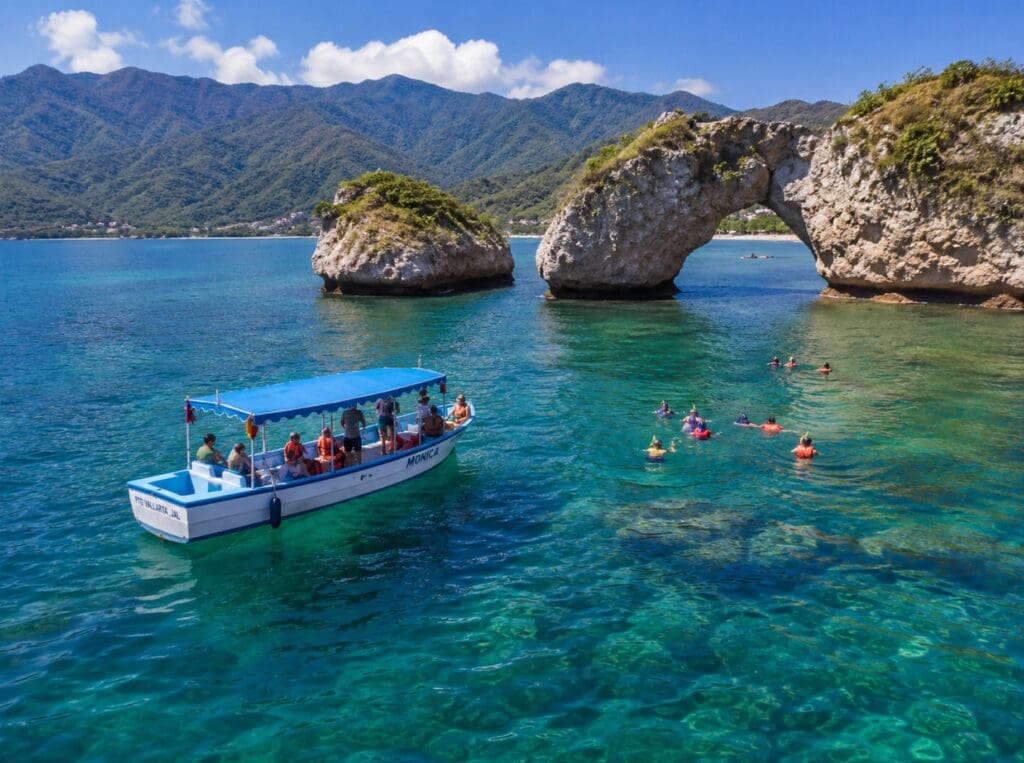
The granite formations are among the city’s most recognizable natural attractions and support snorkeling, kayaking, and diving. Puerto Vallarta’s tourism guide highlights the area’s marine life and underwater formations, while local boat excursions frequently include it as a stop. (visitpuertovallarta.com)
Choose a reputable operator, confirm what equipment is included, and ask about group size.
Furthermore, use reef-conscious sun protection and follow instructions about wildlife and rock formations. The goal is to see the ecosystem, not rearrange it.
Yelapa: a full-day change of pace
Yelapa is a small coastal community south of Puerto Vallarta, most practically reached by water taxi or boat.
Departures operate from Los Muertos Pier and Boca de Tomatlán, although timetables and sea conditions vary. The journey from central Vallarta is commonly described as roughly 40 minutes, depending on the vessel and stops. (visitpuertovallarta.com)
The village feels immediately removed from the urban resort corridor.
Paths connect the pier, beach, homes, restaurants, and waterfall routes. However, do not approach it as an empty “secret” paradise. Yelapa is a living community, and respectful visitors support locally owned businesses without treating residents’ surroundings as an outdoor film set.
Wear shoes suitable for uneven paths. Moreover, verify the final return boat before settling into lunch.
Whale watching
Humpback-whale season generally runs from mid-December through late March as whales migrate into Banderas Bay. January and February are often especially productive months for sightings. (visitpuertovallarta.com)
Use an authorized operator that follows Mexican wildlife-distance regulations.
A responsible excursion does not chase, surround, or cut across the path of an animal. Although no tour can ethically guarantee a dramatic performance, the experience of seeing the bay with a knowledgeable guide remains valuable even during quieter periods.
Gay-focused boat days
LGBTQ+-oriented boat trips and private charters are common during peak season and major event weeks.
A daytime cruise generally begins more socially than a traditional sightseeing tour. Groups meet at the marina or pier, spend time swimming or snorkeling, share lunch, and return before nightlife begins.
Before purchasing, check:
- Departure and return location;
- Boat size and shade;
- Food and beverages;
- Swimming ability requirements;
- Cancellation policy;
- Whether transportation from the hotel is included;
- And whether the program is relaxed, music-focused, or adventure-oriented.
A “boat party” and a “snorkeling tour” may involve the same bay but deliver extremely different days.
Nightlife in the Zona Romántica, Organized by Mood
Mr. Flamingo: the open-air starting point
Mr. Flamingo occupies the busy corner of Lázaro Cárdenas and Ignacio L. Vallarta.
The official tourism guide describes it as a colorful, gay-friendly open-air bar and currently lists daily opening from the afternoon into the early morning. (visitpuertovallarta.com)
Its greatest advantage is permeability.
There is little sense of disappearing behind a heavy club door. The sidewalk, corner, music, and crowd flow together, making it easy to stop for one drink and assess the evening.
Early hours favor conversation and people-watching. Later, the area becomes considerably denser and louder.
Best for: a first stop, groups, casual dancing, and seeing who is out.
La Noche: cocktails and a rooftop view
La Noche opened in 2002 as a small martini lounge before expanding into a larger venue with a multilevel rooftop garden.
Its official site emphasizes the rooftop views over the city and surrounding mountains, as well as its popularity with both local regulars and returning tourists. (La Noche PV)
Arrive earlier when the rooftop is the priority.
You will have more room to find a seat, appreciate the skyline, and talk. As the evening progresses, entertainment and music become more central.
Best for: rooftop drinks, meeting friends before a club, and a night with several different atmospheres in one venue.
Industry: the large-club experience
Industry is designed around scale, lighting, visiting DJs, and major event production.
The club operates at Lázaro Cárdenas 258 and publishes a calendar of large nightlife programs, including holiday festivals and bear-focused events. (Industry Night Club)
This is not necessarily the best place for a long conversation. Instead, it suits the evening when dancing is the central plan.
Check whether a special event requires advance tickets. Also confirm opening time, admission, bag policy, and re-entry before going, because major weekends may operate differently from ordinary nights.
Best for: high-production dance events and late nights.
The Palm Cabaret: a seated show before the bars
The Palm Cabaret at 508 Olas Altas presents ticketed performances throughout the visitor season.
Its calendar includes music, comedy, tribute acts, cabaret, and LGBTQ+ performers. (The Palm Cabaret)
This is an ideal solution when a group wants entertainment without immediately entering a crowded club.
Book a specific production rather than arriving with only a vague idea of “seeing a show.” Furthermore, note the performance time when making dinner reservations; Puerto Vallarta has perfected the art of scheduling excellent food and excellent cabaret simultaneously.
Best for: couples, groups with mixed nightlife preferences, and an early-evening cultural plan.
ACT2PV: theater, music, and piano-bar energy
ACT2PV is another important Zona Romántica performance complex, with theatrical productions, concerts, cabaret, workshops, and piano-bar programming. Its 2026 schedule included ongoing performances and an international cabaret workshop. (act2pv.com)
Because the building contains multiple formats, read the event listing carefully.
A theater ticket, piano-bar evening, and workshop showcase are not interchangeable experiences, even when they take place under the same roof.
Best for: visitors who value live performance as much as nightlife.
The Bear Community: Tropical, International, and More Varied Than the Stereotype
Puerto Vallarta has become one of the most important winter gathering points for North America’s bear community.
Climate plays a role, naturally. A January afternoon can unfold between the beach, a terrace, and a pool rather than beneath several layers of outerwear. More importantly, however, the compact Zona Romántica allows the same visitors to see one another repeatedly at breakfast, on Los Muertos Beach, during a daytime event, and later at a bar.
That repetition creates familiarity.
Someone who seemed like a stranger on the first day becomes a recognizable face by the third. Consequently, the experience can feel less anonymous than the size of the event calendar might suggest.
BeefDip Bear Week
BeefDip is the city’s longest-established international bear gathering.
The 2027 edition is scheduled for January 24 through January 31. Organizers and event guides describe a week of daytime gatherings, pool programs, boat activities, and evening events spread across several Zona Romántica venues. (gayguidevallarta.com)
The event attracts bears, cubs, daddies, admirers, friends, and visitors who may not use any community label.
Therefore, do not approach the week as a body-type qualification process. The most welcoming version of bear culture emphasizes friendship, body confidence, age diversity, and the ability to enter a social space without apologizing for taking up room.
Other bear events
Mantamar hosted its dedicated 2026 Bear Week programming from January 27 through February 1. Meanwhile, Brawny Bear Weekend scheduled a separate four-day 2026 program with daytime and nightclub events. (Guide Vallarta officielle)
These events are independently organized.
A pass for one festival may not include another organizer’s activity, even when both take place during the same broad week. Consequently, study each ticket package instead of assuming “Bear Week” functions as a single unified admission system.
Attending alone
Begin with daytime events.
A beach gathering, registration period, brunch, or small social gives people a reason to talk. Conversely, entering the largest late-night event without having met anyone can feel more intimidating.
A simple introduction is enough:
“It’s my first time at Bear Week. Have you been before?”
There is no need to perform a cartoon version of bear culture. Belonging grows through repeated, respectful participation.
Vallarta Pride: Celebration With a Local Civic Identity
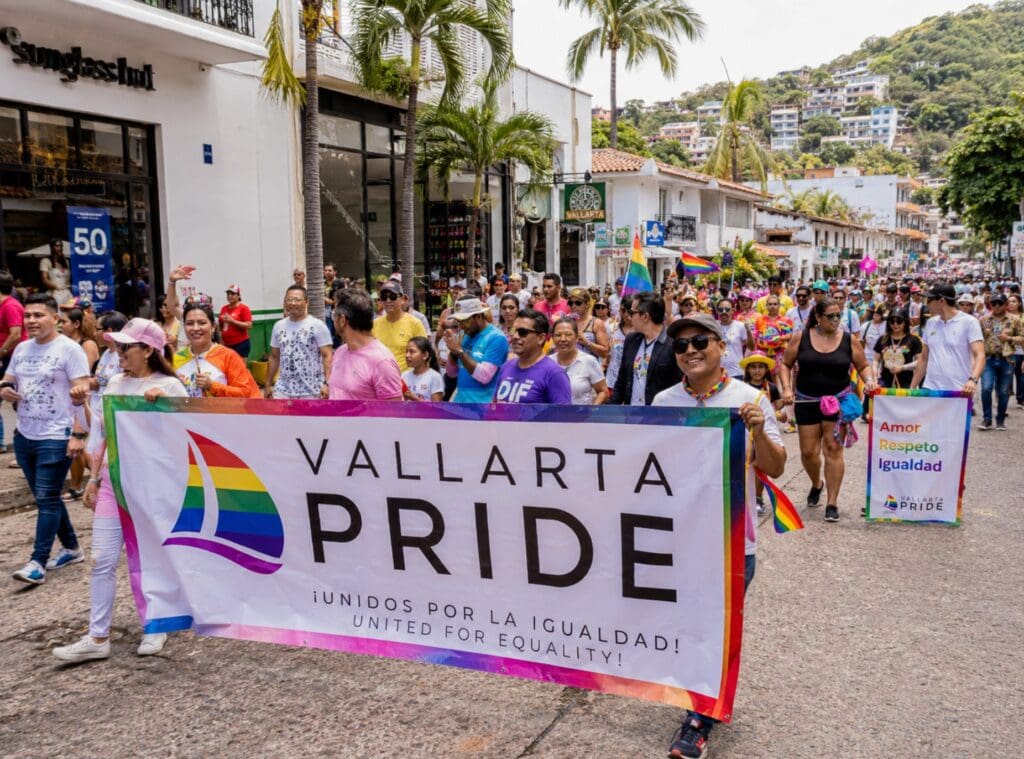
Vallarta Pride is generally held in May.
The 2026 program began on May 17 and included a flag-raising ceremony, civic participation events, a march against LGBTQ+ discrimination, the main Pride parade on May 21, a block party, a pet parade, and cultural programming. (Vallarta Pride)
The event extends beyond bars and tourism promotion.
Official programming involves local activists, government representatives, artists, community groups, businesses, residents, and visitors. Therefore, the Pride experience includes both celebration and public advocacy.
May also brings hot weather and rising humidity. Book air-conditioned accommodation, drink water, and avoid building a full-day schedule that moves directly from a parade into a late-night club without rest.
Locals, Expats, and the Social Culture of Vallarta
Puerto Vallarta’s LGBTQ+ community includes several overlapping populations.
There are Vallartenses born and raised in the region, Mexicans who moved from elsewhere in the country, seasonal workers, retirees, long-term foreign residents, remote workers, and tourists who return every winter.
This mix is especially visible in the Zona Romántica.
English is widely spoken in tourist-facing venues. However, learning basic Spanish immediately changes the tone of an interaction. A greeting, a thank-you, and a respectful attempt to communicate signal that the city is more than a service environment constructed for visitors.
Useful phrases include:
- Buenos días / buenas tardes: Good morning / good afternoon.
- ¿Me trae la cuenta, por favor?: Could you bring me the check, please?
- ¿Aceptan tarjeta?: Do you accept cards?
- ¿Cuánto cuesta?: How much does it cost?
- ¿Dónde puedo tomar un taxi?: Where can I get a taxi?
- Gracias, estuvo muy rico: Thank you, it was delicious.
Moreover, distinguish between expatriate recommendations and local knowledge.
A foreign resident may know the most convenient brunch or English-speaking service. A local resident may understand seasonal traffic, neighborhood changes, regional food, public beaches, and family-owned businesses in a different way. Both perspectives have value, but they are not identical.
Where to Stay
Zona Romántica: best for a first LGBTQ+ trip
Choose the Zona Romántica when beach access and nightlife are the main priorities.
Los Muertos Beach, the pier, restaurants, cabaret, and most gay venues will be within walking distance. Consequently, you can build a full day without calling a car.
However, the neighborhood can be noisy. A beautiful balcony above a busy bar remains beautiful at 1 a.m.; it simply becomes considerably less theoretical.
Best for: first-time visitors, nightlife, beach clubs, Bear Week, and Pride.
Amapas: views and hills
Amapas rises immediately south and east of Los Muertos.
Accommodations often offer bay views and a more residential atmosphere. In exchange, travelers encounter stairs, steep roads, and frequent vehicle rides.
Do not judge accessibility from the map alone. A property that appears two blocks from the beach may be several exhausting vertical blocks above it.
Best for: couples, views, condominium stays, and travelers comfortable with inclines.
El Centro: Mexican city life and the Malecón
El Centro sits north of the Cuale River.
It offers the Malecón, the parish church, galleries, sculptures, restaurants, and easy walking access to the Zona Romántica. The official tourism board describes the nearly one-kilometer Malecón as a central meeting point lined with art, dining, and performance spaces. (visitpuertovallarta.com)
The atmosphere is more mixed and less defined by LGBTQ+ tourism.
Best for: art, city walks, couples, and travelers who want proximity without sleeping beside the busiest gay bars.
5 de Diciembre and Versalles: food and longer stays
These neighborhoods north of El Centro attract residents and repeat visitors seeking restaurants, apartments, and a more everyday urban environment.
They are not walkable to the gay beach in the same effortless way as the Zona Romántica. Nevertheless, a short taxi or rideshare connects them with the southern center.
Best for: food-focused trips, remote work, and visitors who do not need nightlife outside their door.
Marina Vallarta: airport convenience and resort calm
Marina Vallarta is close to PVR and offers hotels, restaurants, a waterfront promenade, and boat departures.
One hotel in the marina currently describes itself as around five minutes from the airport and ten minutes from the central city in favorable traffic. (Flamingo Vallarta)
However, the Zona Romántica requires transportation.
Best for: early flights, resort facilities, marina excursions, and quieter evenings.
Getting Around Once You Arrive
Walking
The Zona Romántica, El Centro, and the Malecón are best explored on foot.
However, surfaces vary. Expect cobblestones, narrow sidewalks, curbs, stairs, and occasional steep gradients. Visitors with mobility requirements should speak directly with their accommodation and venues rather than assuming a “central” property is step-free.
Carry water during the warmer months. Additionally, use extra caution after heavy rain, when polished stones and sloping streets can become slippery.
Taxis and rideshares
Taxis are common and practical.
Before entering a street taxi, ask the fare to the destination when no meter is being used. App-based services provide an estimated price and vehicle record, although pickup points can be affected by traffic restrictions.
At night, wait inside the venue until the driver approaches. Then, verify the plate and vehicle before entering.
Buses
Local buses are inexpensive and useful for routes along the hotel zone and toward southern departure points such as Boca de Tomatlán.
Nevertheless, route signs may be easier to understand than online maps. Ask the driver whether the bus reaches your destination before paying.
Carry small peso notes and coins. Also, do not board with a large suitcase during a crowded period unless you have no practical alternative.
Water taxis
Water taxis depart from Los Muertos Pier and Boca de Tomatlán for southern beaches and villages.
Confirm the price, destination, return time, and whether the fare is one-way or round-trip before boarding. Sea conditions may also alter the schedule.
Safety for US Travelers
Mexico’s current overall US State Department advisory is Level 2: Exercise Increased Caution. Jalisco is listed at a higher state-level advisory because of crime, kidnapping, and security concerns in parts of the state; however, the advisory states that there are no specific US government employee travel restrictions for Puerto Vallarta, including neighboring Riviera Nayarit. (Voyageauxétats-Unis)
That distinction matters.
Puerto Vallarta should not be treated as interchangeable with every part of Jalisco. At the same time, a popular tourism zone is not immune to theft, fraud, unsafe transportation, or changing regional conditions.
Practical habits include:
- Follow current US Embassy alerts and local news;
- Use authorized transportation;
- Avoid displaying large amounts of cash;
- Keep a phone in a closed pocket on crowded streets;
- Use hotel safes thoughtfully;
- Do not leave drinks or belongings unattended;
- Avoid isolated streets when walking alone late;
- And use 911 for an immediate emergency.
A security incident in February 2026 temporarily disrupted roads, taxis, rideshares, and flights in Puerto Vallarta. The episode demonstrates why real-time alerts matter more than a guide published months earlier. (Ambassade des États-Unis au Mexique)
Enroll in the Smart Traveler Enrollment Program when appropriate and keep the contact information for the US consular agency serving the Puerto Vallarta region. (Voyageauxétats-Unis)
Timeshare and sales presentations
Vacation-club and timeshare sales are common in major Mexican resort destinations.
Do not accept transportation, gifts, or discounts until you clearly understand whether they require attending a presentation. Read contracts carefully and never sign under time pressure.
Profeco reminds travelers that prices, promotions, reservation conditions, and services must be honored as advertised. Foreign visitors are protected by Mexican consumer law and can request assistance with abusive or undisclosed charges. (PROFECO)
When to Visit
November through April: the easiest season
Winter and early spring generally bring warm days, lower humidity, limited rainfall, and active nightlife.
This is also the peak period for returning visitors, expatriate residents, whale watching, cabaret seasons, and major bear events.
Hotel rates rise accordingly. Therefore, reserve early for Christmas, New Year, BeefDip, and US holiday weekends.
May: Pride and rising heat
May brings Vallarta Pride and strong community visibility.
Days become hotter, while humidity increases ahead of the rainy season. Air conditioning shifts from pleasant amenity to essential infrastructure.
June through October: tropical green season
Puerto Vallarta’s rainy season typically runs from June through October, with August and September among the wettest months. Rain frequently arrives in afternoon or evening bursts rather than lasting continuously all day. (visitpuertovallarta.com)
Mornings may still be bright and suitable for beach activities. Meanwhile, storms can turn the mountain backdrop intensely green and cool the evening air.
However, humidity is substantial, and some venues or shows reduce schedules during the low season.
Tropical-storm season
The official eastern Pacific hurricane season runs from May 15 through November 30, with peak activity generally during July, August, and September. (Centre de Prévision Climatique)
Travel during these months is common. Nevertheless, use flexible bookings, follow the National Hurricane Center, and understand the accommodation’s cancellation and storm policies.
A Four-Day Gay Puerto Vallarta Itinerary
Day 1: arrive, settle in, and learn the neighborhood
Take an authorized transfer from PVR and check into the Zona Romántica.
Afterward, walk toward Los Muertos Pier. Continue along the beach, observe the different clubs, and avoid committing to every reservation before understanding the geography.
At sunset, cross the pier and watch its lights come on. Then, have dinner nearby and begin the evening at Mr. Flamingo or La Noche.
Keep the first night flexible. The city will still be there tomorrow, looking annoyingly attractive.
Day 2: Los Muertos Beach and cabaret
Arrive at the southern end of Los Muertos during the morning.
Choose Blue Chairs for a classic, social beach day or Mantamar for a more structured pool-and-club experience. Confirm any reservation, minimum spend, or event admission in advance.
In the late afternoon, return to the hotel, rest, and change.
Book a performance at The Palm or ACT2PV. Afterward, decide whether the evening calls for cocktails, conversation, or a larger dance venue such as Industry.
Day 3: Banderas Bay
Take a boat excursion to Los Arcos, Yelapa, or another southern destination.
Choose the trip based on its actual focus. A snorkeling excursion, relaxed sailing day, and DJ-led group cruise should not be booked as though they are the same product.
Return before dinner. Then, take a quieter evening perhaps a rooftop drink or a walk along the Malecón.
Day 4: Mexican Vallarta beyond the gay beach
Cross the Cuale River into El Centro.
Walk the Malecón, see the outdoor sculptures, visit the Los Arcos amphitheater area, and explore galleries or the Cuale cultural district. The Malecón remains the city’s principal public promenade, combining art, restaurants, performance, and views of the Pacific. (visitpuertovallarta.com)
Have a long lunch away from the busiest beach blocks.
Finally, return to Los Muertos for one last sunset and a farewell evening in the Zona Romántica.
Solo Travelers, Couples, and First-Time Bear Visitors
Traveling alone
Puerto Vallarta is comparatively easy for solo LGBTQ+ visitors because public social life is concentrated.
Start during the afternoon rather than entering the largest club at midnight. Sit at a bar, attend a cabaret performance, join a small boat tour, or reserve a beach chair.
Repeated visibility helps. Visit the same café twice, return to a bar you enjoyed, and greet people you recognize.
Traveling as a couple
Do not make every activity a joint obligation.
One partner may prefer a boat excursion while the other wants the beach. Likewise, one may enjoy a late club while the other considers 10:30 p.m. an excellent and civilized bedtime.
Spend part of the day independently, then meet for dinner or sunset.
Visiting Bear Week for the first time
Choose daytime social events before the largest evening programs.
Moreover, do not worry about looking “bear enough.” The community includes different bodies, ages, identities, styles, and relationships to the label.
Attend the events that genuinely interest you instead of selecting only those that appear most popular online.
Meet Locals and Travelers Through BEARWWW
Puerto Vallarta becomes more personal once a few profiles become familiar faces.
Before the trip, open BEARWWW and explore members in the Zona Romántica, El Centro, Amapas, Versalles, Marina Vallarta, and the wider Banderas Bay region.
Join the Bear community Puerto Vallarta 🔥




Mention your dates and ask a concrete question:
“It’s my first trip to Vallarta. Is Los Muertos more social in the morning or late afternoon?”
Or:
“I’m attending BeefDip alone. Which daytime gathering is easiest for meeting people?”
A first meeting does not need to happen in a crowded club.
Coffee in the Zona Romántica, lunch near the Cuale River, a walk on the Malecón, or sunset beside Los Muertos Pier provides a public and low-pressure setting.
Meet publicly, communicate clearly, keep control of your transportation, and protect your accommodation details until trust develops.
Join BEARWWW before your Puerto Vallarta trip and connect with the bears, daddies, cubs, admirers, locals, and travelers who make the city feel like a community rather than a checklist.
Why Gay Travelers Keep Returning
Puerto Vallarta offers the ease of a mature LGBTQ+ destination without completely separating queer life from the surrounding city.
You can spend the morning among Mexican families and fishermen near the pier. Later, you can relax beside a largely LGBTQ+ beach crowd. Afterward, a five-minute walk leads to restaurants, cabaret, rooftop bars, or dancing.
That convenience is powerful.
However, the strongest memory is rarely the convenience itself.
It is the sound of suitcase wheels failing heroically on the cobblestones. It is recognizing people from yesterday’s beach while crossing Lázaro Cárdenas. It is watching the Sierra Madre turn dark green before an evening storm. It is an American visitor attempting Spanish, a Mexican server replying kindly, and both people deciding that mutual effort is more useful than perfection.
The bear community adds another form of familiarity.
During winter gatherings, bodies and generations that can feel peripheral elsewhere become highly visible. Still, the best version of that community is not based on one appearance. It is built through humor, generosity, body confidence, and the willingness to welcome someone arriving alone.
Ultimately, Puerto Vallarta works because it can be many trips at once.
It is a beach vacation, a food trip, a bear gathering, a Pride destination, a cabaret town, a nature base, and a place where queer couples can enjoy ordinary public affection without the entire day being organized around vigilance.
Respect the city beyond its gay district. Spend pesos in local businesses. Learn a few words of Spanish. Follow the bay’s environmental rules. Leave time for conversations that were not on the itinerary.
Then, at sunset, walk toward the sail-shaped pier.
Everyone else probably had the same idea and, somehow, that is part of the charm.
About the Author
Alain VEST is an LGBTQ+ travel journalist and Mexico lifestyle writer
