A compassionate, practical, safety-first guide for anyone thinking about coming out.
Coming out can feel like standing at the edge of a doorway: part hope, part fear, part relief, part “What happens next?” If you are reading this with a racing heart, take a breath. You do not have to tell everyone today. You do not have to have perfect words. You do not owe anyone access to your identity before you are ready.
Table of Contents
Coming out is not a single performance or a deadline. It is a personal process of deciding who gets to know you more fully, when, and under what conditions. The Human Rights Campaign’s coming out resources describe the process as something that should be approached realistically, with care for your own circumstances and support system. (HRC)

First, a Safety Note: You Are Allowed to Wait
Before we talk about scripts, timing, or who to tell first, we need to talk about safety.
If coming out could put you at risk of being harmed, kicked out, financially cut off, monitored, threatened, or isolated, waiting is not “cowardly.” It is self-protection. The Trevor Project’s Coming Out Handbook specifically encourages people to identify safe places they can go if they need distance from a stressful situation, and to connect with trained counselors or supportive LGBTQ+ communities when needed. (The Trevor Project)
This matters because family and community reactions can affect mental health and stability. SAMHSA notes that family acceptance helps protect LGBTQI+ youth against depression, suicidal behavior, and substance use, while the Family Acceptance Project has also found that accepting behaviors from family members can protect against suicide, depression, and substance use. (Samhsa)
If you are in immediate danger, call emergency services. If you are thinking about harming yourself or feel like you cannot stay safe, call or text 988 in the U.S. The 988 Lifeline offers LGBTQI+ support information and call, text, chat, and Deaf/HoH access options. (988 Lifeline)
What “Coming Out” Really Means
Coming out usually means sharing something true about your sexual orientation, gender identity, or relationship life with another person. However, it does not have to mean making a public announcement. It can be as quiet as telling one trusted friend, writing a letter, changing a profile only visible to close people, or saying, “There’s something personal I want you to know.”
The American Psychological Association explains that sexual orientation includes patterns of emotional, romantic, or sexual attraction, as well as a person’s sense of identity and community connection. It also recognizes that orientation exists along a continuum. (APA)
In real life, this means your words may evolve. You might say “gay” now, “queer” later, or simply “I’m still figuring out the exact language, but I know this part of me is real.” That is valid. Your identity does not become less true because your vocabulary is still growing.

Safety First: Assessing Your Environment
Before you choose a person, place, or message, pause and ask practical questions. This step is especially important if you are young, financially dependent, living with family, in a conservative environment, or unsure how someone may react.
Ask yourself these safety questions
Physical safety:
Could this person hurt me, threaten me, lock me out, take my phone, or prevent me from leaving?
Housing safety:
If the reaction is bad, do I have somewhere safe to stay tonight, this week, or longer?
Financial safety:
Could this person stop paying for school, transportation, food, medication, housing, or health care?
Privacy safety:
Could they tell others before I am ready?
Digital safety:
Could they search my phone, read my messages, track my location, or access my accounts?
Emotional safety:
Even if they do not harm me, could their reaction leave me overwhelmed or alone?
CDC data show that LGBTQ+ students experience substantial health disparities, including higher risks related to poor mental health, suicidal thoughts and behaviors, and violence. That does not mean coming out causes harm; rather, it means support and safety planning are not optional details. They are part of caring for yourself. (CDC)
Make a simple safety plan
Before coming out to someone unpredictable, consider having:
A charged phone.
A trusted friend on standby.
A private way to leave the room.
A place you can go afterward.
Copies or access to key documents if you may need to leave home.
Some money, transportation access, or a rideshare option.
A crisis or support hotline saved under a neutral name.
This may sound intense, and hopefully you will not need it. However, planning ahead can help your nervous system feel steadier. It also reminds you that your safety comes first.
There Is No “Right” Timeline
One of the kindest truths about coming out is this: you are not late.
Some people come out in high school. Some come out at 25, 40, 65, or after a marriage, a move, a loss, a spiritual shift, or years of quiet self-discovery. Some people are out to friends but not family. Some are out at work but not online. Some people never use a public label and still live honestly in the ways that matter to them.
PFLAG emphasizes that coming out is different for everyone and can still be challenging for individuals and families, even though the phrase has become familiar in mainstream culture. (PFLAG)
So, if you are not ready, that is information—not failure. If you are ready only to tell one person, that counts. If you came out once and then stepped back, that also counts. Coming out is not a test you pass; it is a series of choices you get to make.
Choosing Your First Ally
The first person you tell matters because their response can shape how safe you feel taking the next step. Ideally, your first ally should be someone who has already shown kindness, discretion, and respect for LGBTQ+ people.
Signs someone may be a safe first person
They speak respectfully about LGBTQ+ people.
They do not gossip about private information.
They listen more than they lecture.
They respect boundaries.
They have supported you during hard moments before.
They do not depend on your family, workplace, or school for their own status.
They can keep your confidence.
Supportive relationships can be protective. The Trevor Project’s research has found that LGBTQ youth who report high family social support report attempting suicide at less than half the rate of those with low or moderate family support. (The Trevor Project)
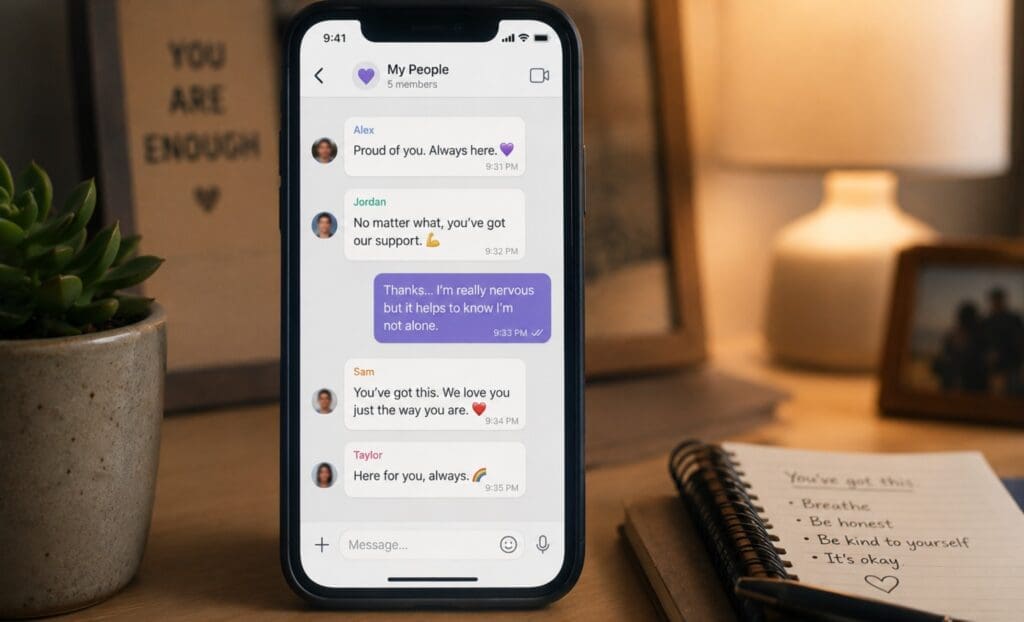
However, your first ally does not have to be a parent. It can be a friend, sibling, cousin, teacher, counselor, coworker, roommate, coach, faith leader, therapist, or LGBTQ+ community member. Start where safety and trust are strongest.
A simple first-ally script
You might say:
“I want to tell you something personal because I trust you. I’m gay. I’m still deciding who else I want to tell, so I need you to keep this private for now.”
Or:
“I’ve been carrying this for a while, and I don’t want to feel alone with it anymore. I’m gay, and I’m hoping you can just listen and be with me in this.”
Or, if you are still exploring:
“I’m figuring out my identity, and I think I may be gay. I don’t need you to solve anything. I just need someone safe to talk to.”
Notice what these scripts do: they name the truth, set the tone, and give the listener a clear job.
How to Decide Who to Tell Next
After your first ally, you can move slowly. You do not have to create a chain reaction. Instead, think in circles of trust.
Circle 1: Emotionally safe people
These are people likely to respond with love, curiosity, or calm. Tell them first.
Circle 2: Important but uncertain people
These may include parents, siblings, close relatives, roommates, or longtime friends. You may want a plan before telling them.
Circle 3: High-risk people
These are people who may react with control, rejection, outing, threats, or financial consequences. You do not owe them immediate access to your identity.
Circle 4: Public or semi-public spaces
This includes social media, extended family, work, school, faith communities, and community groups. Once information is public, you cannot fully control where it travels. Therefore, public coming out should happen only when you feel ready for that level of visibility.

Choosing the Right Method: In Person, Text, Letter, or Call
There is no universally “best” way to come out. The best method is the one that balances honesty with safety, privacy, and emotional capacity.
Coming out in person
This can feel intimate and direct. However, it is best when you trust the person and have a safe exit.
Good for: trusted friends, supportive siblings, affirming parents.
Less ideal for: unpredictable people, controlling households, unsafe environments.
Coming out by text
Text gives you control over wording and timing. It also gives the other person time to process before responding.
Good for: anxious conversations, long-distance friends, people who may need a moment.
Less ideal for: someone who may screenshot or share your message.
Coming out by letter or email
A letter lets you say everything without interruption. It can be especially useful for parents or family members who may react emotionally at first.
Good for: thoughtful explanations, complex relationships, setting boundaries.
Less ideal for: urgent situations where you need immediate support.
Coming out by phone or video call
This can be a middle ground. You can hear the person’s voice while still staying physically separate.
Good for: long-distance loved ones, supportive but emotional family.
Less ideal for: people who may pressure you to keep talking when you need a break.
What to Say: Conversation Starters That Actually Help
The hardest part is often the first sentence. You can keep it simple.
Direct and calm
“I want to share something important with you. I’m gay.”
Gentle and personal
“I’ve been learning to be more honest with myself, and I want to be honest with you too. I’m gay.”
Boundary-forward
“I’m telling you this because I trust you. I’m not ready for everyone to know, so please keep it private.”
Still figuring it out
“I’m still exploring my identity, but I know I’m not straight. I wanted to tell someone I trust.”
For a parent or caregiver
“I know this may be new information for you, but it is not new to me. I’ve thought about this carefully, and I’m telling you because I want a more honest relationship with you.”
If you need support, not debate
“I’m not asking you to analyze this or challenge it. I’m asking you to listen and treat me with love.”
These sentences are not magic. They simply give you a place to begin. You can write them down, rehearse them, or read from your phone if your voice shakes.
Managing Reactions: What to Expect
People react in many different ways. Some will hug you immediately. Some will say, “I already knew.” Some will ask awkward questions because they are trying to understand. Some will need time. And, unfortunately, some may respond with hurtful words.
Your job is not to manage everyone’s emotions perfectly. Your job is to stay grounded in your own worth.
Supportive reaction
They may say:
“Thank you for telling me.”
“I love you.”
“I’m proud of you.”
“How can I support you?”
“Who else knows?”
You can respond:
“Thank you. It means a lot that you’re taking this well.”
“Please keep it private for now.”
“I may need support when I tell others.”
Confused but not hostile reaction
They may say:
“Are you sure?”
“Is this a phase?”
“Why didn’t you tell me sooner?”
You can respond:
“I understand you may need time, but I need you to respect that I know myself.”
“I didn’t tell you sooner because I was scared. I’m telling you now because I want honesty between us.”
“You don’t have to understand everything today. You do need to treat me with respect.”
Hurtful or unsafe reaction
They may raise their voice, shame you, threaten you, or try to control what happens next.
You can respond:
“I’m going to pause this conversation now.”
“I will talk again when we can both be respectful.”
“I’m not staying in a conversation where I’m being insulted.”
“I need space. I’ll check in later.”
If you feel physically unsafe, leave if you can do so safely and contact a trusted person or emergency support. Again, if you are in the U.S. and in crisis, call or text 988; if you are LGBTQ+ and want specialized crisis support, The Trevor Project offers free, confidential 24/7 support by phone, text, or chat for LGBTQ young people in the U.S. (988 Lifeline)
Setting Boundaries After Coming Out
Coming out does not mean you must answer every question. You are allowed to have privacy.
Boundaries you can set
“I’m not comfortable discussing that.”
“Please don’t tell anyone else. I want to choose when and how I share this.”
“I’m happy to send you resources, but I don’t want to debate my identity.”
“I need you to use respectful language.”
“If you need time to process, that’s okay. But I need space from hurtful comments.”
“I’m not asking for permission. I’m sharing who I am.”
Boundaries are not punishment. They are instructions for staying in relationship with you respectfully.
PFLAG offers resources for families and allies because supporters often need guidance too; if someone loves you but does not yet understand how to respond well, pointing them toward a trusted support organization can help move the burden off your shoulders. (PFLAG)
If You Live With Unsupportive Family
This section deserves special care. If you depend on family for housing, tuition, immigration support, transportation, food, medication, or insurance, coming out can carry real consequences.
That does not mean you should live in fear forever. It does mean you should build support before taking a risk.
Before telling unsupportive family, consider
Do I have a safe place to sleep if things go badly?
Could I store important documents somewhere secure?
Do I have access to my own money, bank account, or transportation?
Can a trusted adult, counselor, relative, or friend be on standby?
Could I tell them in a public but calm place, such as a park or café?
Would a letter be safer than an in-person conversation?
Would it be better to wait until I am more independent?
These questions are not meant to scare you. They are meant to protect you. LGBTQ+ young people can face elevated risks when family support is absent, and CDC and NAMI both highlight mental health disparities among LGBTQ+ youth and young people. (CDC)
If waiting is safest
You can still affirm yourself privately. You can journal. You can connect with safe LGBTQ+ spaces online. You can talk to a counselor. You can make a future plan. You can prepare for independence. You can build chosen family one person at a time.
Waiting to come out publicly does not mean you are hiding your truth from yourself. Sometimes it means you are protecting your future.

Coming Out at School or College
School can be a place of support, stress, or both. Before coming out widely, identify which adults or systems are safe.
Consider talking first to a school counselor, trusted teacher, LGBTQ+ student group advisor, resident assistant, campus LGBTQ+ center, or student health provider. If your school has a GSA or LGBTQ+ student organization, that can be a gentle way to meet peers before becoming widely out.
At the same time, public visibility at school can spread quickly. Therefore, if you are not ready for classmates, parents, coaches, or administrators to know, be careful about social media posts, group chats, and public conversations.
If your campus or school environment feels unsafe, look for outside support as well. PFLAG offers local chapters and virtual meetings for LGBTQ+ people, families, and allies, which can be especially helpful when school support is limited. (PFLAG)
Coming Out at Work
Coming out at work is a personal choice, not a professional obligation. Some people want colleagues to know because it makes everyday conversation easier. Others prefer privacy, especially in workplaces where discrimination or gossip may be a concern.
Before coming out at work, consider:
Company culture.
HR policies.
State and local protections.
Whether your manager has shown inclusion.
Whether LGBTQ+ employees are visible and respected.
Whether you want one trusted colleague to know first.
A simple workplace script might be:
“I wanted to share something personal because I value being honest with the team. My partner’s name is David.”
Or:
“Just so you know, I’m gay. I’m private about my personal life, but I didn’t want to keep editing myself in ordinary conversations.”
You do not have to give a speech. Sometimes coming out at work simply means no longer changing pronouns or avoiding weekend stories.
Coming Out Online
Online coming out can feel empowering, especially if your digital community is more affirming than your offline environment. However, online information can travel quickly.
Before posting, ask yourself:
Can family, coworkers, classmates, or community members see this?
Could someone screenshot it?
Is my location visible?
Do I need to adjust privacy settings first?
Am I ready for supportive and unsupportive comments?
Do I have someone to message afterward?
If you want to come out online but keep control, you can start with a private story, close friends list, locked account, or direct messages to selected people. You can also post something simple:
“I’m gay, and I’m happy to share that part of myself more openly. Please respect that this is personal, and please don’t turn the comments into a debate.”
GLAAD’s media guidance encourages respectful, accurate language when discussing LGBTQ people, which is a useful reminder that your identity deserves dignity whether it is discussed online, at home, or in public. (GLAAD)
Coming Out in Religious or Cultural Communities
For many people, coming out is not only personal—it is cultural, spiritual, and family-connected. You may worry about disappointing people, losing a faith community, or being misunderstood by relatives whose first language, cultural background, or beliefs shape how they hear the news.
In these situations, go slowly. You might choose one affirming person within the community first. You might seek LGBTQ-affirming faith groups, culturally specific LGBTQ+ organizations, or a therapist who understands your background. You might also prepare resources in the language your family uses most comfortably.
You are allowed to keep parts of your life separate while you build support. You are also allowed to honor your culture or faith while being honest about who you are. Those things do not have to cancel each other out.
If You Are Bisexual, Pansexual, Queer, Trans, Nonbinary, or Still Questioning
Although this guide uses “gay” in the title because many people search that word first, coming out is not only one kind of story.
If you are bisexual or pansexual, you may face people who assume your identity depends on your current partner. It does not.
If you are trans or nonbinary, coming out may involve names, pronouns, presentation, documents, health care, or safety planning.
If you are asexual, aromantic, queer, or questioning, you may need language that gives you room to explore.
If you are not ready for a label, you can say, “I know enough to know I’m not straight, and I’m still finding the words.”
The Trevor Project and other LGBTQ+ support organizations frame coming out as a process that belongs to the individual, not a single script everyone must follow. (The Trevor Project)
Aftercare: What to Do After the Conversation
Even if the conversation goes beautifully, your body may feel shaky afterward. That is normal. Coming out can release years of tension at once.
Plan something gentle afterward
Text your ally.
Take a walk.
Eat something nourishing.
Watch a comfort show.
Journal what happened.
Take a shower.
Listen to calming music.
Go somewhere familiar.
Sleep.
If the reaction was loving, let yourself receive it. If the reaction was messy, give it time—but do not abandon yourself. If the reaction was harmful, reach out for support quickly.
Crisis Text Line offers free, confidential 24/7 support in the U.S. by texting HOME to 741741, and the LGBT National Help Center lists hotlines including a Coming Out Support Hotline. (Crisis Text Line)
What If You Regret Telling Someone?
Sometimes you may tell someone and later wish you had waited. That does not mean you made a terrible mistake. It means you took a vulnerable step and learned something about that person, that timing, or your needs.
You can still set boundaries afterward:
“I’m glad I told you, but I’m not ready to talk more about it.”
“Please do not bring this up with anyone else.”
“I need some time before we continue this conversation.”
“Your reaction hurt me. I’m willing to talk later if we can do it respectfully.”
If someone outs you after you asked for privacy, that is a violation of trust. Focus first on safety and support, then decide how to address the relationship.
How to Support Someone Who Comes Out to You
If someone sent you this guide because they want to come out—or already did—your response matters.
Say:
“Thank you for trusting me.”
“I love you.”
“I’m honored you told me.”
“Do you want this kept private?”
“How can I support you?”
“You don’t have to explain everything right now.”
Do not say:
“Are you sure?”
“I knew it.”
“Don’t tell anyone else.”
“This is just a phase.”
“What did I do wrong?”
“But you don’t seem gay.”
PFLAG’s guidance for supporters recognizes that coming out can be emotionally significant for both LGBTQ+ people and families, but the first responsibility of the listener is to respond with care, not panic. (PFLAG)
Reputable Support and Crisis Resources
If you are in danger or feel at risk of harming yourself, use emergency support now. You deserve immediate help, not just an article.
988 Suicide & Crisis Lifeline — U.S.
Call or text 988, or use chat support. The 988 Lifeline provides crisis support and has LGBTQI+ resources. (988 Lifeline)
The Trevor Project — LGBTQ+ young people in the U.S.
The Trevor Project offers free, confidential 24/7 crisis support by phone, text, or chat for LGBTQ young people. (The Trevor Project)
Crisis Text Line — U.S.
Text HOME to 741741 for free, confidential 24/7 support from a trained crisis counselor. (Crisis Text Line)
LGBT National Help Center — U.S.
The LGBT National Help Center lists several peer-support hotlines, including the LGBT National Hotline, Coming Out Support Hotline, Youth Talkline, and Senior Hotline. (LGBT National Help Center)
PFLAG — family, allies, and LGBTQ+ people
PFLAG offers local chapters and virtual meetings for LGBTQ+ people, families, and allies. (PFLAG)
Outside the U.S.
Search for your country’s LGBTQ+ helpline, crisis line, or local LGBTQ+ center. If you are in immediate danger, contact local emergency services.
A Final Word: You Are Not a Problem to Be Solved
Coming out is often described as a brave moment, and sometimes it is. But more than bravery, it is an act of self-recognition. You are not asking to become worthy. You already are.
You may come out loudly, quietly, in stages, in a letter, over coffee, after college, after moving out, after therapy, after one deep breath. Every version can be real.
So, as you plan your next step, remember this:
You are allowed to be careful.
You are allowed to be joyful.
You are allowed to change your mind.
You are allowed to protect your peace.
You are allowed to choose your people.
You are allowed to be loved exactly as you are.
About the Author
Alain VEST / Editorial Team is a lifestyle writer and LGBTQ+ advocate with lived LGBTQ+ experience and a focus on emotionally safe, practical guides for real people navigating identity, relationships, family conversations, and community life. This guide was written with a safety-first approach, drawing on reputable LGBTQ+ advocacy, public health, and mental health resources to support readers with compassion, clarity, and dignity.
Discover our Guide Gay Puerto Vallarta, Gay Guide jacksonville and Charlotte