To be gay means, most simply, to experience enduring romantic, emotional, or physical attraction primarily toward people of the same gender and to identify with the word gay.
Table of Contents
However, that definition is only the beginning.
For many people, being gay is also connected to personal discovery, relationships, community, family, culture, language, history, and the freedom to live honestly. For others, it is a private part of identity rather than the center of their public life. Some feel deeply connected to LGBTQ+ culture, while others do not participate in any recognizable gay social scene.
There is no single gay personality, appearance, profession, political outlook, family structure, or way of living. Gay people exist in every racial, cultural, religious, economic, geographic, and generational community.
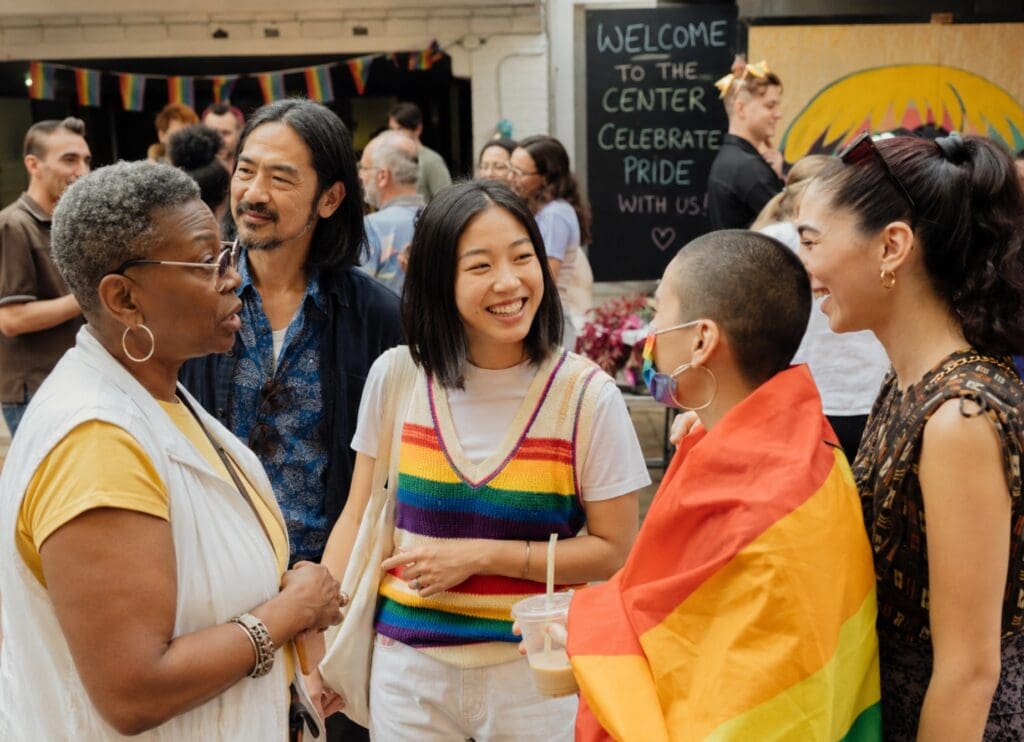
A Clear Definition of “Gay”
The American Psychological Association describes sexual orientation as an enduring pattern of emotional, romantic, or physical attraction. The term also relates to a person’s sense of identity and the social relationships that may grow from those attractions. (APA)
In contemporary American English, gay most often refers to a man who is attracted to other men. Nevertheless, the term can also be used more broadly by women, nonbinary people, and other individuals who experience same-gender attraction.
The National Academies explains that sexual orientation can include three distinct but related dimensions:
- attraction;
- behavior;
- self-identification.
These dimensions do not always align in exactly the same way. Someone can understand that they are gay before entering a relationship. Another person may have had same-gender relationships without using the gay label. Therefore, identity should not be assigned to someone solely on the basis of assumptions about their behavior. (Académies des sciences et de la médecine)
A practical definition is:
A gay person is someone who identifies with a pattern of romantic, emotional, or physical attraction primarily toward people of the same gender.
The word belongs first to the person using it.
Being Gay Is an Orientation, Not a Personality
Sexual orientation describes whom someone may be drawn to. It does not determine how that person dresses, speaks, votes, works, worships, raises children, expresses masculinity or femininity, or participates in society.
A gay person may be:
- outgoing or reserved;
- religious, spiritual, agnostic, or atheist;
- urban, suburban, or rural;
- traditionally masculine, feminine, or neither;
- single, dating, partnered, married, divorced, or widowed;
- deeply involved in LGBTQ+ organizations or disconnected from them;
- open about their identity or highly private.
This diversity is important because popular culture has often reduced gay people to a limited group of recognizable characters. Sometimes those portrayals were affectionate; often they were mocking, incomplete, or written without gay people having meaningful control over their own representation.
Real identity is less theatrical and more ordinary. Being gay can shape a life, but it does not explain every part of that life.
Is “Gay” Only a Word for Men?
The answer depends on context and personal preference.
Today, gay man is the clearest and most common phrase for a man attracted to men. Many women prefer the word lesbian, although some women also identify as gay. Some nonbinary people use gay when it best communicates the direction of their attraction or their relationship to queer culture.
GLAAD’s terminology guidance recognizes gay as an identity related to same-gender attraction while emphasizing that LGBTQ+ language evolves and that people may use different words for themselves. The National Academies likewise notes that identity terms can have varying cultural, generational, and contextual meanings. (glaad.org)
In some conversational settings, people also use gay informally as an umbrella term for the wider LGBTQ+ community. For example, someone may refer to “gay rights” or “gay culture” while discussing a movement that includes lesbian, bisexual, transgender, queer, and other people.
That broader usage remains common, but it can also erase differences. A transgender person is not necessarily gay. A bisexual person is not simply “partly gay.” A lesbian may prefer language that specifically recognizes women. Therefore, LGBTQ+ is often more accurate when referring to the entire community.
Sexual Orientation and Gender Identity Are Different
Sexual orientation concerns attraction. Gender identity concerns a person’s own understanding of their gender.
A transgender man, for example, may be gay if he is attracted to men. A transgender woman may be lesbian, bisexual, straight, asexual, queer, or use another term. Transgender identity does not determine sexual orientation.
GLAAD specifically cautions against confusing these two concepts and notes that transgender people can have the same range of sexual orientations as anyone else. (glaad.org)
This distinction is essential because the letters in LGBTQ+ describe related but different forms of identity:
- lesbian, gay, and bisexual generally refer to sexual orientation;
- transgender generally refers to gender identity;
- queer may refer to orientation, gender, community affiliation, or a broader rejection of rigid categories.
These communities share histories of exclusion and collective activism, but their experiences are not interchangeable.
The History of the Word “Gay”
From “Joyful” to a Modern Identity
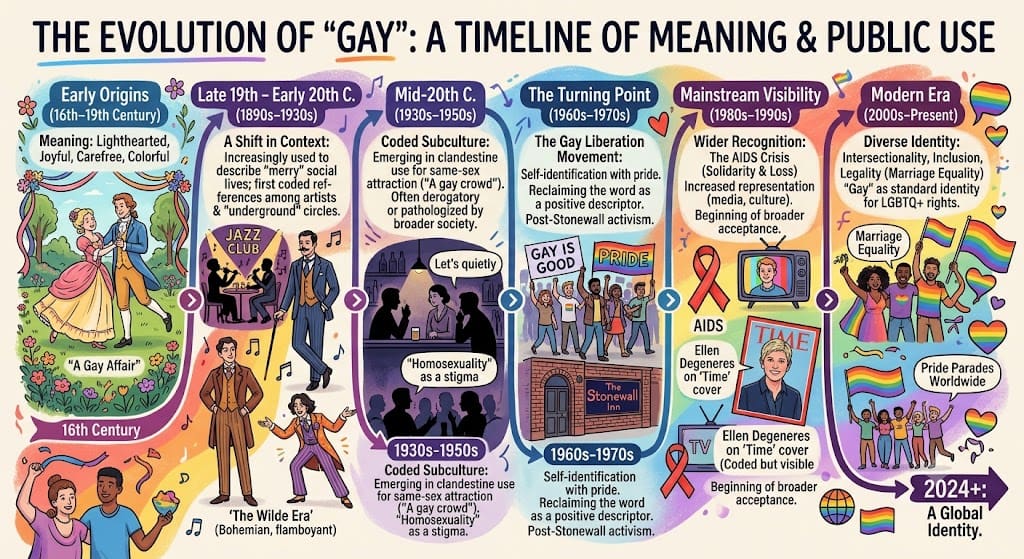
The word gay existed in English long before it referred to sexual orientation.
Merriam-Webster traces it to Middle English and the Anglo-French word gai. Earlier meanings included lively, cheerful, bright, or carefree. Over time, the word acquired additional social meanings, some connected to unconventional living or perceived sexual impropriety. (Merriam-Webster)
By the early and mid-20th century, gay was increasingly used within same-gender communities as a less clinical and more self-directed alternative to words such as homosexual.
That change was culturally important. Communities often gain power when they can name themselves rather than being named exclusively by governments, doctors, police, or hostile outsiders.
Why “Homosexual” Can Sound Clinical or Outdated
The word homosexual was developed in the 19th century and became closely associated with medical, legal, and psychiatric classification. OutHistory notes that the related terms homosexual and heterosexual emerged during 19th-century debates about sexual behavior and law. (outhistory.org)
Today, the word is still used in some historical, legal, and technical contexts. However, when used as a noun—“a homosexual”—it can sound distancing or dehumanizing. The APA Dictionary of Psychology describes the term as outdated in many contexts and notes that it may be considered offensive depending on usage. (dictionary.apa.org)
In respectful contemporary writing, gay person, gay man, lesbian, or the person’s chosen identity is usually preferable.
Language Continues to Change
Words such as gay, lesbian, bisexual, queer, pansexual, and asexual do not function as fixed scientific containers. They are human terms used to describe lived experiences.
The National Academies stresses that understandings of sexual orientation and the language used to describe it continue to evolve. (nap.nationalacademies.org)
For this reason, respectful communication is not about memorizing one permanent glossary. It is about listening to the words people use for themselves.
Gay Identity Is Not a Disease
One of the most important facts in modern LGBTQ+ history is that being gay is not a mental disorder.
For much of the 20th century, medical institutions incorrectly classified homosexuality as pathological. LGBTQ+ activists, researchers, doctors, and mental-health professionals challenged that classification.
In 1973, the American Psychiatric Association removed homosexuality from its diagnostic manual. The organization now describes that decision as a major correction supported by scientific evidence and a milestone in LGBTQ+ civil rights. (Association Psychiatry)
This history matters because medical labeling was not merely theoretical. It justified forced treatment, family rejection, employment discrimination, institutionalization, and the idea that gay people needed to be changed rather than supported.
Contemporary medical consensus recognizes gay orientation as part of normal human variation, not a condition requiring a cure.
Being Gay Is Not a “Lifestyle”
The phrase gay lifestyle is misleading because gay people do not share one style of life.
GLAAD’s language guidance advises using phrases such as gay lives, gay people, or LGBTQ+ communities rather than suggesting that all gay people participate in one chosen lifestyle. (assets.glaad.org)
A lifestyle is a pattern of habits and choices: living in a city, following a particular diet, traveling frequently, or participating in a sport. Sexual orientation is an aspect of identity and attraction.
Gay people make different life choices, just as straight people do.
Does Someone Choose to Be Gay?
People may choose when, how, or whether to use a particular identity label. They may also take time to understand what they feel.
However, describing sexual orientation as a voluntary preference is inaccurate. The phrase sexual preference is often avoided because it suggests that attraction is simply selected and can be exchanged for another preference. GLAAD recommends sexual orientation instead. (assets.glaad.org)
For many gay people, the process is not one of deciding to become gay. It is a gradual recognition of feelings that were already present.
That realization may come early in life, during adulthood, or after years of following social expectations. There is no correct timetable.
Understanding Gay History Before Stonewall
The 1969 Stonewall Uprising is one of the best-known events in American LGBTQ+ history, but gay history did not begin there.
Before Stonewall, LGBTQ+ people had already created social networks, political groups, publications, bars, artistic circles, religious communities, and private forms of resistance.
The Library of Congress documents organizations such as the Society for Human Rights, founded in Chicago in 1924, the Mattachine Society, and the Daughters of Bilitis, founded in San Francisco in 1955. These groups belonged to what is often called the homophile movement, which pursued legal reform, public education, and social acceptance during a period of intense discrimination. (Guides Loc.gov)
In 1965, activist Frank Kameny and members of the Mattachine Society of Washington organized an early White House picket for gay rights. Kameny himself had been dismissed from government employment because he was gay. (The Library of Congress)
These activists worked in an environment where being identified as gay could lead to arrest, job loss, eviction, public exposure, or rejection from one’s family.
A Note on Describing People From the Distant Past
People who formed same-gender relationships have existed throughout recorded history. Nevertheless, historians should be cautious when placing the modern label gay on people who lived before that identity category existed in its present form.
A person in another century may have understood love, gender, family, and social role through concepts very different from modern sexual orientation.
History should acknowledge same-gender lives without pretending that every past society organized identity in the same way contemporary America does.
Stonewall and the Rise of Gay Liberation
In the early hours of June 28, 1969, police raided the Stonewall Inn in New York City. Such raids were part of a broader pattern of surveillance, harassment, and humiliation directed at LGBTQ+ people.
This time, members of the community resisted. Demonstrations continued over several nights and became a major turning point in American LGBTQ+ activism. The National Park Service describes Stonewall as a civil-rights milestone that gave momentum to a much larger movement. (Service National des Parcs)
Stonewall was not the first LGBTQ+ protest, nor was it the work of one person or one demographic. Its significance comes from the way the uprising accelerated visibility, organization, and a more assertive politics of liberation.
Before Stonewall, many advocacy groups had emphasized respectability and quiet reform. Afterward, activists increasingly used language such as:
- gay liberation;
- gay power;
- out and proud;
- pride.
The National Park Service notes that public visibility became a central strategy after Stonewall because secrecy and isolation had long been used to weaken LGBTQ+ communities. (National Park Service)
How Pride Developed
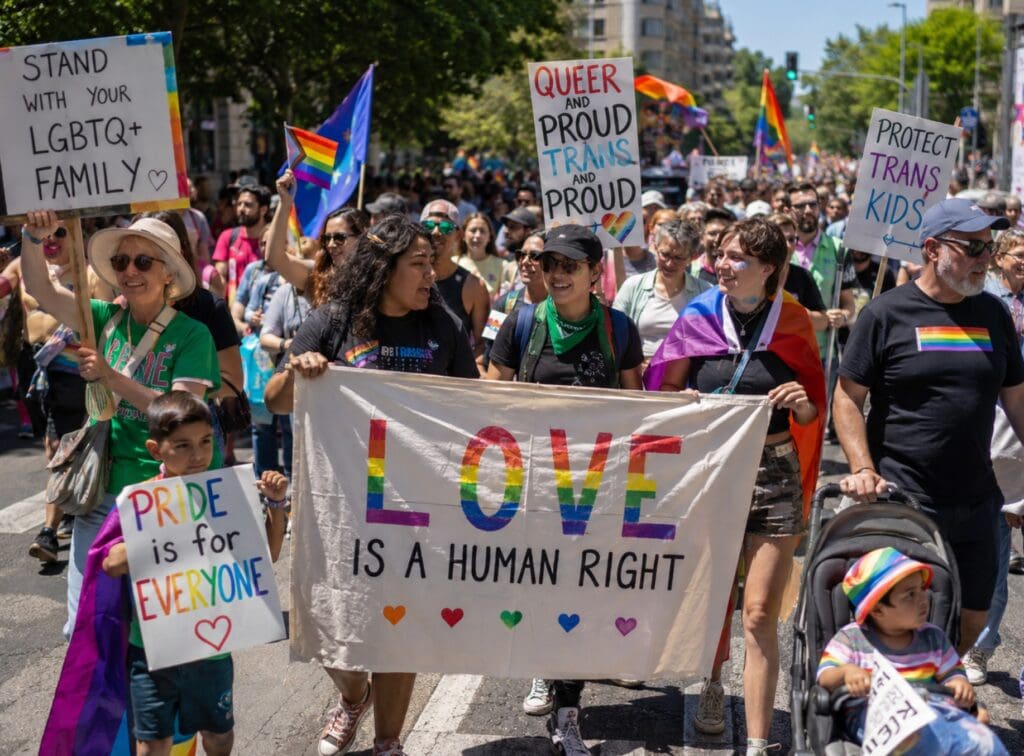
On June 28, 1970, activists in New York organized the Christopher Street Liberation Day March to commemorate the first anniversary of Stonewall. Other early marches took place in Chicago, Los Angeles, and San Francisco, helping establish what later became the global Pride tradition. (The Library of Congress)
Pride has always carried more than one meaning.
It can be:
- a civil-rights demonstration;
- a celebration of survival;
- a memorial;
- a festival;
- a declaration of visibility;
- a gathering place for isolated people;
- a way for organizations to offer resources;
- a reminder that legal progress is incomplete.
For one person, Pride may mean marching with a political group. For another, it may mean quietly seeing two people holding hands in public without fear.
The Rainbow Flag and Queer Visibility
The rainbow flag became one of the most recognizable symbols associated with gay and LGBTQ+ communities.
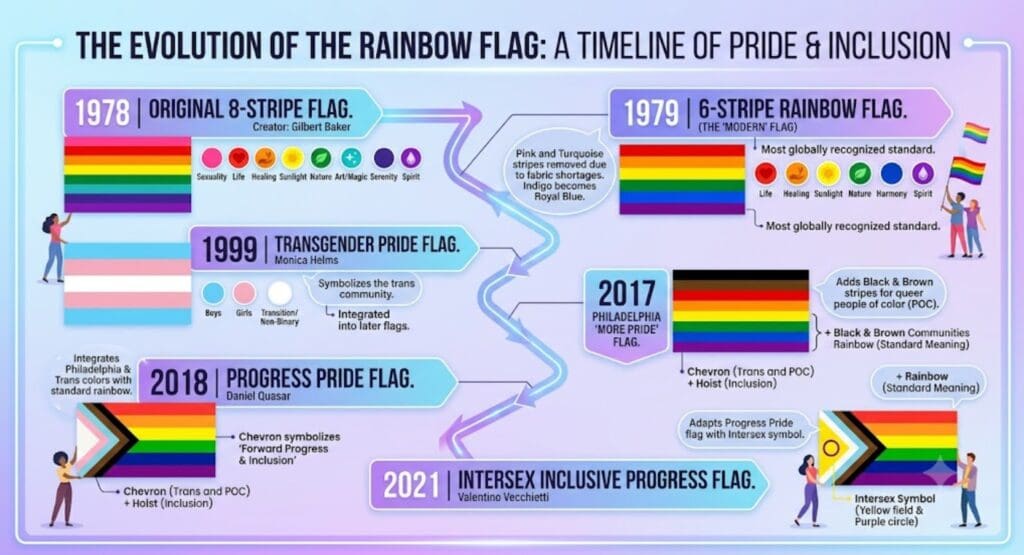
The Smithsonian’s National Museum of American History explains that the original eight-color flag was created collaboratively for San Francisco’s 1978 Pride celebrations. Gilbert Baker is strongly associated with the design, but volunteers including Lynn Segerblom and James McNamara also contributed to its creation. (Musée national d’histoire américaine)
The flag was different from earlier symbols of persecution and secrecy. Its color communicated visibility, possibility, and collective identity.
Since then, additional flags have emerged to represent bisexual, transgender, lesbian, nonbinary, intersex, asexual, pansexual, Bear, and other communities. Updated Pride designs have also emphasized the experiences of transgender people and LGBTQ+ people of color.
The HIV/AIDS Crisis and Gay Community History
Any serious account of modern gay history must address HIV/AIDS.
The first official U.S. reporting of what would later be recognized as the AIDS epidemic occurred in 1981. During the years that followed, gay communities experienced extraordinary loss, fear, stigma, and government neglect. At the same time, they built networks of care, political organizations, memorial projects, legal services, health programs, and public-education campaigns. (HIV.gov)
The crisis shaped generations of gay men and transformed activism, healthcare, art, relationships, and community memory.
It is equally important not to equate HIV with being gay. HIV can affect anyone, regardless of sexual orientation, gender, race, or place of residence. (HIV.gov)
Moreover, medical progress has dramatically changed what living with HIV means. HIV.gov states that people receiving effective care can now live long and healthy lives. (HIV.gov)
A responsible cultural history therefore remembers the people lost, honors survivors and caregivers, and avoids reviving the stigma that once treated illness as a moral judgment.
Gay Culture: Is There Really One?
There is no single gay culture. There are many gay cultures.
A gay man in a rural town may have a different relationship to community than someone living in New York, Lagos, São Paulo, Paris, Manila, or San Francisco. A Black gay community may develop cultural spaces in response to both racism and homophobia. A disabled gay person may encounter access barriers that an able-bodied person never notices. Religious gay people may combine faith and identity in ways outsiders incorrectly assume are impossible.
Therefore, phrases such as gay culture are most useful when they describe shared institutions, histories, artistic forms, language, and social practices—not when they imply that all gay people are alike.
Common Elements of Gay Cultural Life
Depending on place and generation, gay culture may include:
- community centers;
- Pride celebrations;
- bars and cafés;
- sports leagues;
- political organizations;
- choirs and performance groups;
- literature and film;
- drag and ballroom traditions;
- LGBTQ+ media;
- archives and museums;
- neighborhood businesses;
- online communities;
- health and mutual-aid organizations;
- religious groups;
- family networks.
Not every gay person participates in these spaces. Nevertheless, such institutions have often helped people find one another in societies where openness was discouraged or dangerous.
Bars as Social and Historical Spaces
Gay bars have played an important role in LGBTQ+ history because they offered rare opportunities for people to gather.
Before legal protections and online communication, bars could provide anonymity, recognition, friendship, information, and a sense of community. At the same time, they were often subject to police raids, organized crime, licensing discrimination, and public stigma. The National Park Service’s account of Stonewall describes how few safe public choices LGBTQ+ people had and how raids frequently involved humiliation and exposure. (Service National des Parcs)
Today, bars remain meaningful for many people, but gay community life is broader than nightlife. Bookstores, hiking groups, sports leagues, social apps, volunteer organizations, coffee shops, community centers, faith groups, and cultural festivals create different forms of connection.
A person who does not drink or enjoy clubs is not disconnected from gay identity.
Chosen Family
The phrase chosen family refers to relationships that function as family even when they are not based on biology or legal status.
Chosen families can include:
- close friends;
- former partners;
- mentors;
- neighbors;
- caregivers;
- community elders;
- younger people supported across generations.
These relationships became especially important when LGBTQ+ people were rejected by relatives or denied recognition as partners, parents, or caregivers.
SAGE, an organization serving LGBTQ+ elders, describes chosen family and shared intergenerational wisdom as longstanding parts of community life. (SAGE)
Chosen family is not evidence that all gay people are estranged from biological relatives. Many gay people have supportive parents, siblings, children, and extended families. Rather, the concept expands the meaning of family to recognize relationships created through loyalty and care.
Coming Out
Coming out means sharing or acknowledging one’s LGBTQ+ identity.
It is often described as a single dramatic event, but in real life it is usually a continuing process. A gay person may be open with friends but not coworkers, open in one country but private in another, or comfortable discussing identity without wanting it to define every conversation.
Coming out can bring relief, closeness, and a stronger sense of authenticity. It can also carry real risks involving employment, housing, religion, immigration, family support, or physical safety.
Research from the Williams Institute shows that many LGBTQ+ employees remain private about their identity at work and that discrimination continues even where legal protections exist. (Williams Institute)
Therefore, coming out should never be treated as a moral test.
No one owes disclosure to an unsafe family, employer, government, school, or social group. Privacy is not dishonesty when it is necessary for protection.
How to Respond When Someone Comes Out
A supportive response can be simple:
“Thank you for trusting me.”
“I care about you.”
“Is there anything you would like me to understand?”
Do not immediately ask intrusive questions. Do not tell other people without permission. Do not make the moment about your surprise, disappointment, or personal beliefs.
The person coming out should remain in control of their own information.
Gay Identity Across a Lifetime
Gay identity can feel different at different stages of life.
Adolescence and Early Adulthood
Younger people may have access to language and online representation that previous generations lacked. However, visibility does not automatically create safety. Young gay people may still experience bullying, family rejection, religious conflict, or pressure to define themselves before they are ready.
Questioning is a valid stage, not a failure to decide.
Adulthood
Adults may build relationships, careers, friendships, and families while navigating decisions about openness. Some become involved in LGBTQ+ organizations; others develop social worlds in which gay identity is present but not central.
There is no obligation to marry, attend Pride, use dating apps, or live in a traditionally gay neighborhood.
Later Life
Older gay people carry very different histories depending on their generation. Some lived through criminalization, employment bans, police raids, the HIV/AIDS crisis, and decades without legal recognition of their relationships.
SAGE emphasizes both the resilience of LGBTQ+ elders and the importance of community, advocacy, and dignified aging. (SAGE)
Intergenerational connection can prevent history from becoming abstract. Older people share memory; younger people contribute new language, expectations, and forms of organizing.
Neither generation should be treated as automatically wiser or more progressive. The healthiest communities allow learning to move in both directions.
Gay Men, Lesbians, Bisexual People, and Queer Identity
Related identities can overlap, but they are not synonyms.
Gay
Usually describes a person attracted primarily to the same gender, most commonly a man attracted to men.
Lesbian
Usually describes a woman attracted to women. Some nonbinary people also use lesbian.
Bisexual
Describes the capacity for attraction to more than one gender. Bisexuality does not require equal attraction to every gender, nor does a person’s current relationship determine whether they remain bisexual. (glaad.org)
Queer
Can function as an umbrella identity or describe an orientation or relationship to gender that resists rigid categories. Because it was historically used as an insult, not everyone is comfortable with it. It should not be applied to an individual who has not chosen it.
Asexual
Generally describes someone who experiences little or no physical attraction. An asexual person may still form romantic partnerships and may also identify as gay, lesbian, bi, or queer in relation to romantic attraction.
Labels are tools for understanding and communication. They should not become cages.
Intersectionality: Gay People Do Not Experience Identity in Isolation
A gay person’s life is also shaped by race, ethnicity, nationality, disability, income, religion, age, gender expression, immigration status, and location.
A white gay professional in an accepting city may experience social privilege that a low-income gay immigrant, a Black gay teenager, or a disabled gay elder does not. Similarly, a person may encounter homophobia in one community and racism or class prejudice within an LGBTQ+ space.
The Williams Institute’s research on workplace discrimination found that LGBTQ+ people of color and transgender or nonbinary workers reported higher rates of discrimination than white and cisgender LGBTQ+ workers in the same study. (Williams Institute)
This is why representation cannot stop at adding one affluent, white, conventionally attractive gay character to a campaign or television show.
A people-first understanding of gay identity must include people whose lives do not fit the most commercially visible image of the community.
Gay Subcultures and Community Language
Gay communities have developed subcultures based on shared aesthetics, social histories, geography, interests, and values.
Examples may include:
- Bear communities;
- leather communities;
- ballroom houses;
- gay sports groups;
- queer faith networks;
- gay men’s choruses;
- rural LGBTQ+ groups;
- cultural groups centered on race or nationality;
- sober social communities;
- gaming, arts, or outdoor groups.
Terms such as Bear, Cub, Daddy, and Twink may appear in some gay male social contexts. These words can help people find community, but they should not be treated as a compulsory ranking system.
A person is more than a category, body type, age, or style.
Digital Gay Culture
The internet changed how gay people find information and one another.
Online communities can be especially valuable for people who:
- live far from LGBTQ+ venues;
- are questioning their identity;
- have disabilities that make some physical spaces inaccessible;
- live in restrictive family environments;
- are seeking culturally specific communities;
- want friendship rather than nightlife.
Gay Dating and social apps also provide direct access to other gay people. However, they can reproduce racism, ageism, body judgment, harassment, and pressure to present oneself as a marketable profile.
Digital connection works best when it supplements rather than replaces a fuller sense of community. A message thread may begin a friendship, but shared activities, mutual support, and repeated contact often make relationships sustainable.
Gay Identity Around the World
The meaning and safety of being gay vary enormously by country and region.
In some places, gay couples can marry, raise children, serve openly in public institutions, and receive legal protection. Elsewhere, same-gender relationships remain criminalized, LGBTQ+ organizations face legal barriers, and public discussion is restricted.
According to ILGA World’s 2026 legal mapping, 65 United Nations member states criminalized consensual same-gender relations, while many others restricted LGBTQ+ expression or organizing. (ILGA World)
These laws affect whether people can safely use identity labels, attend community events, seek healthcare, or speak publicly.
As a result, public visibility should never be evaluated without considering local conditions. A person living privately under criminalization is not less authentic than someone marching openly at Pride.
Common Misconceptions About Being Gay
“You Can Tell Whether Someone Is Gay by Looking at Them”
No. Appearance, voice, clothing, hobbies, and mannerisms do not prove sexual orientation.
“All Gay Men Are Feminine”
No. Gay men express masculinity, femininity, and personality in countless ways.
“Gay People Cannot Have Families”
Gay people can be parents, stepparents, adoptive parents, foster parents, grandparents, guardians, or members of chosen families.
“Being Gay Is Only About Physical Attraction”
No. Gay identity can include love, companionship, emotional intimacy, family, culture, and community.
“Every Gay Person Loves Pride and Nightlife”
No. Some do; others prefer private social lives, outdoor activities, faith communities, sports, books, or family gatherings.
“A Person Stops Being Gay When Single”
No. Relationship status does not erase orientation.
“Gay and Transgender Mean the Same Thing”
No. Gay usually refers to sexual orientation; transgender refers to gender identity. A transgender person may be gay, straight, bisexual, queer, asexual, or use another orientation label. (glaad.org)
“Legal Equality Means Discrimination Is Over”
No. Laws matter, but discrimination can continue in workplaces, housing, families, schools, healthcare, and public life. Recent Williams Institute research found that LGBTQ+ workers continued to report discrimination and harassment despite federal employment protections. (Williams Institute)
What Does Self-Acceptance Look Like?
Self-acceptance does not always arrive as a dramatic moment of confidence.
Sometimes it looks like:
- saying the word gay privately for the first time;
- stopping the habit of correcting one’s own feelings;
- telling one trusted friend;
- finding a book or film that feels recognizable;
- entering a community space and realizing there are many ways to be gay;
- setting boundaries with people who are disrespectful;
- allowing identity to become ordinary rather than frightening.
Pride is often misunderstood as the claim that gay people are superior. In reality, it developed as a response to shame.
Its core message is not “I am better than you.”
It is:
“I should not have to disappear in order to be treated with dignity.”
How Allies Can Support Gay People
Support begins with ordinary respect.
Use the Right Language
Say gay person, not “a gay” or “a homosexual.” Use the identity and pronouns the person chooses.
Do Not Out People
Never disclose someone’s orientation without permission.
Challenge Casual Prejudice
Comments framed as jokes can still create hostile environments. Do not rely on the gay person present to challenge every remark.
Avoid Assumptions
Do not assume that a gay colleague is single, uninterested in children, politically uniform, or willing to answer personal questions.
Include Partners Naturally
Use the same social recognition you would give any couple. Invite partners, learn names, and avoid treating same-gender relationships as unusual.
Support Safety and Equality
Respect in private matters, but so do policies in workplaces, schools, healthcare systems, housing, and public institutions.
What Being Gay Means on a Human Level
For some people, being gay is a major source of culture, friendship, and pride.
For others, it is one quiet fact among many.
It can mean growing up without seeing one’s future reflected in familiar stories, then gradually discovering an entire history of people who built lives anyway.
It can mean learning that difference is not deficiency.
It can mean finding language for love, forming family in unexpected ways, inheriting community memories, and deciding which traditions should be carried forward.
It can also mean living an entirely ordinary life: going to work, worrying about bills, caring for relatives, arguing about household chores, planning vacations, and choosing what to cook for dinner.
That ordinariness is part of equality too.
Frequently Asked Questions
Gay describes a person who experiences romantic, emotional, or physical attraction primarily toward people of the same gender and identifies with that term.
The words can refer to similar patterns of attraction, but gay is generally the more respectful and commonly used identity term. Homosexual can sound clinical or outdated, particularly when used as a noun. (dictionary.apa.org)
Yes. Many women prefer lesbian, but some use gay. Personal preference should guide the language.
Yes. Some nonbinary people use gay to describe their attraction or cultural identity. Others prefer queer, bisexual, pansexual, lesbian, or another term.
People may choose a label or decide when to disclose their identity, but sexual orientation itself is not accurately described as a casual preference or lifestyle choice. (assets.glaad.org)
No. Attraction and self-understanding can exist without prior relationship experience. The National Academies distinguishes attraction, behavior, and identity as related but separate components of sexual orientation. (Académies des sciences et de la médecine)
No. The American Psychiatric Association removed homosexuality from its diagnostic manual in 1973, and contemporary scientific consensus does not classify gay orientation as a disorder. (Association Psychiatry)
No. Disclosure is personal and should be based on readiness, privacy, and safety.
No. There are overlapping gay cultures shaped by region, race, religion, age, class, disability, language, and personal interests.
About the Author
Alain VEST is an LGBTQ+ cultural journalist