Updated: July 2026
Table of Contents
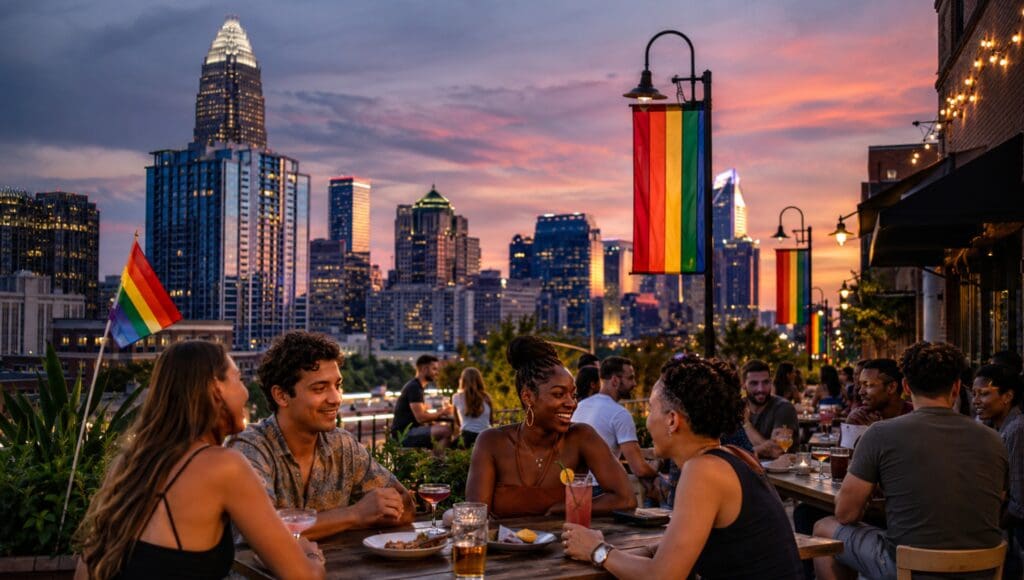
Charlotte’s LGBTQ+ life does not fit neatly inside one official gayborhood.
Charlotte, North Carolina Rainbow Index & Weather Dashboard
Charlotte has been recognized as an All-Star City by the HRC for its commitment to LGBTQ+ equality, despite being in a state with limited statewide protections.
Instead, it stretches across several neighborhoods, each offering a different way to experience the Queen City. NoDa brings murals, live music, coffee, drag, and an arts-district spirit. Plaza Midwood feels more intimate and eccentric, with vintage shops, neighborhood bars, performance spaces, and patios where conversations can last for hours. South End moves faster, mixing light-rail convenience, new apartments, breweries, fitness culture, rooftop energy, and some of Charlotte’s largest LGBTQ+ nightlife venues.
Meanwhile, Uptown becomes the community’s most visible stage during Charlotte Pride, when First Ward Park and Tryon Street fill with performers, nonprofits, families, vendors, health resources, and visitors from across the Carolinas.
That variety is the central appeal of gay Charlotte.
The city is large enough to support dance clubs, sports leagues, choirs, gaming communities, queer-owned businesses, HIV services, youth organizations, and one of the Southeast’s most significant Pride organizations. Nevertheless, it remains approachable enough that becoming a regular still matters.
A visitor can meet someone at Chasers, see them again at a Stonewall Sports game, and later recognize them at a Plaza Midwood market or Charlotte Pride event. For singles, that repetition provides an alternative to endless app swiping. For couples, Charlotte offers enough culture, food, parks, and nightlife to build a full weekend without turning every evening into a club marathon.
This guide is designed for LGBTQ+ travelers, solo visitors, couples, people considering relocation, and anyone who wants to understand Charlotte beyond generic lists of bars and brunch spots.
Gay Charlotte at a glance
🗺️ Charlotte LGBTQ+ Guide 30+ Spots
Explore Charlotte’s LGBTQ+ nightlife, queer-owned businesses, Pride locations, transit stations, community organizations, and recommended hotels. Click on any pin or list item to discover more!
Why Charlotte has become a major LGBTQ+ destination in the Southeast
Charlotte’s appeal comes from balance.
It has the scale of a large metropolitan city, yet its queer scene is still built around recognizable people, recurring events, and neighborhood institutions. It offers major nightlife without requiring visitors to spend every evening inside one entertainment district. It also attracts new residents from across North Carolina, South Carolina, Georgia, Virginia, and smaller Southern communities.
Charlotte Pride describes itself as one of the largest Pride organizations in the American Southeast. The organization reports that its annual celebration grew from roughly 10,000 visitors to approximately 260,000, becoming the largest LGBTQ+ celebration of its kind in the Carolinas and Charlotte’s largest annual parade. Its broader programming also includes Charlotte Trans Pride, Charlotte Latine Pride, Charlotte Women’s Pride, Reel Out Charlotte, scholarships, job programs, and interfaith events. Learn more through the official organization at charlottepride.org.
Still, Pride is only one part of the picture.
The year-round community also includes the Carolinas LGBT+ Chamber of Commerce, Stonewall Sports Charlotte, Charlotte Gaymers Network, One Voice Chorus, RAIN, and Time Out Youth. Together, these groups create ways to meet people through sports, music, gaming, business, health, volunteering, and community service rather than relying only on Gay dating apps or bars.
NoDa and Plaza Midwood: Charlotte’s creative queer hubs
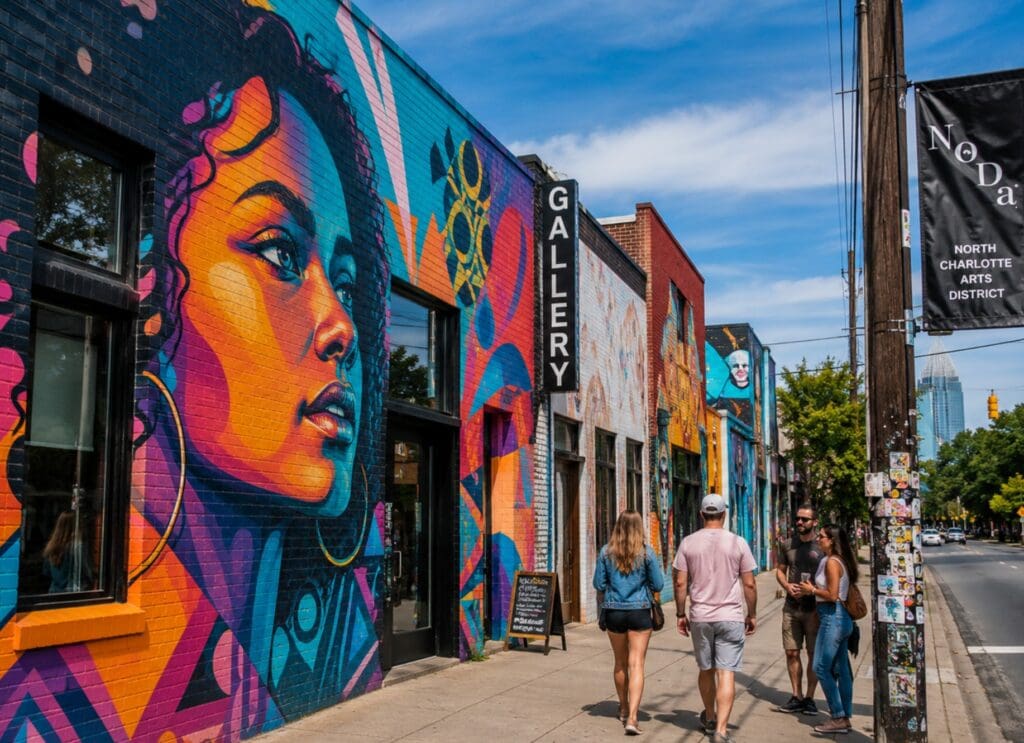
NoDa and Plaza Midwood are often grouped together because both feel artistic, independent, and welcoming. However, they are not interchangeable.
NoDa feels like an entertainment district built around art, music, cafés, breweries, murals, and converted commercial spaces. Plaza Midwood feels more like a long-established neighborhood where creative businesses, older homes, dive bars, restaurants, and local culture overlap.
In practice, NoDa is easier for a first-time visitor to navigate quickly. Plaza Midwood is better understood slowly.
NoDa: murals, music, coffee, and a visible creative community
NoDa takes its name from North Davidson Street, the neighborhood’s central corridor. Charlotte’s official tourism organization describes it as the city’s historic arts district, with murals, independent retail, breweries, music venues, and direct access from the LYNX Blue Line. Explore the official NoDa neighborhood guide.
What NoDa actually feels like
NoDa is busiest around North Davidson Street near the 36th Street light-rail station.
During the day, people move between cafés, tattoo studios, vintage shops, bakeries, galleries, and breweries. In the evening, the neighborhood shifts toward live music, cocktails, drag, karaoke, and nightlife.
The architecture is uneven in the best way. Older mill-era buildings sit beside newer apartments, while murals interrupt blank walls and side streets. Although development has made parts of NoDa more polished, the district still retains a sense that different scenes can share the same block.
You may see:
- a drag brunch crowd leaving one venue;
- indie-music fans waiting outside Neighborhood Theatre;
- friends sharing pizza at a brewery;
- someone working alone over coffee;
- a Bear Night gathering;
- couples wandering between murals and shops.
This overlap makes NoDa particularly comfortable for LGBTQ+ travelers who want visibility without being confined to an exclusively gay district.
The Artisan’s Palate: food, art, and intentional inclusion
The Artisan’s Palate is part restaurant, part cocktail and wine bar, and part rotating gallery.
Its official website states that the venue supports the LGBTQ+ community and that its staff is composed of women and LGBTQ+ people. It also exhibits local artists and has hosted charity drag events and community-focused programming.
The room feels more intimate than a food hall or brewery. Artwork gives the space a sense of personality, while the menu makes it appropriate for a proper date rather than a quick pre-club meal.
It works best for:
- brunch;
- a first date;
- dinner before Chasers;
- solo travelers who prefer sitting at a bar;
- visitors interested in local artists;
- small groups wanting conversation.
Check the event calendar before visiting because a normal dinner and a special drag or spirits event can feel like entirely different experiences.
Crown Station Coffee House & Pub
Crown Station combines coffee, beer, cocktails, art, live music, open-mic events, comedy, and community programming.
Charlotte’s LGBTQ+ and allied business guide highlights the venue’s casual daytime atmosphere and recurring events, including Bear-focused gatherings.
In the morning or afternoon, it works as a coffee stop. Later, it can feel more like a neighborhood pub or small performance space.
That gradual transformation makes it useful for visitors who dislike abrupt nightlife transitions. You can start with coffee or an early drink, then decide whether to stay for the evening programming.
Detour Coffeebar: queer-owned coffee without a fixed storefront
Detour Coffeebar operates as a mobile coffee shop, serving espresso drinks, tea, and creative non-coffee options at events and rotating locations.
Local business coverage has identified Detour as LGBTQ+-owned, while Charlotte’s official LGBTQ+ and allied guide continues to feature the business. Because it is mobile, checking the current schedule is essential.
Detour is particularly useful during:
- Pride events;
- neighborhood markets;
- corporate and community gatherings;
- pop-up weekends;
- outdoor festivals.
Rather than assuming a permanent location, follow the current calendar through its official site.
Chasers: high-energy queer nightlife with a neighborhood feel
Chasers sits at 3217 The Plaza, close to NoDa and Plaza Midwood.
The venue has served Charlotte’s LGBTQ+ community for decades and currently hosts dancing, karaoke, lip-sync events, themed parties, country nights, drag, and other recurring programming. Its official calendar is the most reliable way to understand the night’s atmosphere before going.
The Chasers vibe
Chasers feels more local and less polished than Charlotte’s large South End clubs.
Neon, go-go dancers, a compact dance floor, familiar faces, and rotating theme nights create an environment that can feel surprisingly social. Because the venue is smaller than Scorpio, the energy becomes concentrated quickly.
Earlier evenings are better for conversation. Later, the room becomes more dance-focused.
Chasers suits visitors who want:
- a classic neighborhood LGBTQ+ bar;
- theme nights;
- karaoke;
- drag;
- country-dance events;
- less corporate nightlife;
- the possibility of actually recognizing people from one night to the next.
Plaza Midwood: more eccentric, less programmed
Plaza Midwood is one of Charlotte’s strongest neighborhoods for queer visitors who value personality over polish.
The official neighborhood guide describes a community of murals, vintage retailers, tattoo shops, live music, independent food, breweries, and tree-lined residential streets. Explore Plaza Midwood through Charlotte’s tourism site.
The real Plaza Midwood rhythm
Plaza Midwood is not a single nightlife strip.
Instead, people move between restaurants, neighborhood bars, patios, music venues, vintage shops, record stores, and side streets. A successful evening usually includes two or three carefully chosen stops rather than a large bar crawl.
Compared with NoDa, Plaza Midwood feels:
- more residential;
- more irregular;
- less designed for visitors;
- stronger for repeat local habits;
- better for long conversations;
- more connected to Charlotte’s alternative music and performance communities.
Petra’s: performance, queer creativity, and Hazy Sundays
Petra’s is a live-performance venue, cocktail bar, and art space known for karaoke, jazz, indie music, dance parties, drag, and visual art.
Charlotte’s official guides highlight its LGBTQ+-friendly environment and the recurring Hazy Sundays, when DJs bring house music to the back patio on selected Sundays.
The most important thing to know is that Petra’s changes personality according to the event.
One evening may center live music. Another may feel like an art gathering. A Sunday afternoon may become a full patio dance party.
Therefore, Petra’s is best for travelers who enjoy:
- event-driven nightlife;
- queer and mixed crowds;
- local performers;
- smaller rooms;
- creative programming;
- afternoons that unexpectedly become evenings.
Hattie’s Tap & Tavern: a neighborhood patio rather than a gay club
Hattie’s is not formally designated as an exclusively LGBTQ+ bar. Nevertheless, it has become a favored gathering place for queer women, femmes, and mixed LGBTQ+ groups.
Charlotte’s tourism guide describes a relaxed neighborhood setting with local beer, a large dog-friendly patio, comedy, burlesque, drag, and themed events.
This is the place to choose when you want:
- a low-pressure drink;
- a patio;
- dogs;
- local beer;
- a more conversational night;
- community events without nightclub intensity.
Dish and Papi RickO: eating in Plaza Midwood
Dish has served comfort food in Plaza Midwood for more than two decades and remains useful for brunch, casual dinners, and Southern staples. Papi RickO, meanwhile, grew from a food-truck concept into a more permanent Latin-fusion destination. Both appear in Charlotte’s LGBTQ+ and allied business guide.
Dish is better when you want familiar, comforting food and an unhurried meal.
Papi RickO is better when you want louder flavors, a more playful atmosphere, and something that can lead naturally into an evening around Central Avenue.
South End: modern, fast-moving, and built around the light rail
South End feels almost opposite to Plaza Midwood.
The neighborhood follows the LYNX Blue Line and Rail Trail south from Uptown. Former textile and industrial spaces now sit beside breweries, luxury apartments, restaurants, fitness studios, offices, murals, rooftop bars, and shopping.
Charlotte’s official guide describes South End as a rapidly developing district connected directly to Uptown by light rail. Explore the official South End guide.
The South End vibe
South End is:
- social;
- young-professional-oriented;
- visually polished;
- convenient without a car;
- crowded on warm weekends;
- more trend-driven than NoDa or Plaza Midwood.
This is the neighborhood for people who want brunch, breweries, group activities, fitness culture, rooftop bars, and large nightlife venues.
It can also feel more anonymous. Unlike a small neighborhood bar, South End’s busiest spaces may process a steady flow of new faces. For visitors, that creates energy. For new residents, it can take more effort to move from social visibility to actual friendship.
Scorpio: Charlotte’s historic nightclub in a new era
The Scorpio is Charlotte’s oldest major LGBTQ+ nightclub institution.
After closing its longtime Freedom Drive location, Scorpio reopened at 225 Fairwood Avenue in the former RSVP complex. The current venue includes multiple rooms and bars, allowing different crowds and music styles to coexist under one roof. Its official site currently lists Friday and Saturday operating hours.
What Scorpio feels like
Scorpio is Charlotte nightlife at its largest and most theatrical.
Expect:
- major drag shows;
- touring performers;
- multiple rooms;
- DJs;
- crowded dance floors;
- rooftop or garden-style areas;
- groups arriving dressed for a full night out.
The building’s scale means that the experience can vary from one area to another. One room may feel dance-focused, while another offers more space to talk or watch the crowd.
Scorpio is best for:
- Pride weekend;
- major drag bookings;
- birthday groups;
- late-night dancing;
- people who want several atmospheres without changing venues.
Check ticketing and event details before arrival, because major shows may require advance purchase.
Bar Argon: queer karaoke, drag, and video-bar energy
Bar Argon operates at 4544 South Boulevard in Lower South End.
The venue presents itself as an LGBTQ+ video and dance bar, with karaoke, drag, themed nights, line dancing, leather-oriented events, Latin programming, and social gatherings. Its official event calendar publishes current schedules.
The Argon vibe
Argon feels flexible.
On one night, the room may center karaoke and laughter. On another, the energy becomes more dance-driven or themed. It is smaller than Scorpio and generally less overwhelming.
Argon is a strong choice for:
- karaoke fans;
- solo travelers;
- theme nights;
- casual dancing;
- visitors who prefer a venue where participation matters more than spectacle.
Sidelines Sports Bar & Billiards
Located beside Bar Argon, Sidelines offers an LGBTQ+ sports-bar environment with billiards, television screens, drinks, and a more relaxed social rhythm.
Its official site lists current hours and its South Boulevard address.
Sidelines is especially useful when:
- you want to talk rather than dance;
- you are meeting someone from an app for the first time;
- your group includes both clubgoers and non-clubgoers;
- you want to watch sports in an LGBTQ+ environment;
- you prefer pool tables to performance stages.
A practical South End night can begin at Sidelines and continue next door at Bar Argon.
The Rail Trail as a daytime social space
The South End Rail Trail runs alongside portions of the Blue Line and connects restaurants, public art, breweries, apartments, and shopping.
It is a useful place for:
- a morning walk;
- casual first dates;
- coffee;
- meeting before brunch;
- moving between venues without driving.
However, South End construction can temporarily change routes. CATS reported Blue Line and Rail Trail work during 2026, so check current alerts before relying on a familiar path.
Nightlife beyond the main districts
The Woodshed: leather, Bears, and community near the airport
The Woodshed is located in west Charlotte near the airport and is known for serving the leather, Bear, pup, and broader masculine queer communities.
Charlotte’s tourism guide describes a low-light bar, inexpensive drinks, pool, outdoor areas, and a leather shop component.
Because it is not near the main light-rail corridor, plan to use a car or rideshare.
The Woodshed is best for visitors who want:
- leather-community events;
- a Bear-oriented crowd;
- a less polished atmosphere;
- outdoor patio socializing;
- nightlife away from the trendier districts.
Starlight on 22nd
Starlight on 22nd sits between NoDa and Optimist Park and combines cocktails, craft beer, karaoke, trivia, open-mic programming, and drag events.
Charlotte’s official drag guide highlights Crown Kings performances and recurring themed nights.
The atmosphere is usually more casual than a nightclub and works well for small groups or visitors who want entertainment without a large dance floor.
A quick nightlife decision guide
Choose Scorpio when you want:
- a major nightclub;
- national and local drag talent;
- multiple rooms;
- a high-energy late night.
Choose Chasers when you want:
- a longstanding neighborhood queer bar;
- theme nights;
- dancing without a mega-club atmosphere.
Choose Bar Argon when you want:
- karaoke;
- themed programming;
- a flexible queer bar experience.
Choose Sidelines when you want:
- sports;
- billiards;
- conversation;
- a low-pressure meetup.
Choose Petra’s when you want:
- art;
- local music;
- queer creative culture;
- a strong event calendar.
Choose Hattie’s when you want:
- a neighborhood patio;
- a mixed LGBTQ+ crowd;
- a relaxed evening.
Choose the Woodshed when you want:
- leather and Bear community;
- a less polished, more subcultural experience.
Daytime explorations and cultural activities
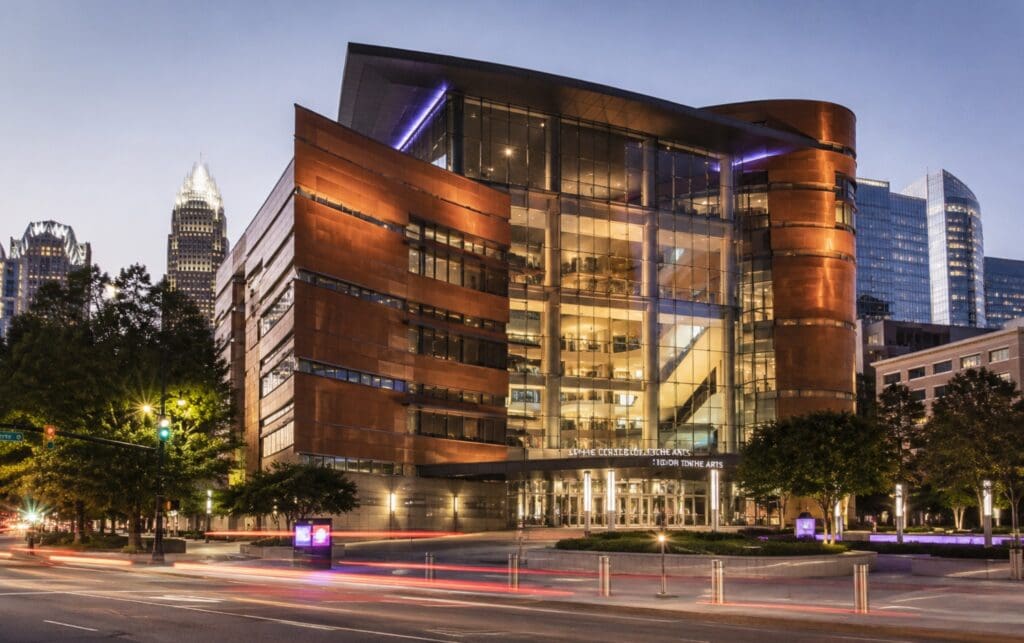
Charlotte offers enough museums, parks, public art, markets, and food halls to make nightlife optional rather than compulsory.
Levine Center for the Arts
The Levine Center for the Arts brings together three major Uptown museums within one compact area:
- Mint Museum Uptown;
- Bechtler Museum of Modern Art;
- Harvey B. Gantt Center for African-American Arts + Culture.
Charlotte’s tourism office recommends the museums as a walkable cultural cluster, making them easy to combine in one afternoon.
Mint Museum Uptown
Best for contemporary art, design, and a broad museum experience.
Bechtler Museum
Best for modern art and travelers who prefer a more focused collection.
Harvey B. Gantt Center
Essential for understanding Black art, history, identity, and culture in Charlotte and the broader region.
The Gantt Center is especially important because a complete LGBTQ+ travel guide should not treat queer life as disconnected from race, migration, regional history, or cultural power.
Romare Bearden Park
Romare Bearden Park offers skyline views, lawns, fountains, and easy access to Uptown hotels, Truist Field, and cultural attractions.
It is ideal for:
- a picnic;
- a short walk;
- an inexpensive date;
- sunset photographs;
- resting between museums and dinner.
Camp North End
Camp North End transformed former industrial facilities into a creative campus filled with food, art, retail, markets, events, and large outdoor gathering areas.
Charlotte’s official guide traces the site’s history from a Ford factory to military manufacturing and then to its current role as a cultural destination.
The site is particularly strong for groups because people can choose different food, drinks, and shopping without separating completely.
Check the calendar for:
- vintage markets;
- live music;
- cultural festivals;
- art installations;
- food and wine events;
- Pride-related programming.
U.S. National Whitewater Center
The Whitewater Center lies outside the central neighborhoods but offers rafting, trails, climbing, kayaking, cycling, and seasonal events.
It is a good addition for couples or friend groups who want a day outdoors, although it requires a car or rideshare and should be treated as a separate excursion rather than squeezed between Downtown appointments.
Charlotte’s queer community beyond nightlife
Stonewall Sports Charlotte
Stonewall Sports Charlotte organizes inclusive recreational sports and community events for LGBTQ+ people and allies.
The organization reports more than 2,000 annual players and describes itself as one of the largest LGBTQ+ sports organizations in the Carolinas.
For new residents, sports leagues are one of the most effective ways to overcome app fatigue because they create repeated, structured contact.
You do not have to be an elite athlete. The value comes from:
- consistent schedules;
- teammates;
- post-game gatherings;
- volunteering;
- meeting friends outside nightlife.
Charlotte Gaymers Network
Charlotte Gaymers Network is a volunteer-led nonprofit focused on inclusive gaming, technology, and community connection.
Its activities include video games, tabletop games, role-playing, and social events.
It is particularly valuable for:
- introverted newcomers;
- sober people;
- anyone who finds club environments overstimulating;
- residents seeking interest-based friendships.
One Voice Chorus
One Voice Chorus is Charlotte’s LGBTQIA+ and allies chorus.
The organization began in 1990 and uses choral performance to increase understanding and acceptance while creating a public cultural presence for LGBTQ+ people.
Concerts offer visitors a way to participate in queer cultural life without nightlife, while membership provides new residents with a recurring creative community.
RAIN
RAIN provides HIV services, prevention, testing, support, and stigma-reduction programming in the Charlotte region.
The organization offers free and confidential HIV and STI testing through walk-in or appointment services, with no insurance or payment required according to its current testing information.
RAIN is a community health institution, not a tourism attraction. Nevertheless, it is an important resource for travelers and residents who need affirming sexual-health support.
Time Out Youth
Time Out Youth serves LGBTQ+ young people ages 13 to 24 through counseling, housing support, community programs, leadership, and affirming services.
The center is intended for eligible youth rather than general tourism. Visitors should respect program boundaries while supporting the organization through donations, public events, or volunteer opportunities.
Carolinas LGBT+ Chamber of Commerce
The Carolinas LGBT+ Chamber maintains a current business directory covering restaurants, hotels, professional services, retail, healthcare, nightlife, and other sectors.
Because ownership and management can change, this directory is one of the best tools for verifying which businesses are currently participating in the LGBTQ+ business network.
Charlotte Pride: the city’s biggest queer weekend
The 2026 Charlotte Pride Festival and Parade are scheduled for August 15 and 16, 2026.
The festival takes place in and around First Ward Park, while the parade runs along North Tryon Street in Uptown on Sunday. The official program also includes arts and culture, a youth and family zone, community vendors, a health fair, a Charlotte Black Pride stage and dance tent, and accessibility measures including ASL interpretation and mobility-friendly event areas. Admission to the main festival and parade is free.
Current details are available at charlottepride.org/pride-festival.
What Pride weekend feels like
Pride transforms Uptown.
Hotels fill, rideshare prices rise, transit becomes more valuable, restaurants become crowded, and nightlife venues organize special programming.
The official Pride safety guidance identifies dehydration and heat exhaustion as common medical concerns. Visitors are advised to drink water, use sunscreen, take shade breaks, stay aware of their surroundings, and use a buddy system.
Practical Pride advice
- Stay near Uptown, NoDa, or the Blue Line.
- Avoid relying on surface parking near First Ward Park.
- Carry a refillable water bottle.
- Bring a portable phone battery.
- Wear shoes suitable for pavement and long periods of standing.
- Check bag rules before arrival.
- Do not bring pets into prolonged August heat.
- Plan one indoor break during the afternoon.
- Book major drag events early.
Where to stay
🏨 Charlotte Lodging Guide 20+ LGBTQ+-Friendly Stays
Compare LGBTQ+-friendly hotels, Airbnbs, and unique stays in Charlotte’s most vibrant neighborhoods: Uptown, South End, NoDa, and Plaza Midwood.
Uptown: best for Pride, museums, and a first visit
Uptown offers the largest hotel selection and the easiest access to Pride, museums, sports, the convention center, and transit.
Kimpton Tryon Park Hotel
Kimpton Tryon Park overlooks Romare Bearden Park and sits close to stadiums, restaurants, and major Uptown attractions.
It works well for:
- couples;
- luxury weekends;
- Pride travelers;
- visitors who want a rooftop bar;
- people attending sports or concerts.
The Ivey’s Hotel
The Ivey’s provides a boutique, design-focused stay near Blumenthal Performing Arts Center and central Uptown.
Choose it for:
- romantic weekends;
- quieter luxury;
- theater and arts;
- sophisticated cocktail spaces.
Uptown tradeoffs
Advantages:
- excellent location;
- easy Pride access;
- strong museum and event options;
- simple airport connection.
Disadvantages:
- higher prices during events;
- less neighborhood intimacy;
- some blocks become quiet outside business hours.
South End: best for nightlife and light-rail convenience
The Holiday Inn Express & Suites Charlotte–South End provides a practical base near the Rail Trail, restaurants, breweries, and Blue Line stations.
South End is ideal when:
- Scorpio is a priority;
- you want modern surroundings;
- you plan to use light rail;
- breweries and brunch matter;
- you prefer newer hotels.
However, Bar Argon and Sidelines sit farther south in LoSo, so rideshare may still be necessary.
NoDa: best for arts and local atmosphere
NoDa has limited traditional hotel inventory. Therefore, many visitors stay in Uptown and use the Blue Line to reach the neighborhood.
A carefully reviewed short-term rental may offer a more residential experience, but verify local rules, accessibility, recent reviews, and exact walking distance to the light rail.
Plaza Midwood: best for neighborhood character
Plaza Midwood also has limited conventional lodging.
Stay here only when you prioritize:
- Petra’s and Hattie’s;
- local restaurants;
- vintage shopping;
- a residential atmosphere;
- a quieter return after nightlife.
Otherwise, Uptown provides easier logistics.
Navigating the Queen City
🚇 Charlotte Transit Map LYNX · CATS · CLT
Navigate Charlotte’s public transportation system, including LYNX Light Rail, CATS buses, and key hubs like Charlotte Douglas International Airport (CLT), Uptown, and popular neighborhoods.
Charlotte is not fully walkable as a city, but several neighborhoods are highly walkable once you arrive.
The most practical strategy is to travel between neighborhoods by train, streetcar, bus, or rideshare, then explore each district on foot.
From Charlotte Douglas International Airport
The CATS Sprinter connects Charlotte Douglas International Airport with the Charlotte Transportation Center in Uptown.
The official CATS page currently lists service seven days a week, approximately every 30 minutes on weekdays, with a fare of $2.50. Verify schedules before traveling at CATS Sprinter Airport Connector.
Rideshare is preferable when:
- you arrive late;
- you have substantial luggage;
- your hotel is in Plaza Midwood or NoDa;
- you are traveling in a group;
- Pride or event road closures complicate transit.
LYNX Blue Line
The Blue Line is Charlotte’s most useful visitor transit route.
It connects:
- South End;
- Uptown;
- NoDa;
- University City;
- Lower South End areas through nearby stations.
Use it for trips between NoDa, Uptown, and South End rather than repeatedly paying for rideshare.
The current base local bus and rail fare is $2.20, with a $6.60 day pass listed by CATS. Check for changes at CATS Fares & Passes.
CityLYNX Gold Line
The Gold Line streetcar connects Historic West End, Uptown, Elizabeth, and the edge of Plaza Midwood.
CATS describes the current line as a four-mile route with 17 stops.
It can be useful for daytime travel toward Plaza Midwood, although service frequency and construction should be checked in real time.
Rideshare
Rideshare remains the most practical choice for:
- the Woodshed;
- late-night trips;
- Lower South End bars;
- Plaza Midwood after transit hours;
- the Whitewater Center;
- groups moving between distant venues.
During Pride, sports games, concerts, and weekend nightlife, walk a few blocks away from the busiest closure zone before requesting pickup.
Do you need a rental car?
You do not need a car for a weekend focused on:
- Uptown;
- NoDa;
- South End;
- Pride;
- museums;
- Plaza Midwood.
A car becomes useful when visiting:
- outer neighborhoods;
- the Whitewater Center;
- lakes;
- suburban communities;
- multiple destinations in one day.
Parking at hotels and nightlife venues can add significant cost, so calculate it before renting.
The best time to visit Charlotte
March through May
Spring provides comfortable patio weather, festivals, flowers, and easier neighborhood walking.
This is one of the best seasons for NoDa, Plaza Midwood, South End, and outdoor attractions.
June
June brings national Pride Month programming, drag events, community celebrations, and warm weather.
Charlotte’s primary Pride festival, however, takes place in August rather than June.
July and August
Summer is hot and humid. Charlotte Pride adds extraordinary energy in August, but visitors must plan hydration and indoor breaks.
Schedule outdoor activities in the morning or evening.
September through November
Fall is arguably Charlotte’s most comfortable season.
Patios remain active, humidity often becomes more manageable, and neighborhood festivals continue.
December through February
Winter is usually milder than in the Northeast or Midwest, but cold rain and occasional winter weather can disrupt plans.
This season is well suited to museums, restaurants, theater, cafés, drag, and indoor community events.
Dating in Charlotte: moving beyond the apps
Charlotte has an active digital dating scene. Nevertheless, geography can make app dating deceptive.
A profile listed as “nearby” may live across the city, in another part of Mecklenburg County, or over the state line in South Carolina. Traffic can turn a casual meeting into a significant commute.
Therefore, practical dating in Charlotte works best when the first meeting is tied to a neighborhood.
Good low-pressure date ideas include:
- coffee at a Detour pop-up;
- a walk through NoDa murals;
- a drink at Sidelines;
- dinner at Artisan’s Palate;
- a Hazy Sunday at Petra’s;
- museums in Uptown;
- Camp North End;
- the Rail Trail;
- a Stonewall Sports event;
- a Charlotte Gaymers gathering.
Why in-person community matters here
Charlotte’s scene is large but not anonymous enough to make behavior irrelevant.
People share friends, teams, venues, volunteer networks, and community organizations. Consequently, how someone treats others often becomes visible over time.
That can make dating healthier than a purely app-based environment.
Instead of asking only whether a city has enough profiles, ask whether it offers enough recurring spaces to see people as full human beings.
Charlotte does.
LGBTQ+ safety and legal context
Charlotte’s local nondiscrimination ordinance protects sexual orientation, gender identity, and gender expression in areas including public accommodations and employment. The City of Charlotte explains the ordinance and complaint process at charlottenc.gov/NDO.
However, local protections should not be confused with the full statewide legal environment.
The ACLU of North Carolina tracks current LGBTQ+ legislation and litigation, including 2026 legal developments affecting transgender people. Its current Know Your Rights guide for trans and nonbinary people was updated in May 2026.
Practical safety advice
At nightlife venues
- Keep your drink with you.
- Carry a valid government-issued ID.
- Verify age restrictions and cover charges.
- Arrange transportation before closing.
- Avoid leaving valuables visible inside a parked car.
- Meet app contacts in a public place.
- Share your location with someone you trust.
During Pride
- Hydrate continuously.
- Use sunscreen.
- Identify shade and indoor spaces.
- Keep your group connected.
- Avoid engaging with protestors.
- Know your exits and meetup location.
For trans and nonbinary visitors
- Review current state legal guidance before travel.
- Carry identification that matches travel bookings when possible.
- Save local affirming healthcare and community resources.
- Contact Time Out Youth only when eligible for its youth services.
- Use the ACLU of North Carolina’s current resources rather than older travel blogs.
A realistic three-day gay Charlotte itinerary
72 Hours in Gay Charlotte
A Queer Weekend Itinerary
Friday
South End Nightlife
Saturday
NoDa, Plaza Midwood & Creative Queer Culture
Sunday
Community & Uptown Culture
🌈 Alternative Sunday
- Stonewall Sports: LGBTQ+ recreational leagues.
- Charlotte Gaymers: Board game or video game meetups.
- One Voice Chorus: LGBTQ+ chorus performances.
- Pride Events: Public programs or gatherings.
Moving to Charlotte as an LGBTQ+ person
Charlotte can be a strong relocation choice for LGBTQ+ singles and couples, especially those who want a major Southern city without the scale or expense of the largest coastal markets.
However, choosing the right neighborhood will shape daily life.
Choose NoDa when you want:
- art;
- music;
- transit;
- walkability;
- a creative social scene.
Choose Plaza Midwood when you want:
- neighborhood character;
- queer-friendly bars;
- restaurants;
- vintage culture;
- a less corporate atmosphere.
Choose South End when you want:
- new apartments;
- light rail;
- fitness and brewery culture;
- large nightlife venues;
- fast-paced social energy.
Choose Uptown when you want:
- business access;
- museums;
- Pride;
- hotels;
- sports;
- transit connections.
Choose Dilworth or Elizabeth when you want:
- quieter residential streets;
- established homes;
- brunch and dining;
- proximity without living inside nightlife.
Building community after moving
The most effective first-month plan is simple:
- Attend one Carolinas LGBT+ Chamber event.
- Join one recurring sports, gaming, music, or volunteer group.
- Choose one neighborhood café or bar and return regularly.
- Attend a public Charlotte Pride program outside festival weekend.
- Build friendships without treating every interaction as a date.
In a city like Charlotte, familiarity creates opportunity.
Common mistakes first-time visitors make
Treating South End as the entire queer scene
South End has major clubs, but NoDa and Plaza Midwood offer more creative and neighborhood-based LGBTQ+ culture.
Calling Uptown “Downtown” in every conversation
People will understand you, but Charlotte’s central district is locally called Uptown.
Assuming every venue is near the light rail
The Woodshed, parts of Plaza Midwood, and several outer neighborhoods require rideshare or a car.
Visiting only during Pride
Charlotte Pride is extraordinary, but year-round events reveal the actual community.
Expecting every LGBTQ+ space to be a gay-male dance club
Charlotte’s queer life includes women-centered spaces, trans programs, leather culture, sports, choirs, gaming, youth services, arts, and sober community options.
Failing to check event calendars
Petra’s, Chasers, Argon, Scorpio, and neighborhood venues can feel completely different depending on the program.
Final verdict: why Charlotte deserves more attention
Charlotte is rapidly becoming one of the Southeast’s most complete LGBTQ+ city destinations.
It has large-scale Pride visibility without reducing queer life to one weekend. It has serious nightlife, but also sports, health services, youth support, music, gaming, business networks, cafés, museums, and neighborhood gathering places.
Most importantly, Charlotte provides several different versions of queer urban life.
NoDa is colorful and creative.
Plaza Midwood is eclectic and personal.
South End is modern and fast-moving.
Uptown is visible and event-driven.
The outer venues preserve subcultures that a polished entertainment district cannot replace.
For a visitor, that variety creates a memorable weekend.
For a new resident, it creates something more valuable: multiple ways to belong.
Charlotte’s queer heart is not hidden in one bar, one parade, or one neighborhood. It emerges through the connections between them.
About the Author
Alain VEST is LGBTQ+ travel journalist.
Their reporting focuses on LGBTQ+ neighborhoods, modern dating culture, nightlife, queer-owned businesses, community organizations, regional transportation, Pride events, and the ways Southern cities create inclusive spaces beyond traditional gay districts.
This guide was prepared using current information from Charlotte Pride, Charlotte’s official tourism organization, the City of Charlotte, CATS, the Carolinas LGBT+ Chamber of Commerce, official venue websites, RAIN, Time Out Youth, Stonewall Sports Charlotte, Charlotte Gaymers Network, One Voice Chorus, and the ACLU of North Carolina.
Venue schedules, business ownership, hotel availability, transportation service, event locations, and laws can change. Readers should verify essential details through the linked official sources before traveling.