Atlanta does not reveal its queer identity through one street alone. Instead, the city unfolds gradually: first through Midtown’s rainbow-painted crosswalks, then through the broad lawns of Piedmont Park, and afterward through clusters of neighborhood bars, queer theaters, feminist bookstores, Black LGBTQ+ cultural events, artist markets, and community fundraisers.
Table of Contents
At the same time, Atlanta’s LGBTQ+ geography is unusually dispersed. Midtown remains the historic and most visible heart of gay Atlanta; however, Ansley Square, Cheshire Bridge, Poncey-Highland, Edgewood Avenue, East Atlanta Village, Downtown, Decatur, Old Fourth Ward, and Boulevard Heights each contribute something different. Consequently, the city rewards travelers who understand its neighborhoods rather than attempting to treat the entire metropolitan area as one walkable entertainment district.
Buckhead, meanwhile, provides a deliberate contrast. Whereas Midtown feels public, social, and community-centered, Buckhead feels polished, retail-driven, and carefully curated. Its luxury hotels, designer storefronts, landscaped courtyards, and destination restaurants offer a more refined version of Atlanta hospitality.
Therefore, the best gay Atlanta itinerary does not force Midtown and Buckhead to compete. Instead, it uses both neighborhoods to reveal the city’s range.
Atlanta officially describes itself as the LGBTQ+ capital of the American South, while its municipal LGBTQ Affairs division supports community programs in areas including health, youth engagement, trans affairs, arts, economic development, and LGBTQ+ aging. Nevertheless, the claim that Atlanta has the South’s numerically “largest” gay community depends on how metropolitan populations and identities are measured. It is more accurate, therefore, to understand the title as a reflection of Atlanta’s exceptional regional influence, visibility, cultural infrastructure, and year-round LGBTQ+ life. (Atlanta GA)
Why LGBTQ+ Atlanta Cannot Be Reduced to a List of Bars
Atlanta’s nightlife is important; however, it is only one layer of the city’s queer identity.
For generations, LGBTQ+ people from smaller cities and rural communities throughout the Southeast have viewed Atlanta as a regional center where they could find work, friendship, organizing networks, cultural events, health resources, nightlife, and greater visibility. Moreover, Atlanta’s LGBTQ+ history includes Black gay institutions, lesbian gathering spaces, drag traditions, feminist organizing, queer arts movements, HIV/AIDS activism, leather communities, trans-led organizations, sports leagues, churches, bookstores, and public-policy work.
Accordingly, the City of Atlanta has begun formally documenting historically significant LGBTQ+ locations. That project is especially important because many gathering places have closed, relocated, or been threatened by redevelopment. In other words, queer Atlanta is not merely a contemporary marketing identity; it is part of the city’s documented social and architectural history. (Atlanta GA)
Black LGBTQ+ culture is equally fundamental. Bulldogs, Atlanta Black Pride, Southern Fried Queer Pride, ballroom communities, Black queer artists, and generations of organizers have shaped Atlanta’s national reputation. Therefore, visitors should avoid treating Black LGBTQ+ spaces as a separate or optional appendix to the city’s story. They are central to it. (Discover Atlanta)
Furthermore, lesbian, sapphic, trans, and nonbinary communities have created their own enduring institutions. My Sister’s Room has operated since 1996, while Charis Books and More has supported feminist, queer, and trans literature and organizing for more than half a century. Meanwhile, Southern Fried Queer Pride continues to produce arts programming that centers Black and QTPOC communities. (My Sister’s Room)
Gay Atlanta at a Glance
Base for a first visit: Midtown, particularly between Midtown MARTA station, Piedmont Park, and the intersection of 10th Street and Piedmont Avenue.
Neighborhood for luxury hotels and shopping: Buckhead, especially around Buckhead Village District, Lenox Square, and Phipps Plaza.
Best concentrated nightlife cluster: Ansley Square, where Atlanta Eagle, Mixx, Felix’s, and Oscar’s sit within the same general complex. (Discover Atlanta)
Best neighborhood for alternative queer nightlife: Edgewood Avenue and East Atlanta Village, particularly Lore and Mary’s.
Best daytime LGBTQ+ cultural stops: Charis Books and More, Out Front Theatre Company, FiNCA to FiLTER, Boy Next Door Menswear, the rainbow crosswalk, and rotating Southern Fried Queer Pride events.
Most practical airport connection: MARTA’s Red or Gold Line from ATL’s Domestic Terminal. A standard MARTA trip costs $2.50 and includes up to four free transfers within three hours. (itsmarta.com)
Most important planning principle: Group activities geographically. Atlanta’s traffic can turn an apparently short cross-city journey into a significant interruption.
Midtown: The Historic Heart of Gay Atlanta
Midtown is the most intuitive starting point because several versions of Atlanta overlap here.
Along Peachtree Street, office towers, hotels, theaters, restaurants, and apartment buildings create a dense urban corridor. Yet, only a few blocks east, old trees, residential streets, neighborhood patios, and Piedmont Park soften the skyline.
Consequently, Midtown feels metropolitan without becoming entirely concrete. Moreover, LGBTQ+ visibility appears as part of everyday life rather than as an isolated tourism product. Pride flags hang beside ordinary storefronts, queer venues share blocks with restaurants and apartment buildings, and the rainbow crosswalk functions as an active public intersection.
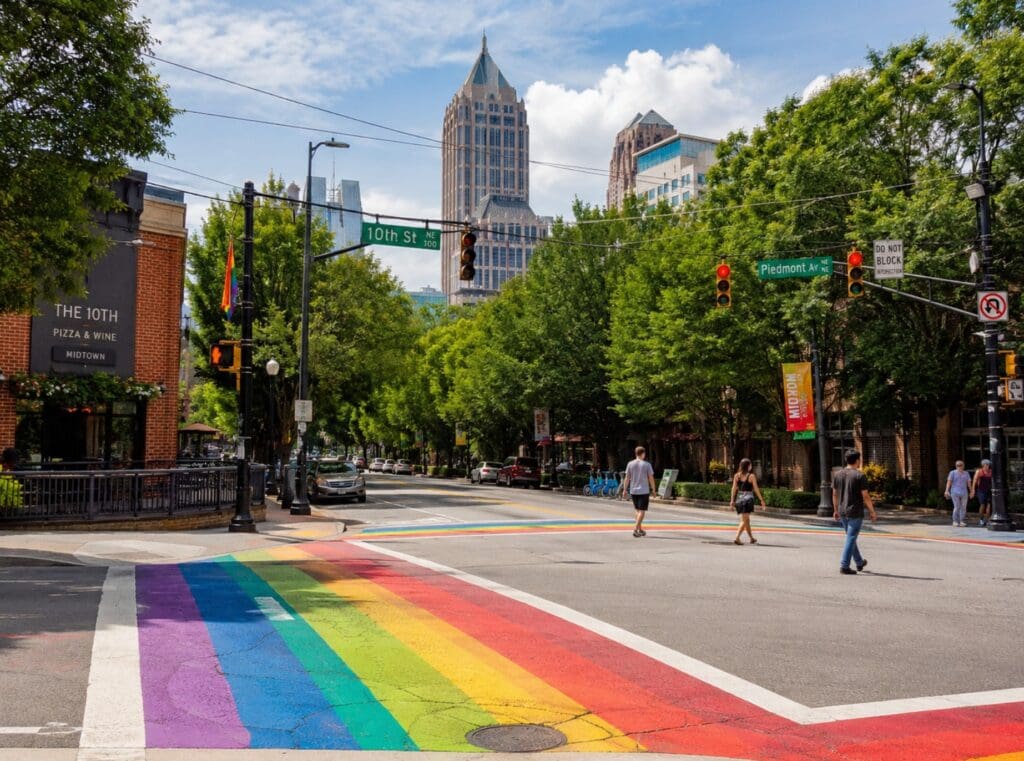
Walking the Rainbow Crosswalk at 10th and Piedmont
The rainbow crosswalk is not dramatic because of its scale. Rather, it is powerful because of its setting.
Traffic continues through the intersection. Pedestrians wait for the signal. Residents walk dogs toward Piedmont Park. Brunch groups stop for photographs before continuing along 10th Street. Meanwhile, the colors remain fixed within the rhythm of an ordinary Atlanta day.
That everyday quality matters. The rainbow is not hidden inside a private venue, nor is it installed only during Pride. Instead, it occupies a functioning Midtown intersection throughout the year.
The crosswalk first appeared temporarily in 2015 and became permanent in 2017. Furthermore, the Atlanta Pride Parade route passes directly across it. (Discover Atlanta)
For the easiest photographs, arrive during the morning. At that time, the light is generally softer, the sidewalks are calmer, and it is easier to compose a photograph without obstructing other pedestrians. Nevertheless, this remains a busy road. Therefore, wait for the pedestrian signal, remain alert for turning vehicles, and avoid lingering in the roadway.
From Midtown MARTA station, walk east along 10th Street. The route is straightforward, while the gradual transition from office buildings to neighborhood patios helps visitors understand Midtown’s layout. Midtown is served by both the Red and Gold lines and is MARTA’s closest rail station to Piedmont Park. (itsmarta.com)
The Daytime Atmosphere Around 10th and Piedmont
During the morning, the neighborhood feels comparatively unhurried. Coffee shops open, runners move toward the park, and restaurant patios begin filling gradually.
By late morning, however, the social energy becomes more visible. Friends gather for brunch, visitors stop at the crosswalk, and groups decide whether the afternoon will include the Botanical Garden, the High Museum, shopping, or simply a picnic.
Southern brunch in Atlanta is usually not designed to be rushed. Instead, it often functions as the main social event of the early afternoon. Consequently, a reservation is worthwhile on Saturday and Sunday, particularly during Pride, major festivals, holiday weekends, or warm-weather events in Piedmont Park.
Moreover, Atlanta’s summer humidity can be intense. Therefore, avoid building an itinerary that moves directly from a heavy brunch into several hours of exposed walking. A slower meal, followed by a shaded route toward the park, is usually more enjoyable.
Boy Next Door Menswear
Before entering the park, visitors interested in supporting a long-established LGBTQ+ business can stop at Boy Next Door Menswear at 1000 Piedmont Avenue. The store carries men’s clothing, swimwear, accessories, and Pride-oriented collections and sits close to the rainbow intersection. (Boy Next Door Menswear)
Although it is a retail stop rather than a community institution in the traditional sense, its location demonstrates how LGBTQ+ commerce is woven into Midtown’s daily streetscape. In addition, it provides a practical option for travelers who need an outfit or accessory before an evening event.
Piedmont Park: How to Experience Atlanta’s Queer Front Lawn
Piedmont Park begins only a short walk from the rainbow crosswalk. Nevertheless, the change in atmosphere feels immediate.
Traffic noise begins to fade, paths widen, and the Midtown skyline appears between trees instead of above storefronts. Because the park covers more than 200 acres, it offers enough space for both major festivals and quiet afternoons. The park is open daily from 6 a.m. until 11 p.m. (Piedmont Park Conservancy, Inc.)
Where to Enter and What to Bring
For a first visit, enter from the 10th Street side and continue toward Lake Clara Meer. From there, you can follow the water, cross the central lawns, or move toward the Atlanta Botanical Garden.
However, do not underestimate either the park’s size or Atlanta’s heat. Bring water, sunscreen, comfortable shoes, and a portable battery. Furthermore, if you plan to stay for several hours, use a restroom when one is conveniently nearby rather than assuming the next facility will be close.
Restrooms are located near Greystone, Noguchi Playscape, Legacy Fountain, the tennis center, the dog park, Charles Allen Gate, and Magnolia Hall. Their usual operating hours are 8 a.m. to 6 p.m., which are notably shorter than the park’s opening hours. (Piedmont Park Conservancy, Inc.)
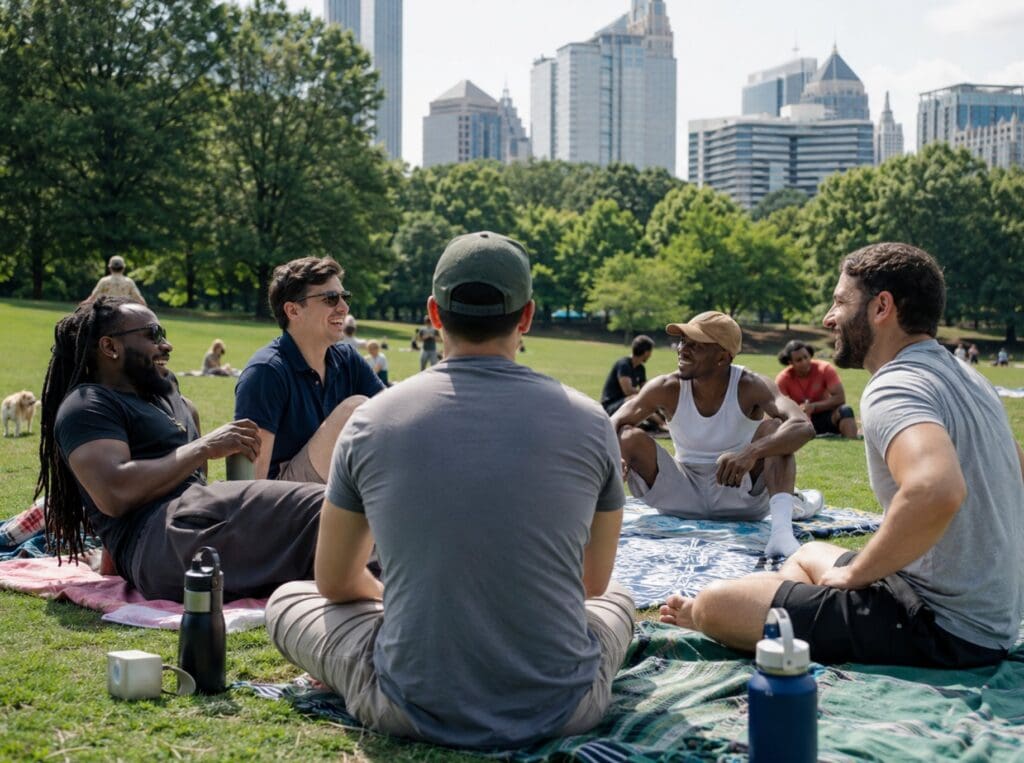
Planning a Picnic
Personal food and nonalcoholic beverages are permitted. Glass containers, however, are prohibited, while alcoholic beverages may be purchased and consumed only during appropriately permitted events. Therefore, reusable bottles, sealed takeout containers, and a lightweight picnic blanket are the most practical choices. (Piedmont Park Conservancy, Inc.)
For a quieter experience, move away from the busiest entrances and organized playing fields. On the other hand, if people-watching is part of the appeal, the lawns closer to the central paths provide a more social atmosphere.
Before arriving, check the park’s alerts and event calendar. Festivals, races, community gatherings, sports reservations, and construction can significantly change access. (Piedmont Park Conservancy, Inc.)
Why Piedmont Park Matters to LGBTQ+ Atlanta
Piedmont Park functions as far more than a convenient green space. It is the central site of the Atlanta Pride Festival, as well as a venue for Joining Hearts and other major community gatherings.
In 2026, the Atlanta Pride Festival is scheduled for October 10 and 11 in Piedmont Park. In addition, Joining Hearts’ principal 2026 fundraiser is scheduled at the park’s Greystone and Aquatic Center on July 25. (Atlanta GA)
Consequently, many LGBTQ+ Atlantans associate the park with community visibility, collective memory, fundraising, and celebration. Even on an ordinary afternoon, therefore, relaxing here provides more context than simply seeing another attractive urban park.
Midtown by Day Versus Midtown After Dark
During the day, Midtown is broad and mixed. Office workers, residents, families, museum visitors, runners, and brunch groups all share the same streets.
After dark, however, LGBTQ+ social life becomes more concentrated. Music carries through doorways, rideshares gather near active corners, and groups move between restaurants, shows, patios, and dance floors.
Nevertheless, Atlanta’s nightlife is not one continuous pedestrian strip. Some Midtown venues are close enough to combine on foot, while others sit around Ansley Square, Cheshire Bridge, Downtown, Edgewood Avenue, or East Atlanta Village.
Therefore, the most satisfying evening usually includes one main venue and one optional second stop. Attempting to visit six places often results in spending more time in traffic than inside the venues themselves.
Central Midtown LGBTQ+ Venues
Blake’s on the Park
Blake’s occupies one of the most visible locations in gay Atlanta, only steps from the rainbow crosswalk and Piedmont Park. It has operated for more than 35 years and combines music, food, DJs, live entertainment, and performances. Furthermore, its central position makes it a convenient starting point for first-time visitors who want a recognizable Midtown atmosphere without beginning the night far from their hotel. (Blake’s on the Park)
Earlier in the evening, conversation is generally easier. Later, especially on weekends, the space becomes busier and more performance-oriented. Consequently, arrive early when you want room to settle in, or arrive later when you specifically want a high-energy crowd.
Blake’s is restricted to guests aged 21 and older, and a valid government-issued photo ID is required. (Blake’s on the Park)
Bulldogs
Bulldogs, located at 893 Peachtree Street, has operated since 1978 and is widely considered Atlanta’s oldest continuously operating gay bar. Moreover, it has a particularly important place within Atlanta’s Black gay community, with music and dancing at the center of its identity. (Eater Atlanta)
Visitors should approach Bulldogs as a living community space rather than as a spectacle. In practice, that means respecting regular patrons, supporting the staff, and allowing the atmosphere to unfold naturally.
Because Bulldogs sits closer to the Peachtree corridor than the 10th-and-Piedmont cluster, it can be combined with Midtown dining or a nearby hotel stay. Nevertheless, late-night visitors should still consider a short rideshare rather than an unfamiliar walk.
X Midtown
X Midtown, formerly associated with the TEN name, operates at 990 Piedmont Avenue. It combines a large patio, drinks, food from Nellie B’s Chicken Shack, themed gatherings, DJs, and live entertainment. (xmidtown.com)
Because X sits only a few blocks south of the rainbow crosswalk, it can fit naturally into a central Midtown evening. Moreover, its patio offers a useful break when the interior becomes crowded.
Opening days vary, however, and the venue is closed on several weekdays. Therefore, review its current weekly schedule rather than assuming it operates every night. (xmidtown.com)
My Sister’s Room
My Sister’s Room is Atlanta’s longest-running lesbian bar and has served lesbian, sapphic, queer, and wider LGBTQ+ communities since 1996. Its programming includes karaoke, comedy, DJs, live shows, and community events. Furthermore, its official positioning emphasizes that everyone is welcome while retaining its identity as a lesbian-centered space. (My Sister’s Room)
The venue is located at 1104 Crescent Avenue, approximately three blocks from Midtown MARTA station. Consequently, it is one of the easiest LGBTQ+ nightlife venues to reach without a car. (My Sister’s Room)
Nevertheless, programming and hours can change during special events. A physical ID is required, and entry is limited to guests aged 21 and older. (My Sister’s Room)
Ansley Square: Atlanta’s Most Convenient LGBTQ+ Bar Cluster
Ansley Square sits north of Piedmont Park along Piedmont Avenue. Although tourism guides sometimes describe it as Midtown, it feels distinct from the 10th Street corridor.
Most importantly, several LGBTQ+ venues sit within immediate walking distance of one another. Therefore, this is Atlanta’s most practical area for bar-hopping without repeatedly ordering a car. The current cluster includes Atlanta Eagle, Mixx, Felix’s, and Oscar’s. (Discover Atlanta)
Atlanta Eagle
Atlanta Eagle identifies itself as a leather and queer bar serving the entire community. Its current venue includes regular programming such as cabaret, karaoke, trivia, country nights, Gaymer nights, and themed community events. Consequently, the experience can change substantially according to the calendar. (Atlanta Eagle)
Although the Eagle is rooted in leather and Levi culture, visitors do not need to belong to one particular subcommunity to attend ordinary programming. Nevertheless, specific event nights may have a stronger theme or audience. Therefore, consult the calendar before arriving.
The Eagle’s former home at 306 Ponce de Leon Avenue also carries major historical significance. That earlier location became a protected LGBTQ+ landmark, while the current business operates at 1492 Piedmont Avenue. (Discover Atlanta)
Mixx Atlanta
Mixx operates as a dining, lounge, dance, and entertainment complex at 1492 Piedmont Avenue. The venue emphasizes a diverse clientele, a stage, a main dance floor, televisions, food, and a glass-enclosed patio overlooking the BeltLine corridor. (Mixx Atlanta)
Because Mixx opens earlier than some dance-focused venues, it can work as a bridge between dinner and late-night entertainment. On the other hand, its weekend atmosphere becomes more energetic later in the evening.
Felix’s Atlanta
Felix’s, at 1510 Piedmont Avenue, is a long-established neighborhood bar with a compact interior, an outdoor patio, and recurring community events. Its official site describes more than two decades of operation, while current hours extend late into the night on most days. (Felix’s Atlanta)
Compared with a large club, Felix’s generally feels more informal. Therefore, it is a useful option for travelers who prefer conversation, familiar music, trivia, or a neighborhood-bar atmosphere.
Oscar’s Bar
Oscar’s sits beside Felix’s and operates as an LGBTQ+ martini and neighborhood bar with weekly entertainment. Because the venues are adjacent, travelers can easily compare the atmosphere of both without committing to a longer journey. (Eater Atlanta)
Earlier in the evening, Oscar’s is generally suited to a more conversational stop. Later, however, scheduled performances and music can change the energy.
Cheshire Bridge and the Armour Area
Historically, Cheshire Bridge Road formed another important corridor of gay Atlanta. Although redevelopment and business closures have changed the area, several LGBTQ+ venues remain nearby.
Because the streets are less comfortable for casual nighttime walking than central Midtown, rideshares are usually the simplest option.
The Heretic
The Heretic is one of Atlanta’s longest-established gay dance clubs. It is known for major DJs, a large dance area, themed events, and an outdoor deck. Furthermore, it retains strong ties to Atlanta’s leather and bear communities while welcoming a wider LGBTQ+ crowd. (Discover Atlanta)
The atmosphere depends heavily on the event. Consequently, travelers should check the night’s theme, ticket requirements, and opening time in advance rather than arriving with a generic expectation.
BJ Roosters
BJ Roosters operates at 2043 Cheshire Bridge Road and combines a bar, DJ-driven music, pool tables, a dance floor, and a patio. It is a 21-and-over venue and may feel more adult-oriented than a neighborhood pub, although it remains included here in neutral, SFW terms as a public LGBTQ+ nightlife business. (bj-roosters.wsite.top)
Because current information is less consistently maintained than for some larger venues, verify its hours directly before traveling.
Xion
Xion has been described as an after-hours option near the Heretic and BJ Roosters, with activity beginning after many standard bars close. However, because dependable official visitor information is limited, it should not be treated as a guaranteed stop without same-day verification. (Eater Atlanta)
Woofs Sports Bar
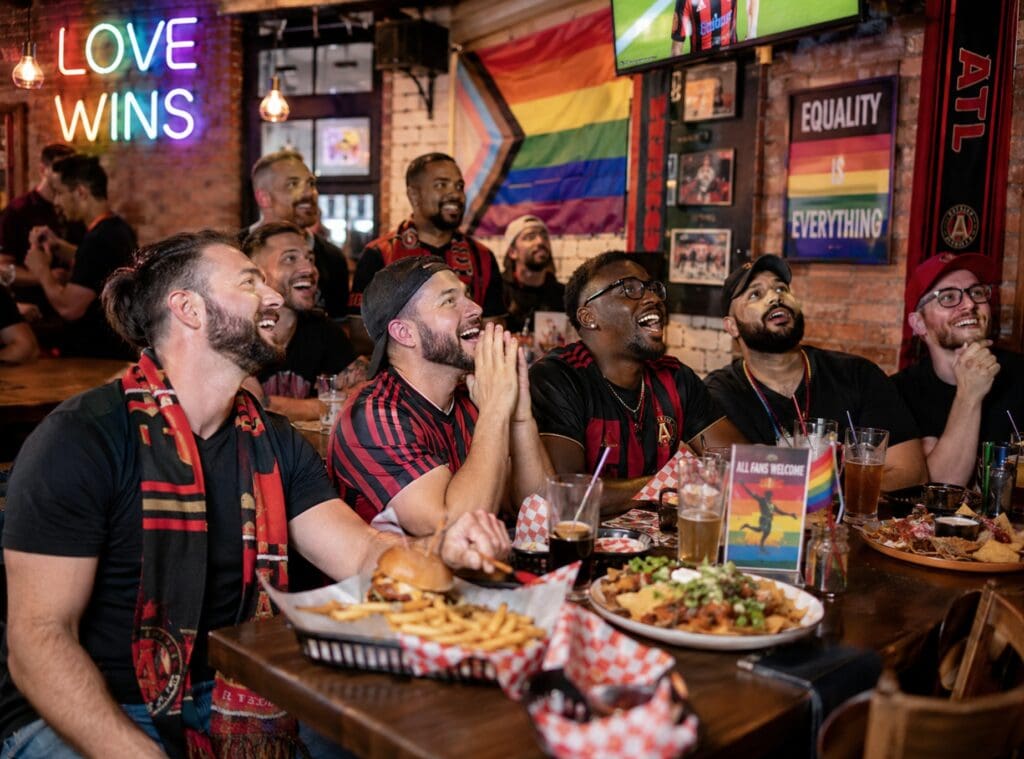
Woofs has served Atlanta’s LGBTQ+ sports community since 2002. Unlike a dance club, it centers food, televised games, darts, community fundraisers, and support for local LGBTQ+ sports organizations. (woofsatlanta.com)
Its current location is at 494 Plasters Avenue, away from the old Piedmont Road address still shown by some outdated directories. Consequently, travelers should use the official address rather than relying on older travel listings. (woofsatlanta.com)
Woofs works particularly well for solo travelers, sports fans, and visitors who want an LGBTQ+ environment where conversation remains realistic.
Poncey-Highland, Edgewood Avenue, and Old Fourth Ward
East of Midtown, Atlanta’s queer geography becomes more independent and less centered on the traditional gay-bar model.
Here, neighborhood dive bars, performance spaces, queer publications, artist collectives, and mixed-orientation gathering places overlap. Consequently, this part of the city often feels younger, more alternative, and more event-dependent.
Friends on Ponce
Friends on Ponce operates at 736 Ponce de Leon Avenue. Its official site emphasizes a relaxed, inexpensive, neighborhood atmosphere, with karaoke and recurring social events among its regular programming. (Friends)
This is a useful alternative when a crowded dance club feels too demanding. Moreover, pool tables, a jukebox, and familiar regulars create a more informal environment than many central Midtown venues. (Eater Atlanta)
Lore
Lore, at 466B Edgewood Avenue, is one of Atlanta’s newest dedicated queer venues. It describes itself as an LGBTQIA+ third space, bar, and live-events venue. In addition to evening dance parties and performances, it offers food, cocktails, mocktails, a patio, gender-neutral bathrooms, and recurring daytime or early-evening programming. (Lore Atlanta)
This broader programming matters. Whereas many nightlife venues come alive only after dark, Lore deliberately creates opportunities for brunches, karaoke, community gatherings, and lower-pressure social time.
Consequently, Lore is particularly useful for mixed groups, visitors who do not drink, and travelers who want queer community without committing immediately to a late-night club experience.
Sister Louisa’s Church of the Living Room and Ping Pong Emporium
Located beside Lore, Sister Louisa’s is not exclusively an LGBTQ+ bar. Nevertheless, it has a long-standing queer-friendly reputation, an intentionally camp visual identity, karaoke, games, and an eclectic crowd. (Discover Atlanta)
Because it is not a dedicated LGBTQ+ venue, the crowd can vary greatly. However, its proximity to Lore makes it a convenient supplementary stop rather than a separate journey.
FiNCA to FiLTER
FiNCA to FiLTER is a queer, woman-owned Atlanta coffee business with current locations in Old Fourth Ward and Boulevard Heights. Both locations emphasize community, inclusion, locally roasted coffee, and regular events. (FiNCA to FiLTER)
The Old Fourth Ward café at 652 Angier Avenue is especially useful for visitors exploring the BeltLine, while the Boulevard Heights location at 680 Hamilton Avenue shares its site with Side Saddle, a wine bar. (FiNCA to FiLTER)
Consequently, FiNCA provides a valuable daytime alternative to nightlife-centered LGBTQ+ tourism.
East Atlanta Village: Queer Nightlife With a Neighborhood Edge
East Atlanta Village feels different from Midtown almost immediately.
The streetscape is smaller, more independent, and less polished. Restaurants, music venues, tattoo studios, neighborhood bars, and late-night food spots sit close together. Therefore, the area works well for travelers who prefer creative neighborhoods to corporate entertainment districts.
Mary’s
Mary’s is the neighborhood’s central gay institution. Located at 1287 Glenwood Avenue, it combines karaoke, DJs, recurring performances, themed evenings, and a compact dance floor. Its official weekly schedule includes Wednesday karaoke, Thursday performances, Friday video programming, and rotating Saturday DJs. (marysatlanta.com)
The space is intimate rather than enormous. Consequently, it can feel lively very quickly once the crowd builds.
Because East Atlanta Village is not directly served by MARTA rail, a rideshare is generally the simplest option. Moreover, arrange the return journey before leaving Midtown, particularly on weekend nights when demand and prices can increase.
Downtown Atlanta: Large-Scale LGBTQ+ Entertainment
Future Atlanta
Future Atlanta operates within Underground Atlanta and offers a much larger club experience than most neighborhood bars. Discover Atlanta describes a two-story venue combining dining, drag cabaret, major DJs, and large-scale parties. (Discover Atlanta)
Consequently, Future is better suited to travelers seeking a full production, a large stage, and a destination-night atmosphere than to those who want a quiet drink.
Its Downtown location also makes it convenient for visitors staying near major convention hotels, State Farm Arena, or Mercedes-Benz Stadium. Nevertheless, event tickets, covers, and schedules should be confirmed in advance.
Additional LGBTQ+ and Queer-Friendly Entertainment
Lips Atlanta
Lips combines dining with drag-focused entertainment and scheduled shows. It is located on Buford Highway rather than in Midtown, so it works best as a reserved destination rather than an improvised stop. (Eater Atlanta)
Because it also attracts private celebrations and mixed groups, the atmosphere differs from a community neighborhood bar. Nevertheless, it remains an important part of Atlanta’s public drag-entertainment landscape.
City Winery
City Winery is not an exclusively LGBTQ+ venue. However, it regularly hosts queer-oriented events, including Wussy-produced themed brunches and performances. Therefore, visitors should treat it as an event-dependent option and check the calendar rather than visiting solely because of the venue name. (Discover Atlanta)
Plaza Theatre, 7 Stages, Aisle 5, and Little Five Points Venues
These are not permanent LGBTQ+ institutions; however, they regularly host Southern Fried Queer Pride screenings, markets, workshops, performances, and community gatherings.
For example, the 2026 Southern Fried Queer Pride festival used 7 Stages, Aisle 5, the Plaza Theatre, the Little Five Points Community Center, and outdoor space along Euclid Avenue. Consequently, a current event calendar is more useful than a static list when exploring Atlanta’s queer arts scene. (Southern Fried Queer Pride)
LGBTQ+ Arts, Books, Shops, and Community Spaces
A deeper Atlanta guide must move beyond places serving drinks.
Out Front Theatre Company
Out Front Theatre Company exists specifically to tell stories about LGBTQIA+ experiences and to give LGBTQIA+ artists a platform through theater and performance. It operates at 999 Brady Avenue in West Midtown. (outfronttheatre.com)
Because schedules change by production, book tickets around the current season. Furthermore, allow time for a meal in West Midtown rather than treating the theater as a quick detour from central Midtown.
Charis Books and More
Charis Books and More, in Decatur, describes itself as the South’s oldest independent feminist bookstore. Founded in 1974, it carries LGBTQIA+, queer, and trans books throughout its collections and works alongside the nonprofit Charis Circle to support social-justice programming. (charisbooksandmore.com)
The store sits beside Agnes Scott College rather than directly on Decatur Square. Therefore, check the walking or local transit route after arriving in Decatur.
Nevertheless, Charis is one of the city’s most meaningful daytime LGBTQ+ destinations because it connects literature, feminism, queer history, and community organizing.
Southern Fried Queer Pride
Southern Fried Queer Pride is an Atlanta-based arts organization that centers Black and QTPOC communities. Rather than operating as a single permanent attraction, it produces exhibitions, markets, workshops, performances, film screenings, meals, and community discussions across different venues. (Southern Fried Queer Pride)
Consequently, visitors should follow the organization’s calendar before traveling. A well-timed SFQP event can provide a more locally grounded experience than a generic evening assembled from tourism lists.
Atlanta’s Emerging LGBTQ+ Community Center
Atlanta is developing a next-generation LGBTQ+ community-center initiative intended to create a permanent space for connection, care, culture, and community services. The project remains an initiative rather than a completed visitor attraction; therefore, travelers should not expect a fully operating central facility yet. (AFCRA – LGBTQ –)
Nevertheless, its development reveals an important truth: despite Atlanta’s enormous LGBTQ+ influence, the metropolitan area has lacked the kind of centralized brick-and-mortar community center found in many smaller cities.
Buckhead: Upscale Dining and Southern Charm
Buckhead provides the sharpest contrast to Midtown.
Whereas Midtown’s identity emerges through public parks, neighborhood gathering places, Pride landmarks, and walkable cultural pockets, Buckhead expresses itself through luxury hotels, landscaped retail districts, destination dining, and high-touch service.
However, Buckhead should not be misrepresented as Atlanta’s second gayborhood. It does not have Midtown’s concentration of explicitly LGBTQ+ venues. Instead, it gives LGBTQ+ travelers a polished place to stay, shop, dine, and celebrate.
Understanding Buckhead’s Layout
Buckhead is not one single pedestrian district. Rather, it consists of several commercial and residential areas.
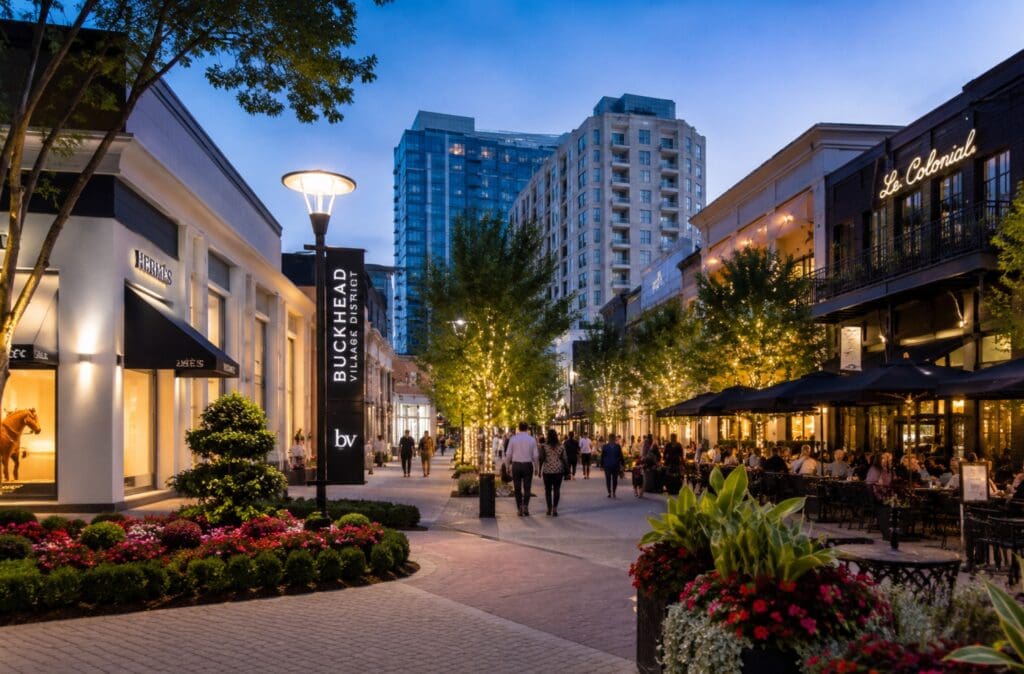
Lenox Square and Phipps Plaza form the largest luxury-shopping cluster. Meanwhile, Buckhead Village District covers eight walkable blocks of boutiques, restaurants, landscaping, and public spaces. (Discover Atlanta)
Although the Buckhead Village complex itself is designed for walking, the broader neighborhood remains car-oriented. Consequently, walking from Buckhead MARTA station to every major attraction is not always comfortable, particularly in hot weather or formal clothing.
What Buckhead Feels Like During the Day
During the day, hotel lobbies fill with meetings, shoppers move between major brands, and restaurants host long lunches. Furthermore, service tends to be more formal than in Midtown’s neighborhood restaurants.
For a balanced visit, combine one retail area with a cultural stop. The Atlanta History Center, for example, adds historical context and gardens to an otherwise commerce-heavy itinerary. Buckhead also includes PATH400 and Chastain Park for travelers who want green space away from Midtown. (Discover Atlanta)
Buckhead After Dark
After dark, Buckhead becomes more dressed-up. Destination restaurants, rooftops, lounges, and hotel bars replace Midtown’s casual movement between neighborhood venues.
Consequently, Buckhead is an excellent place for the trip’s most important dinner. Nevertheless, traffic makes timing important. A restaurant only a few miles from Midtown can still require a surprisingly long drive during peak periods.
Should LGBTQ+ Travelers Stay in Buckhead?
Choose Buckhead when luxury accommodation, shopping, spas, and quieter mornings matter more than walking to gay nightlife.
Choose Midtown, however, when your priorities are Pride landmarks, Piedmont Park, museums, LGBTQ+ venues, and the ability to complete more of the day on foot.
Ultimately, many travelers will find the strongest balance by staying in Midtown and reserving one carefully planned Buckhead afternoon and evening.
Planning Your Trip: ATL Airport, MARTA, and Rideshares
Hartsfield-Jackson Atlanta International Airport is approximately 10 miles south of Downtown Atlanta. During normal traffic, the drive may take around 20 minutes; however, rush-hour conditions, construction, weather, and large events can increase that time substantially. (atl.com)
Therefore, avoid making a nonrefundable restaurant reservation immediately after landing.
Taking MARTA From the Domestic Terminal
MARTA’s Airport station is located at the west end of the Domestic Terminal between the North and South baggage-claim areas. Both Red and Gold Line trains travel north through Downtown and Midtown. (atl.com)
The standard fare is $2.50, with up to four free transfers within three hours. Furthermore, MARTA’s Better Breeze system now supports updated fare media and contactless payment options. (itsmarta.com)
Midtown is reached directly by either the Red or Gold Line. Buckhead, however, is served by the Red Line. MARTA lists the average journey between Buckhead station and the airport at approximately 32 minutes, before platform waits and walking time. (itsmarta.com)
Arriving at the International Terminal
After collecting luggage at the International Terminal, Atlanta-bound passengers cannot directly enter the secured concourse system to reach the Domestic Terminal. Instead, the airport provides a free 24-hour international shuttle connector.
The shuttle journey to the Domestic Terminal’s ground-transportation area takes approximately 15 minutes and provides access to MARTA. (atl.com)
MARTA Operating Hours
MARTA currently lists standard rail hours as approximately 4:45 a.m. to 1 a.m. on weekdays and 6 a.m. to 1 a.m. on weekends. However, track work and major events can alter frequency and routing. (itsmarta.com)
Therefore, check real-time service alerts before leaving a venue, especially late at night or on weekends.
When MARTA Is Best
Use MARTA for airport transfers, journeys between Downtown, Midtown, and Buckhead, and major events that create extensive road closures.
In addition, MARTA is particularly useful during Atlanta Pride because parking around Piedmont Park is limited and traffic becomes heavier.
When a Rideshare Is Better
Use a rideshare for East Atlanta Village, Cheshire Bridge, Plasters Avenue, Buckhead Village, West Midtown, and late-night travel between venue clusters.
Moreover, a rideshare is usually worthwhile when carrying luggage, wearing formal clothing, traveling during heavy rain, or moving through areas with wide roads and uncomfortable pedestrian crossings.
Nevertheless, avoid requesting a car for every movement within central Midtown. Between Midtown station, Crescent Avenue, 10th Street, the rainbow crosswalk, and the western side of Piedmont Park, walking can be faster.
ATL · LGBTQ+ Transit & Nightlife
A Four-Day LGBTQ+ Atlanta Itinerary
Day One: The Midtown Introduction
Begin with brunch in Midtown. Afterward, walk east along 10th Street, photograph the rainbow crosswalk responsibly, and browse Boy Next Door Menswear.
Then, continue into Piedmont Park, circle Lake Clara Meer, and spend time on the lawns. Later, choose either the Atlanta Botanical Garden or the High Museum of Art.
In the evening, start with Blake’s, X Midtown, or My Sister’s Room. Finally, keep a second nearby venue optional rather than mandatory.
Day Two: Ansley Square and LGBTQ+ Culture
Begin slowly with coffee or a relaxed lunch. Next, visit Out Front Theatre, Charis Books, or a current queer exhibition.
Afterward, head toward Ansley Square. Because Atlanta Eagle, Mixx, Felix’s, and Oscar’s are clustered together, you can compare several atmospheres without repeatedly using rideshares.
Nevertheless, check each event calendar first. One venue may suit conversation, while another may be focused on a particular performance or theme.
Day Three: Buckhead in Style
Travel north by MARTA, then choose between Lenox Square, Phipps Plaza, Buckhead Village District, and the Atlanta History Center.
Later, return to your hotel before dinner. Because Buckhead rewards preparation, make this the evening for a meaningful reservation rather than attempting to improvise at peak time.
Day Four: Eastside Queer Atlanta
Start at FiNCA to FiLTER in Old Fourth Ward or Boulevard Heights. Then, explore the BeltLine, Edgewood Avenue, Little Five Points, or a Southern Fried Queer Pride event.
In the evening, choose Lore for queer programming or Mary’s for an East Atlanta neighborhood-bar experience.
🗺️ ATL · 4-Day LGBTQ+ Itinerary
This final day provides a valuable counterpoint to Midtown. Whereas Midtown represents Atlanta’s established gay geography, the Eastside demonstrates how queer culture continues to evolve through art, independent businesses, and event-led communities.
Major LGBTQ+ Events
Atlanta Pride
The 2026 Atlanta Pride Festival is scheduled for October 10 and 11 in Piedmont Park. Because it is one of the city’s largest annual events, visitors should reserve accommodation early and expect road closures, crowded trains, restaurant waits, and higher rideshare prices.
Atlanta Black Pride
Atlanta Black Pride takes place around Labor Day weekend and includes a wide range of cultural, community, wellness, advocacy, and social programming.
Rather than assuming every event happens in Midtown, consult the official schedule carefully. Programming is typically distributed across hotels, clubs, community spaces, and neighborhoods throughout metropolitan Atlanta.
Southern Fried Queer Pride
Southern Fried Queer Pride’s principal festival takes place in June, although the organization produces events throughout the year. In 2026, festival programming included artist markets, film screenings, workshops, performances, and intergenerational community gatherings across Little Five Points and nearby venues. (Southern Fried Queer Pride)
Joining Hearts
Joining Hearts raises money for HIV/AIDS prevention, care, and housing assistance. Its 2026 calendar includes events at Atlanta Eagle, Heretic, Piedmont Park, and Colony Square. (Joining Hearts)
Current LGBTQ+ Atlanta Venue Directory
The following public-facing locations were verifiable through official sites or recent Atlanta visitor and dining guides as of July 2026.
Dedicated LGBTQ+ Bars, Clubs, and Entertainment Venues
🏳️🌈 Atlanta · LGBTQ+ Venues
- Atlanta Eagle — Ansley Square; leather and queer bar with varied community programming.
- BJ Roosters — Cheshire Bridge; bar, music, games, and adult nightlife in a public 21+ setting.
- Blake’s on the Park — Midtown; long-running gay bar near the rainbow crosswalk.
- Bulldogs — Midtown; historic gay bar with an important place in Black gay Atlanta.
- Felix’s Atlanta — Ansley Square; informal neighborhood bar.
- Friends on Ponce — Poncey-Highland; relaxed neighborhood gay bar.
- Future Atlanta — Downtown; large LGBTQ+ club and cabaret venue.
- The Heretic — Cheshire Bridge; long-established gay dance club.
- Lore — Edgewood Avenue; dedicated queer bar, third space, and performance venue.
- Mary’s — East Atlanta Village; gay neighborhood bar with karaoke and rotating programming.
- Mixx Atlanta — Ansley Square; lounge, food, dancing, and entertainment.
- My Sister’s Room — Midtown; lesbian-centered and broadly queer-inclusive venue.
- Oscar’s Bar — Ansley Square; LGBTQ+ martini and entertainment bar.
- Woofs Sports Bar — Plasters Avenue; LGBTQ+ sports bar and restaurant.
- X Midtown — central Midtown; patio, food, events, and late-night entertainment.
- Xion — Cheshire Bridge area; after-hours venue whose current schedule should be checked directly.
- Lips Atlanta — Buford Highway; reservation-based drag dining and entertainment.
These locations are supported collectively by official venue pages, Discover Atlanta’s current nightlife directory, and Eater Atlanta’s October 2025 update. (Discover Atlanta)
LGBTQ+ Cultural, Community, Retail, and Daytime Places
- Rainbow Crosswalk at 10th and Piedmont
- Piedmont Park, particularly as the home of Atlanta Pride
- Out Front Theatre Company
- Charis Books and More
- FiNCA to FiLTER, Old Fourth Ward and Boulevard Heights
- Boy Next Door Menswear
- Southern Fried Queer Pride events
- Atlanta Pride events
- Atlanta Black Pride events
- Joining Hearts events
- Atlanta LGBTQ+ public-art and historic-preservation sites
- The developing Atlanta LGBTQ+ Community Center initiative
Event-Dependent Queer-Friendly Venues
- Sister Louisa’s Church
- City Winery
- Plaza Theatre
- 7 Stages
- Aisle 5
- The Supermarket
- Little Five Points Community Center
- Colony Square, particularly during Joining Hearts and Pride-related events
These are not all permanent LGBTQ+-exclusive spaces. Instead, their relevance depends on the event calendar. (Discover Atlanta)
Venues Requiring Additional Status Verification
Older Atlanta guides may still mention The Hideaway, Midtown Moon, or former addresses for businesses that have moved. Because I could not verify sufficiently dependable, current official operating information for every older listing, they should not be presented as guaranteed destinations.
Likewise, several directories continue to show Woofs at an outdated Piedmont Road address, whereas its official site lists 494 Plasters Avenue. (woofsatlanta.com)
This distinction is important: a shorter verified directory is more useful than an apparently exhaustive list that sends travelers to closed or relocated businesses.
Inclusive Travel and Personal Safety
Atlanta’s LGBTQ+ community includes people of different races, genders, ages, body types, disabilities, incomes, and cultural backgrounds. Therefore, avoid entering any venue with assumptions about who should be there.
Moreover, Black gay venues, lesbian bars, trans-centered arts events, and leather-community spaces are not themed attractions created for outsiders. They are community institutions with regulars, histories, and social norms.
Accordingly, treat staff respectfully, tip service workers and performers appropriately, and ask permission before photographing people at close range.
When meeting someone through a social or dating app, meet publicly first, maintain control of your transportation, and share your plan with a trusted person. Furthermore, verify the vehicle and license plate before entering a rideshare.
These precautions are not unique to Atlanta. Rather, they are sensible practices in any large city.
Meet LGBTQ+ Atlantans Through BEARWWW
Atlanta becomes more meaningful once the city is connected to real conversations.
Before arriving, open BEARWWW and explore profiles in Midtown, Buckhead, East Atlanta, Decatur, Old Fourth Ward, and the wider metropolitan area. Then, rather than opening with a generic message, mention a genuine interest: Southern food, queer history, art, sports, Piedmont Park, bookstores, Pride, or Atlanta’s neighborhood culture.
Moreover, a first meeting does not need to begin in a nightclub. Suggest coffee at FiNCA to FiLTER, brunch in Midtown, a public walk through Piedmont Park, a visit to Charis Books, a museum afternoon, or a group evening at Woofs.
By connecting through shared interests, BEARWWW can turn a static itinerary into a more personal Atlanta experience. Nevertheless, communicate clearly, respect boundaries, meet publicly, and keep control of your return journey.
Join us. Sign up now 🔥




Final Thoughts
Gay Atlanta is not one intersection, even though the rainbow crosswalk offers its most recognizable image.
Instead, the city exists in transitions.
The journey moves from a bustling Midtown brunch to the shade of Piedmont Park, contrasts an old neighborhood bar with a new queer arts venue, and traces the path from historic Black gay institutions to emerging trans- and QTPOC-centered creative spaces. It also highlights the difference between central Midtown’s vibrant community life and Buckhead’s refined, upscale hospitality.
Furthermore, Atlanta rewards patience. Because traffic discourages frantic movement, the city is best experienced by giving each neighborhood enough time to develop its own rhythm.
Therefore, do not attempt to “complete” gay Atlanta in a weekend. Walk the crosswalk when the signal changes. Sit beneath the park’s trees. Support a queer-owned business. Reserve one memorable dinner. Attend an event created by the community itself. Above all, leave enough room for the city to surprise you.
About the Author
Alain VEST is an LGBTQ+ travel journalist and lifestyle writer.
