Last updated: 31 July 2026
Table of Contents
What you need to know
- Canal Street and the surrounding Gay Village form Manchester’s principal LGBTQ+ district, within a short walk of Manchester Piccadilly.
- Via, The Molly House, New Union, New York New York and Oscars offer very different nights; choose by atmosphere rather than trying to visit every venue.
- Sackville Gardens is essential, not optional: it contains the Alan Turing Memorial, the Beacon of Hope and the National Transgender Memorial.
- Manchester Village Pride runs from 28 to 31 August 2026, with its parade on Saturday 29 August and free community programming on Monday.
- Stay around Canal Street, Piccadilly, Kampus or Portland Street when walking home easily matters more than saving a small amount on accommodation.
Manchester’s Gay Village is one of Britain’s most practical LGBTQ+ city-break destinations: compact, walkable, culturally significant and close to a major railway station. Start at Sackville Gardens, explore Canal Street before dark, eat properly, then choose one or two venues that suit your preferred pace.
Manchester’s queer scene also extends beyond the Village. Alternative club nights, trans-led events, LGBTQ+ arts, sober gatherings and community programmes take place across the Northern Quarter, Salford and Greater Manchester. Nevertheless, Canal Street remains the clearest starting point for a first visit. (Visit Manchester)
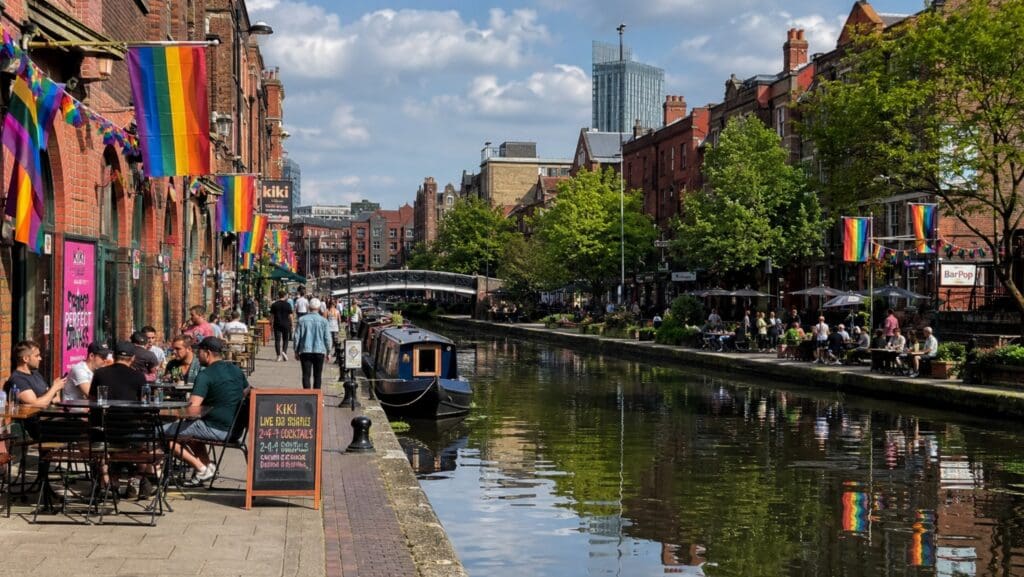
Manchester’s Gay Village is centred on Canal Street, beside the Rochdale Canal and immediately south of Chinatown. Its practical boundaries extend across Richmond Street, Bloom Street, Sackville Street, Chorlton Street and Princess Street, approximately between Manchester Piccadilly, Piccadilly Gardens and St Peter’s Square. (Visit Manchester)
Canal Street provides the Village’s most recognisable image: red-brick buildings, canal-side terraces, rainbow flags and a dense concentration of bars. However, several important venues sit on the neighbouring streets rather than directly beside the water.
Useful orientation points include:
- Canal Street: Via, Oscars, The Brewers and several terraces;
- Richmond Street: The Molly House, Richmond Tea Rooms and the traditional G-A-Y address;
- Bloom Street: New York New York, The Eagle and The Goose;
- Princess Street: New Union Hotel and the route towards Chinatown;
- Sackville Street: Sackville Gardens and LGBT Foundation;
- Kampus: restaurants, gardens and modern accommodation immediately beside the Village.
Where should you arrange to meet?
“Meet me on Canal Street” is insufficient during a busy Saturday or Pride weekend.
Use a specific landmark:
- the Alan Turing statue in Sackville Gardens;
- the entrance to Via;
- the Canal Street sign beside New Union;
- the Richmond Tea Rooms entrance;
- a named hotel lobby;
- Manchester Piccadilly’s main concourse before walking together.
Sackville Gardens is especially visible, although it becomes very busy during major events and closes under ordinary park rules from dusk until dawn. (Manchester City Council)
Canal Street became a queer meeting area partly because industrial decline left the Rochdale Canal corridor quiet and poorly overlooked. After the partial decriminalisation of sex between men in England and Wales in 1967, more LGBTQ+ venues gradually opened and formed the recognisable Gay Village. (Visit Manchester)
The street itself dates to the construction of the Rochdale Canal in 1804. As Manchester’s cotton economy changed, warehouses and waterside streets lost some of their original industrial purpose. Quiet towpaths, railway arches, underpasses and poorly lit streets then offered anonymity to people whose relationships could result in arrest, blackmail or violence. (Visit Manchester)
What role did the New Union play?
The building now known as New Union Hotel and Show Bar dates from 1865 and became associated with gay customers before modern legal equality. The location allowed customers to use nearby underpasses and move through the area discreetly when police surveillance was a serious concern. (Visit Manchester)
Its importance is not that it remained unchanged. Rather, it demonstrates how a venue can move through several social identities: neighbourhood pub, discreet meeting place, show bar, club and LGBTQ+ hotel.
How did Queer as Folk change the Village?
Russell T Davies’s Channel 4 drama Queer as Folk, first broadcast in 1999, introduced millions of viewers to a fictionalised version of Canal Street. Its club Babylon was filmed using real Manchester locations, and visitors subsequently arrived looking for the programme’s venues. (Visit Manchester)
The programme did not create the Village. However, it altered its visibility, tourism and cultural status. Canal Street became simultaneously:
- a working LGBTQ+ neighbourhood;
- a nightlife destination;
- a television landmark;
- a symbol of urban regeneration;
- a place where queer history risked being reduced to entertainment.
That tension still matters. The Village welcomes visitors, but it is not an LGBTQ+-themed attraction detached from the people who live, work and organise there.
Manchester Piccadilly is the simplest arrival point for most visitors. The Village is close enough to walk from the station with manageable luggage. Piccadilly Gardens and St Peter’s Square are useful Metrolink alternatives, while direct trains connect Manchester Airport with Piccadilly in about 20 minutes. (National Rail)
How do you walk from Manchester Piccadilly to Canal Street?
From the main station concourse:
- follow the city-centre exit;
- descend towards London Road or Piccadilly;
- continue towards Sackville Street;
- use Sackville Gardens as the principal landmark;
- cross through or around the gardens to Canal Street.
The correct route depends on which station exit is open and where your accommodation sits. Rather than relying on a memorised turn-by-turn route, save the hotel or first venue and check live pedestrian directions.
The walk is short, but rolling suitcases can become awkward on uneven paving, kerbs and crowded streets.
Which Metrolink stop is closest?
There is no stop named “Canal Street”.
The most useful choices are:
- Manchester Piccadilly: best for rail connections and the eastern Village;
- Piccadilly Gardens: practical for the northern end, Chinatown and Portland Street;
- St Peter’s Square: useful for Princess Street and the western side;
- Manchester Oxford Road railway station: potentially useful for hotels south-west of the Village.
Visit Manchester lists St Peter’s Square as approximately 0.37 miles from the Village and identifies Manchester Piccadilly and Oxford Road as the nearest mainline stations. (Visit Manchester)
Manchester Oxford Road does not provide the same level of step-free access as Piccadilly, which has step-free Category A access to every platform, lifts, accessible toilets and a Changing Places facility. (National Rail)
How do you travel from Manchester Airport?
Direct trains from Manchester Airport to Manchester Piccadilly usually take around 20 minutes and run frequently throughout the week. The airport railway station is connected to the terminals by covered walkways. (Manchester Airport)
Metrolink also serves Manchester Airport. However, the tram is generally slower for reaching the Village because it follows a longer route before entering central Manchester. It can still be useful when staying elsewhere on the network. Airport trams normally run every 12 minutes, subject to service changes. (Manchester Airport)
Airport decision guide
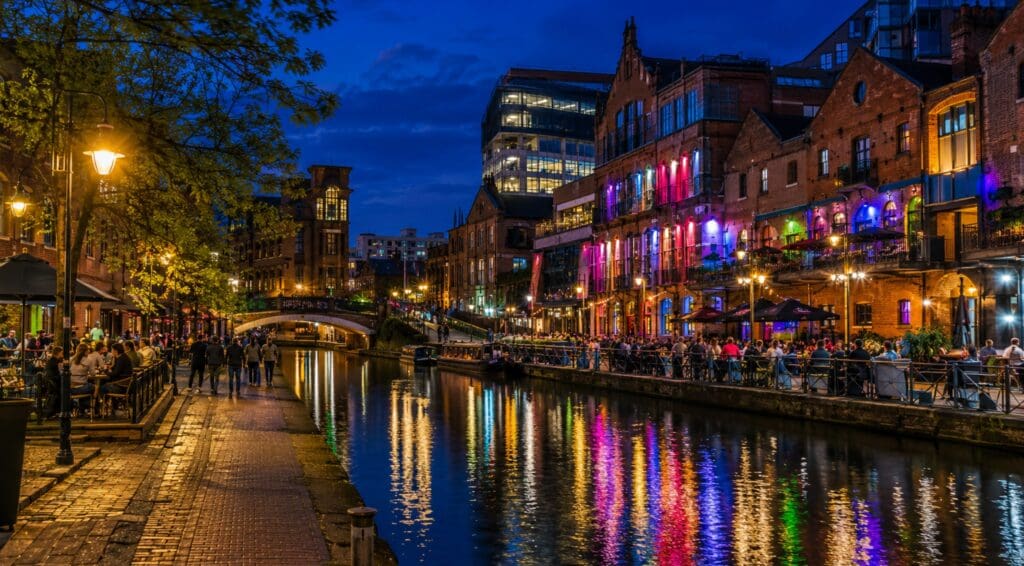
Canal Street is calmest in the morning, socially active from lunch and significantly louder after dark. Daylight is best for understanding the geography and memorials; Friday and Saturday nights bring fuller terraces, door queues and a more mixed crowd of locals, tourists and celebration groups. (Visit Manchester)
What is Canal Street like during the day?
The canal provides a clear visual edge, so the street is easier to understand than many nightlife districts. One side contains terraces and venue entrances; the other follows the Rochdale Canal.
Our preferred first visit would begin before 17:00. That timing allows you to:
- identify the main streets without crowds;
- visit Sackville Gardens in daylight;
- check venue access and entrances;
- have coffee or lunch;
- recognise the route back to the hotel;
- avoid treating the Village solely as a night-time product.
In summer, Canal Street operates as an outdoor social space as much as a bar district. In July 2026, Manchester City Council also began trialling expanded protected seating on parts of Bloom Street and Richmond Street, accompanied by road-layout changes. (Manchester City Council)
What changed on Bloom Street and Richmond Street in summer 2026?
The trial created additional outdoor seating:
- on Bloom Street between Abingdon Street and Chorlton Street;
- on Richmond Street between Sackville Street and Chorlton Street.
Bloom Street became one-way in the relevant section, while part of Richmond Street closed to through traffic. Visitors should therefore expect mapping applications, taxi drop-off points and old articles to lag behind temporary street changes. (Manchester City Council)
What is Canal Street like after dark?
The Village becomes busier in stages rather than at one precise hour.
- Early evening: dinner, after-work drinks and conversation;
- around 21:00: drag, DJs and bar-focused entertainment build;
- after 23:00: queues, dance venues and late licences become more relevant;
- after 02:00: choices narrow and transport planning matters more.
The atmosphere can feel liberating to a first-time visitor because rainbow flags and same-gender couples are visible without explanation. At the same time, Canal Street now attracts many non-LGBTQ+ visitors. That broad popularity brings economic support, but it can also produce tension when large groups treat queer spaces as novelty nightlife. Visit Manchester describes the area as packed with both LGBTQ+ and heterosexual visitors during busy weekends. (Visit Manchester)
The strongest all-round recommendations are Via for a classic Canal Street evening, The Molly House for conversation, New Union for drag and late opening, New York New York for DJs, Oscars for show tunes, Vanilla for lesbian nightlife and The Brewers for pop-led dancing. Programmes should be checked by date.
The table describes relative atmosphere rather than guaranteed admission, music or door prices. Private events, Pride, football fixtures and university calendars can change a venue’s crowd dramatically.
Choose The Molly House for an unhurried drink, Via for a complete first-night introduction, New Union for cabaret and late energy, New York New York for accessible dancing, Oscars for show tunes, Vanilla for lesbian nightlife and The Brewers or AXM when the dance floor is the priority.
Is Via the best venue for a first visit?
Via is the easiest all-purpose introduction because it combines food, seating, a large interior, entertainment and a central Canal Street address.
The venue opened in 1995 and describes itself as the “grande dame” of Canal Street. Its current site maintains separate pages for opening hours, events, bookings and Pride programming. (viamanchester.co.uk)
Via’s interior is divided into several visual and social areas. That is useful when a group has mixed expectations: one person may want food, another wants drag and somebody else simply wants to observe the room before deciding whether to stay out.
We recommend arriving before the principal evening entertainment when:
- travelling alone;
- visiting Canal Street for the first time;
- needing a table;
- wanting to ask staff about the programme;
- preferring to understand the room before it becomes crowded.
The venue accepts bookings, which is useful for birthdays and larger groups. (viamanchester.co.uk)
Is The Molly House suitable for a quieter evening?
The Molly House is the clearest recommendation for conversation, particularly for couples, solo visitors and anyone who finds large show bars overwhelming.
It sits just behind Canal Street on Richmond Street and occupies two floors, with a more intimate upstairs area and terrace. The venue promotes a large drinks selection and tapas, while current CAMRA information lists later closing on Fridays and Saturdays than during the rest of the week. (The Molly House Manchester)
The experience is closer to a characterful pub and wine bar than a commercial club. Consequently, it works particularly well:
- before a louder night;
- for a first date;
- during a solo visit;
- for people interested in beer or food;
- when talking matters more than completing a venue checklist.
Its quieter reputation does not guarantee an empty room. Weekend tables remain limited.
What makes New Union historically important?
New Union combines one of the Village’s longest venue histories with contemporary drag, DJs, karaoke and accommodation.
Its building dates to 1865, while the current business presents drag-queen DJs across much of the week and a Sunday cabaret programme. The official website publishes particularly late Friday opening. (Visit Manchester)
New Union can feel like two different venues depending on arrival time:
- in the afternoon, a traditional pub and hotel;
- later, a show bar with a more active dance floor.
It is not the best option for somebody seeking a polished cocktail lounge. It is far more relevant to visitors interested in Village history, accessible entertainment and a recognisable local institution.
When should you visit New York New York?
New York New York is best when you want a friendly party-bar format without immediately committing to a large nightclub.
Its official site states that the principal room opens from 20:00 nightly, with resident DJs running from Wednesday through Sunday. The venue has operated in the Village for more than 30 years. (New York New York Bar)
It is a useful bridge between an early pub and a late club because dancing and entertainment begin without the formality of a major ticketed event.
The venue also sits within Manchester City Council’s 2026 outdoor-seating trial zone on Bloom Street, alongside The Goose and The Eagle. (Manchester City Council)
Who will enjoy Oscars?
Oscars works best for visitors who genuinely enjoy musicals, film clips, live singers and group singalongs.
The venue is an intimate theatre-style bar at 34 Canal Street. Its programme includes musical-film content and selected live performances rather than one uniform nightly format. (Visit Manchester)
Because the concept is clear, it can be unusually easy for a solo visitor: the entertainment gives everyone a shared focus. On the other hand, someone seeking house music or an anonymous dance floor may find the theme too specific.
Where should lesbian and queer women go?
Vanilla remains Manchester’s best-known permanent women-centred Village venue, while The Molly House and wider Northern Quarter also attract mixed queer crowds.
Vanilla opened in 1998 and has long marketed itself around lesbian nightlife. Its history includes recognition from DIVA and a prominent role in the Village’s women’s scene. (Visit Manchester)
Check event and ticket information directly before travelling. Women-centred venues have historically been fewer in number than gay male bars, so allies should be mindful of the space they occupy.
Is G-A-Y Manchester currently open?
Public information is inconsistent as of 31 July 2026, so G-A-Y should be verified on the day rather than treated as a guaranteed recommendation.
Recent Visit Manchester material still names G-A-Y among Canal Street venues, and a June 2026 directory update listed it at 63 Richmond Street. However, another recent specialist listing marks the Manchester venue as permanently closed. (Visit Manchester)
This is precisely why nightlife guides must distinguish familiar names from verified current operations. Before building an evening around G-A-Y:
- check its latest official social post;
- call the venue where possible;
- confirm whether an event is actually selling tickets;
- have an alternative nearby.
Which outdated recommendation should you remove from old guides?
MAYA closed after its final service on 29 May 2026. Any guide presenting it as a current restaurant or nightlife recommendation is now outdated. (The Caterer)
Friday and Saturday bring the largest crowds, longest queues and most club-focused programming. Thursday begins the weekend build-up, while Sunday remains relevant for cabaret and drag. Monday to Wednesday are better for conversation, karaoke and visitors who prefer a less compressed Village experience.
Is Friday or Saturday better?
Friday often feels more locally social after work and may build slightly later.
Saturday usually attracts the broadest mix of visitors, birthdays, tourists, students and celebration groups. It therefore offers the greatest choice, but also the most friction:
- longer queues;
- fuller terraces;
- stricter door decisions;
- increased demand for taxis;
- less room for conversation;
- greater likelihood of event charges.
Is Sunday worth visiting?
Yes. New Union advertises Sunday cabaret, while Via and other Village venues regularly programme entertainment beyond the Friday–Saturday core. (newunionhotel.co.uk)
Sunday works well for visitors who want performers and community atmosphere without the full Saturday crush. However, public transport and hotel check-out plans may limit how late you want to remain.
Which night is best for a solo traveller?
We recommend Wednesday or Thursday, or an early Sunday show.
A specific activity karaoke, drag, theatre clips or a scheduled performance provides a natural point of focus. By contrast, entering a packed Saturday dance venue alone after midnight requires much more confidence.
Richmond Tea Rooms offers the Village’s most distinctive daytime experience, while The Molly House suits tapas and drinks, Via provides food within a nightlife venue, and Kampus adds pizza and contemporary restaurants. Chinatown sits immediately beside the Village and greatly expands affordable dining options.
Is Richmond Tea Rooms worth visiting?
Richmond Tea Rooms is a strong choice for afternoon tea, themed interiors and an alcohol-free or daytime social plan.
The venue draws on Alice in Wonderland imagery and has become a recognisable destination in its own right rather than merely somewhere to wait for bars to open. (Visit Manchester)
Book when planning:
- weekend afternoon tea;
- a birthday;
- a Pride-period visit;
- a larger group;
- a time-sensitive pre-theatre meal.
Its elaborate decor may be the attraction, but do not let photographing the room interrupt other customers.
Where should you eat before going out?
Useful styles include:
- The Molly House: tapas and a pub atmosphere;
- Via: food without leaving the central nightlife circuit;
- Nell’s Kampus: large thin-crust pizza close to Canal Street;
- Chinatown: Chinese, Thai, Vietnamese and other East or Southeast Asian options;
- Kampus: modern restaurants with a calmer canal-side environment.
Visit Manchester’s current Village listings include Richmond Tea Rooms, Nell’s Kampus, Via and several Chinatown-adjacent choices. (Visit Manchester)
Why should you eat before 21:00?
Venue kitchens commonly finish earlier than bars and clubs. A reliable schedule is:
- eat between 18:00 and 20:00;
- visit Sackville Gardens before dusk;
- begin with a conversational venue;
- move towards entertainment afterwards.
A late club’s snack options should be treated as a backup, not a dinner strategy.
Sackville Gardens contains three central pieces of Manchester’s queer public memory: the Alan Turing Memorial, the Beacon of Hope HIV memorial and the National Transgender Memorial. Visit during daylight, allow time to read the space and avoid treating the monuments as interchangeable photo props.
Why is the Alan Turing Memorial here?
Alan Turing worked at the University of Manchester after the Second World War and contributed fundamentally to the development of computing. He was prosecuted in 1952 for a relationship with another man and subjected to hormonal treatment.
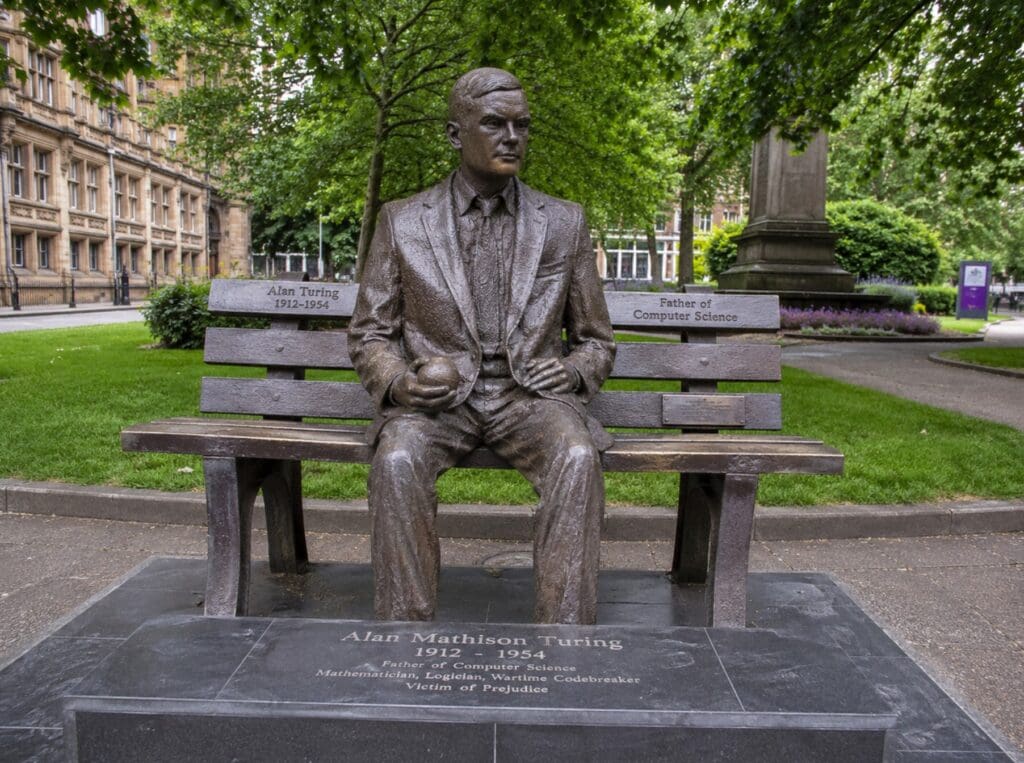
Manchester City Council identifies Sackville Gardens as the home of the life-sized bronze Turing memorial. The surrounding location connects his scientific work, persecution and public rehabilitation to the modern Village. (Manchester City Council)
Our recommendation is to sit on the opposite side of the path rather than immediately posing beside the statue. The view places Turing within the wider garden and makes the relationship between university buildings, the Village and memorial landscape easier to understand.
What is the Beacon of Hope?
The Beacon of Hope is Britain’s first permanent HIV memorial. It was conceived in 1997 and erected in 2000 to remember people lost to HIV and express solidarity with those living with HIV today. (George House Trust)
It remains the focus of candlelit vigils, including the closing remembrance event of Manchester Village Pride. (Manchester Village Pride)
This is not background decoration for a party. During a vigil:
- stop conversations;
- silence notifications;
- follow requests from organisers;
- avoid intrusive close-up photography;
- leave space for bereaved people and those living with HIV.
What is the National Transgender Memorial?
Sackville Gardens also contains the National Transgender Memorial, created to remember people killed because of transphobic hatred and prejudice. Visit Manchester describes the garden as the first memorial of its kind in the United Kingdom. (Visit Manchester)
Its presence matters because Manchester’s queer identity cannot be reduced to gay male nightlife. The gardens connect gay, lesbian, bisexual and trans histories through distinct memorials rather than merging them into a vague rainbow narrative.
The best daytime programme combines the Manchester LGBTQ+ Walking Trail, Sackville Gardens, Chinatown, Kampus and the Northern Quarter. It provides historical context before nightlife and makes the Village feel like part of Manchester rather than a detached strip of late-opening bars.
Is there an LGBTQ+ history trail?
Yes. The Everyone Welcome: Manchester LGBTQ+ Walking Trail, written by playwright and guide Chris Hoyle, links venues, memorials, former meeting places and political landmarks across the city. (Visit Manchester)
Its stops include:
- New Union;
- former Manto;
- Alan Turing Memorial;
- Canal Street;
- Proud Trust-related locations;
- Northern Quarter;
- Manchester Art Gallery;
- Manchester Town Hall;
- former Haçienda and Flesh connections.
The trail is more useful than a generic pub crawl because it explains why particular buildings and street corners matter.
Where can you find LGBTQ+ support?
LGBT Foundation is a major Manchester-based organisation focused on LGBTQ+ health, wellbeing, information and support. Its work extends beyond tourism and nightlife. (Visit Manchester)
Community services should be approached respectfully. Do not visit an office as though it were a cultural attraction. Use official contact routes when you need:
- health information;
- wellbeing support;
- local referrals;
- help after discrimination;
- sexual-health guidance;
- information about community groups.
What else is close to Canal Street?
A walkable daytime circuit can include:
- Canal Street;
- Sackville Gardens;
- Kampus;
- Chinatown;
- Manchester Art Gallery;
- Piccadilly Gardens;
- the Northern Quarter;
- Ancoats.
The Village’s proximity to other central districts is one of its strongest practical advantages. You do not need to choose between a queer weekend and a wider Manchester trip.
Manchester Village Pride runs from Friday 28 to Monday 31 August 2026. The parade takes place on Saturday, while Monday offers free community and family programming followed by the George House Trust Vigil. Friday to Sunday access to the enclosed event area requires the appropriate wristband. (Manchester Village Pride)
What is different about the 2026 event?
The 2026 edition is organised by Manchester Village Pride CIC, a new community-interest company whose board is described as volunteer-led and whose structure includes an asset lock intended to reinvest surplus into community organisations. (Manchester Village Pride)
The published programme includes:
- a main stage at Bloom Street and Sackville Street;
- a Community Showcase in Sackville Gardens;
- a Dance Arena;
- the Saturday parade;
- citywide fringe activities;
- a Monday family and community day;
- the closing Vigil at the Beacon of Hope. (Manchester Village Pride)
How much do Manchester Village Pride tickets cost?
As published on 31 July 2026:
These prices and release conditions come from the official event site and may change if an allocation sells out. (Manchester Village Pride)
Why is a wristband required?
During the main event, the Village becomes a licensed live-event space with road closures, stages, security, medical provision and controlled access. The organiser states that wristband income covers those operational costs and performer payments. (Manchester Village Pride)
A wristband should not be confused with unrestricted admission to every private club or separately promoted after-party. Check whether an event requires an additional ticket.
How accessible is Pride?
The published 2026 plan includes:
- viewing platforms at the main stage and Sackville Gardens;
- quiet and lower-stimulation spaces;
- British Sign Language interpretation;
- free essential-companion tickets;
- accessible facilities;
- Monday’s free community programme. (Manchester Village Pride)
Contact the access team before purchase when you require a precise platform position, wheelchair route, medication policy or sensory accommodation.
What is the best Pride strategy?
- Arrive before the busiest check-in period.
- Collect or activate the required wristband early.
- Download tickets rather than relying on mobile reception.
- Choose one meeting point outside the densest area.
- Carry a rain layer and sun protection.
- Schedule food and quiet breaks.
- Distinguish the parade route from the ticketed Village perimeter.
- Do not book tightly timed trains after the Vigil.
- Check street closures and Metrolink disruption shortly before travelling.
Pride is more rewarding when the Vigil, community stages and grassroots organisations receive as much attention as the headline entertainment.
Canal Street, Piccadilly, Kampus and Portland Street are the most practical bases for a first visit. They allow easy walking between the station, Village and city centre. The Northern Quarter offers more independent character, while Oxford Road and Ancoats can provide alternatives during expensive Pride weekends.
Visit Manchester currently lists central properties including Holiday Inn Manchester City Centre, LEVEN, Townhouse Hotel Manchester, voco Manchester and Clayton Hotel Manchester City Centre around the Village and neighbouring districts. (Visit Manchester)
What should you ask before booking?
- Does the room face Canal Street or a late venue?
- Is reception staffed throughout the night?
- Does the hotel have step-free access?
- Is the booked bed type guaranteed?
- Can a licensed taxi stop directly outside?
- Is air conditioning available?
- Can luggage be stored after check-out?
- Does Pride affect vehicle or pedestrian access?
- Is the room above a bar, function room or loading bay?
A “five-minute walk” can be an advantage for nightlife and a disadvantage for sleep. Read room-position information, not merely the hotel’s postcode.
The central district is compact, but cobbles, kerbs, crowded terraces, narrow historic buildings and basement venues create barriers. Manchester Piccadilly offers comprehensive step-free station access; individual bars vary considerably, so venue-specific information should be requested before booking a show or table. (National Rail)
What physical barriers should you expect?
- uneven paving beside the canal;
- narrow or crowded pavements;
- temporary street furniture;
- old buildings without lifts;
- basement performance areas;
- tightly packed standing events;
- queues crossing pedestrian routes;
- wet surfaces after rain.
Canal Street’s relative flatness is useful, but “flat route” does not mean step-free entrance.
How should you plan an accessible visit?
- Use Manchester Piccadilly rather than Oxford Road when full step-free railway access is essential.
- Contact the venue, naming the exact room or event.
- Ask whether seating must be reserved.
- Confirm accessible-toilet availability.
- Check whether Pride changes the entrance.
- Request the essential-companion ticket before the deadline.
- Save a quiet alternative when a venue becomes too crowded.
During Manchester Village Pride, official plans include viewing platforms, BSL interpretation and quiet zones. (Manchester Village Pride)
Plan your return before drinking, keep your phone and belongings secure, use licensed transport and ask venue staff for help immediately when something feels wrong. Just as importantly, protect other customers’ privacy: do not photograph strangers, challenge discriminatory behaviour and respect community-centred door policies.
What should you do before going out?
- Save your accommodation address offline.
- Identify a walking, tram and taxi option.
- Carry physical photo identification.
- Charge your phone.
- Eat before late-night kitchens close.
- Agree on a meeting point.
- Keep a backup payment method separate.
- Check whether the venue accepts solo entry late at night.
Some Village venues have historically applied event-specific, membership or late-night entry restrictions. Admission to one venue does not guarantee admission to another.
How should you behave in LGBTQ+ venues?
Do not:
- photograph strangers without permission;
- touch performers;
- assume somebody’s pronouns;
- treat drag as an invitation to interrupt;
- disclose another person’s identity;
- pressure someone to continue a conversation;
- mock a community-specific door policy;
- treat memorials as party props.
The Village is open and visible, but some customers may not be out at work, with family or on social media.
What should solo visitors know?
An early arrival is usually easier than joining a packed queue after midnight.
Good solo starting points include:
- The Molly House;
- Via before peak hours;
- Richmond Tea Rooms during the day;
- Sackville Gardens in daylight;
- a scheduled Oscars performance;
- New Union before the later crowd arrives.
Choose a place with a visible bar, staff presence and a format you understand.
For emergencies in the United Kingdom, call 999 or 112.
A balanced weekend uses the first day for orientation and a gentle Village evening, then combines queer history, wider Manchester and a more energetic second night. Do not spend both days recovering from nightlife when Canal Street, Sackville Gardens and the city’s cultural districts are all walkable.
What should you do on Friday?
Afternoon
- Arrive at Manchester Piccadilly.
- Leave luggage near Piccadilly, Kampus or Portland Street.
- Walk through Sackville Gardens.
- Identify the Alan Turing Memorial and Beacon of Hope.
- Continue to Canal Street before the evening crowd.
Early evening
Choose one:
- afternoon tea at Richmond Tea Rooms;
- tapas at The Molly House;
- food and drinks at Via;
- pizza at Kampus;
- dinner in Chinatown.
Night
A sensible sequence is:
- The Molly House or Via;
- Oscars or New Union for entertainment;
- New York New York, The Brewers or AXM when dancing still appeals.
Do not enter every venue simply because it is close.
What should you do on Saturday?
Morning
Follow part of the Manchester LGBTQ+ Walking Trail. Include:
- New Union;
- Canal Street;
- Sackville Gardens;
- the Village’s former venue sites;
- Manchester Art Gallery;
- the Northern Quarter.
Afternoon
Explore Chinatown, Kampus or Ancoats. Return to the hotel and rest before the main evening.
Night
Choose one clear objective:
- drag and entertainment: New Union;
- show tunes: Oscars;
- classic Village energy: Via;
- party-bar dancing: New York New York;
- women-centred nightlife: Vanilla;
- late club atmosphere: AXM or a verified current event.
What should you do on Sunday?
Have brunch, revisit Sackville Gardens and leave enough time for Piccadilly’s platforms and crowds.
When remaining on Sunday evening, check New Union’s cabaret and Via’s programme before committing to a later train. (newunionhotel.co.uk)
Canal Street remains the city’s LGBTQ+ centre, but Manchester’s alternative queer nightlife also appears at venues and promoters across the Northern Quarter, Salford and other districts. Homoelectric and event-led nights offer less commercial music and performance for visitors who find the Village too mainstream.
Visit Manchester’s 2026 LGBTQ+ guide highlights events associated with spaces such as Hidden, The White Hotel, Firehouse, The Carlton Club and Derby Brewery Arms, while Homoelectric remains one of the city’s recognised alternative queer club names. (Visit Manchester)
Other annual or recurring LGBTQ+ entities include:
- Sparkle Weekend, a major trans and gender-diversity celebration;
- Great British Bear Bash, traditionally associated with the May Bank Holiday;
- SCENE Festival, linked to queer film and culture;
- LGBT Foundation programmes;
- George House Trust vigils and HIV activism;
- community and fringe events surrounding Pride. (Visit Manchester)
Is the Village too commercial?
It can feel commercial on peak weekends, particularly when large visiting groups dominate the street. However, dismissing it entirely ignores its memorials, community organisations, historic businesses and continuing role as a visible refuge.
A more useful approach is to combine:
- one night in the Village;
- one alternative event elsewhere;
- one daytime history route;
- one community or cultural activity.
BEARWWW can help visitors speak with bears, daddies, mature men, cubs, chubs, otters and admirers before arriving. Use it to arrange a public coffee, brunch, museum visit or early Village drink rather than depending on an improvised late-night meeting after several venues.
Gay dating, gay contacts and gay meet-ups in Manchester🔥




A practical travel profile might say:
“In Manchester for the weekend. I’m planning the LGBTQ+ history trail, Sackville Gardens, dinner around Canal Street and a relaxed Village night. Happy to meet for coffee, food, drag or a walk before deciding on anything later.”
That description works because it gives another person several specific, low-pressure choices.
Where should you meet first?
- Richmond Tea Rooms;
- The Molly House during early evening;
- a Kampus café;
- Manchester Art Gallery;
- Sackville Gardens during daylight;
- Via before the night becomes crowded;
- a public Pride or Sparkle event.
What should you confirm?
- the precise venue;
- the meeting time;
- whether either person needs the last tram or train;
- accessibility requirements;
- the preferred type of plan;
- an independent route home.
Create your BEARWWW profile, add your Manchester travel dates and start discovering the city through conversations with its local bear community.
Final recommendation
Manchester’s Gay Village succeeds because it is both easy to enter and difficult to reduce to one idea.
Canal Street provides the visible celebration: terraces, drag, music, show tunes and late-night movement. However, Sackville Gardens supplies the context. The Alan Turing Memorial recalls state persecution; the Beacon of Hope remembers lives lost to HIV; and the National Transgender Memorial insists that queer history includes communities too often pushed to the edge.
A good first trip should therefore balance:
- nightlife and remembrance;
- famous venues and independent spaces;
- Canal Street and wider Manchester;
- Pride celebration and community activism;
- spontaneity and practical planning.
Our strongest first-visit formula is simple: stay near Piccadilly or Kampus, walk through Sackville Gardens before dark, eat properly, begin at The Molly House or Via and choose only one later venue.
Above all, verify current information. MAYA closed in May 2026, G-A-Y’s public status is inconsistent and Pride is operating through a new organisational model. A useful LGBTQ+ guide should acknowledge those changes rather than preserving familiar names after reality has moved on.
🏳️🌈 FAQ – Manchester’s Gay Village
- Where is Manchester’s Gay Village?
- The Gay Village is centred on Canal Street beside the Rochdale Canal. It extends across Richmond Street, Bloom Street, Sackville Street, Chorlton Street and Princess Street, close to Manchester Piccadilly and Chinatown.
- How far is Canal Street from Manchester Piccadilly?
- Canal Street is a short city-centre walk from Manchester Piccadilly. Most visitors can walk between them with light luggage, although uneven paving and busy streets may affect journey time.
- Which tram stop is best for the Gay Village?
- Manchester Piccadilly, Piccadilly Gardens and St Peter’s Square are all practical, depending on your route. There is no Metrolink stop called Canal Street.
- What is the best bar for a first visit?
- Via is the easiest all-round introduction because it combines food, seating and entertainment. The Molly House is preferable for conversation, while New Union suits visitors seeking drag and later nightlife.
- Where can you find show tunes in Manchester?
- Oscars on Canal Street specialises in classic and modern musical-film clips, cocktails and selected live performances.
- Where can lesbian and queer women go in Manchester?
- Vanilla is Manchester’s best-known permanent women-centred Village venue. The Molly House and many alternative events outside the Village also attract mixed queer communities.
- Is G-A-Y Manchester open?
- Current public listings conflict as of 31 July 2026. Some recent tourism and directory sources still list the venue, while another specialist directory marks it closed. Verify directly before travelling.
- What happened to MAYA Manchester?
- MAYA closed after its final service on 29 May 2026. Older Manchester guides that still recommend it are outdated.
- When is Manchester Village Pride 2026?
- The event runs from Friday 28 to Monday 31 August 2026. The parade takes place on Saturday 29 August.
- Do you need a wristband for Manchester Village Pride?
- Friday-to-Sunday access to the licensed Village event area requires the relevant wristband. Monday’s community programme and Vigil are free.
- Is Sackville Gardens free to visit?
- Yes. It is a public garden, normally open from dawn until dusk. Event access arrangements may change during Pride or other festivals.
- What memorials are in Sackville Gardens?
- The gardens contain the Alan Turing Memorial, the Beacon of Hope HIV memorial and the National Transgender Memorial.
- Is Manchester suitable for solo LGBTQ+ travellers?
- Yes. The Village is compact, close to Manchester Piccadilly and contains venues suitable for early, structured visits. Solo travellers should still plan transport, carry identification and retain an independent route home.
- Where should LGBTQ+ visitors stay?
- Canal Street, Piccadilly, Kampus and Portland Street offer the easiest access. The Northern Quarter suits travellers seeking independent culture, while Oxford Road can offer a wider accommodation search.
About the Author
Alain VEST / BEARWWW Editorial Team writes about LGBTQ+ travel, nightlife, community spaces, and city culture across the UK and Europe. This guide was created with a travel-journalism approach focused on real visitor needs: where to arrive, where to stay, how to understand the Village, how to plan for Pride, and how to experience Manchester’s LGBTQ+ life with respect, safety, and curiosity.
