A First Doorway Into Bear Culture
The first thing to understand about the Bear community is that it is not simply a look. It is not just a beard, a belly, a checked shirt, a deep laugh, a pub night, a Pride flag, or a dating label. Instead, at its best, Bear culture is a social world: a place where many gay, bi, queer and transmasculine people have found warmth after feeling judged by narrower ideas of beauty, age, body size, masculinity or desirability.
Table of Contents
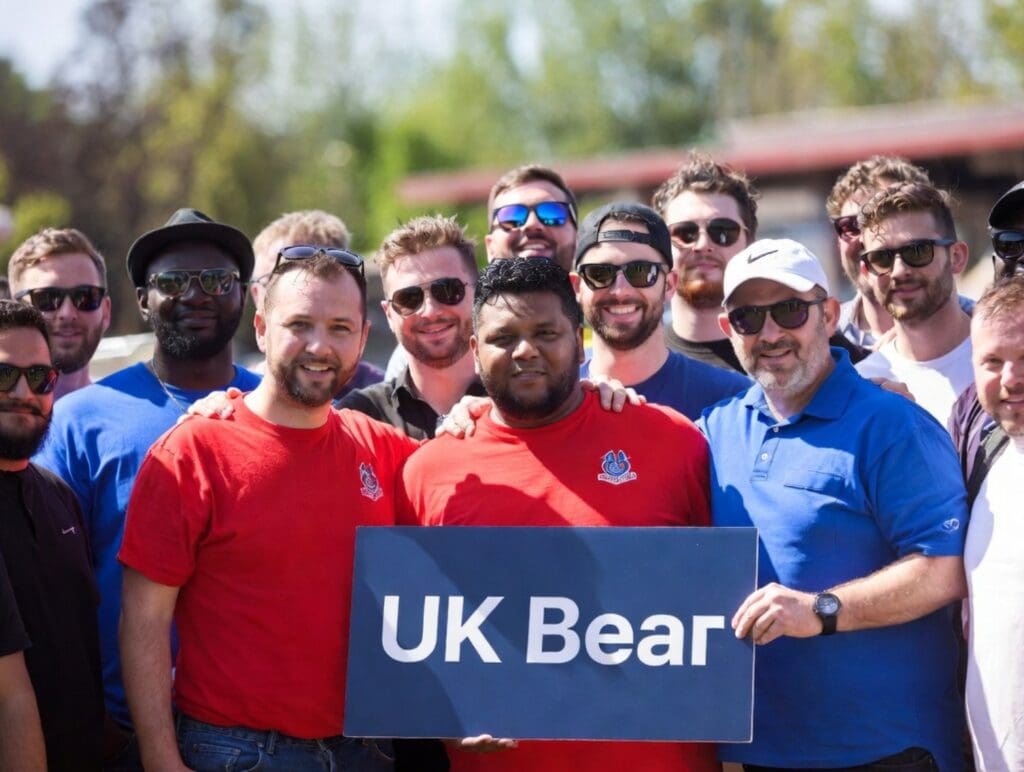
In Britain, that feeling often becomes visible in very ordinary places: a Sunday karaoke session in Soho, a relaxed afternoon social in Manchester, a BearScots weekend in Edinburgh, a club night in London, or a group of friends gathering before Pride. Moreover, the atmosphere is usually less about posing and more about recognition. You walk into the room, and, if the event is doing its job properly, you feel that a wider range of bodies, ages, accents, styles and personalities are allowed to take up space.
That is why the question “What is a gay bear?” deserves more than a dictionary answer. Ultimately, it is a question about bodies, belonging, history, friendship, humour, resilience and community.
Defining the Bear: Beyond the Stereotypes
In LGBTQ+ culture, a Bear has historically referred to a gay or bisexual man who is often bigger-bodied, hairy, mature-looking, bearded, rugged, broad, stocky or otherwise outside the slim, polished mainstream ideal. However, that definition is only a starting point. As Them’s cultural guide explains, the term has traditionally been linked to gay and bisexual men who are hairy, fat, muscular or big-bellied, yet the meaning has also expanded over time to include trans, non-binary and other queer people who find belonging in Bear culture. (Them)
Sociologist Peter Hennen describes Bears as a gay male subculture that values larger, hirsute bodies, while also showing that Bear masculinity can be both liberating and complicated: it challenges some mainstream gay body standards, yet it can sometimes reproduce narrow ideas of masculinity if the community is not careful. (Sage Journals)
Therefore, a better definition is this:
A gay Bear is usually a queer man, or someone aligned with Bear culture, who identifies with a community that celebrates body hair, bigger or broader bodies, mature presence, warmth, masculinity in many forms, and social belonging outside narrow beauty standards.
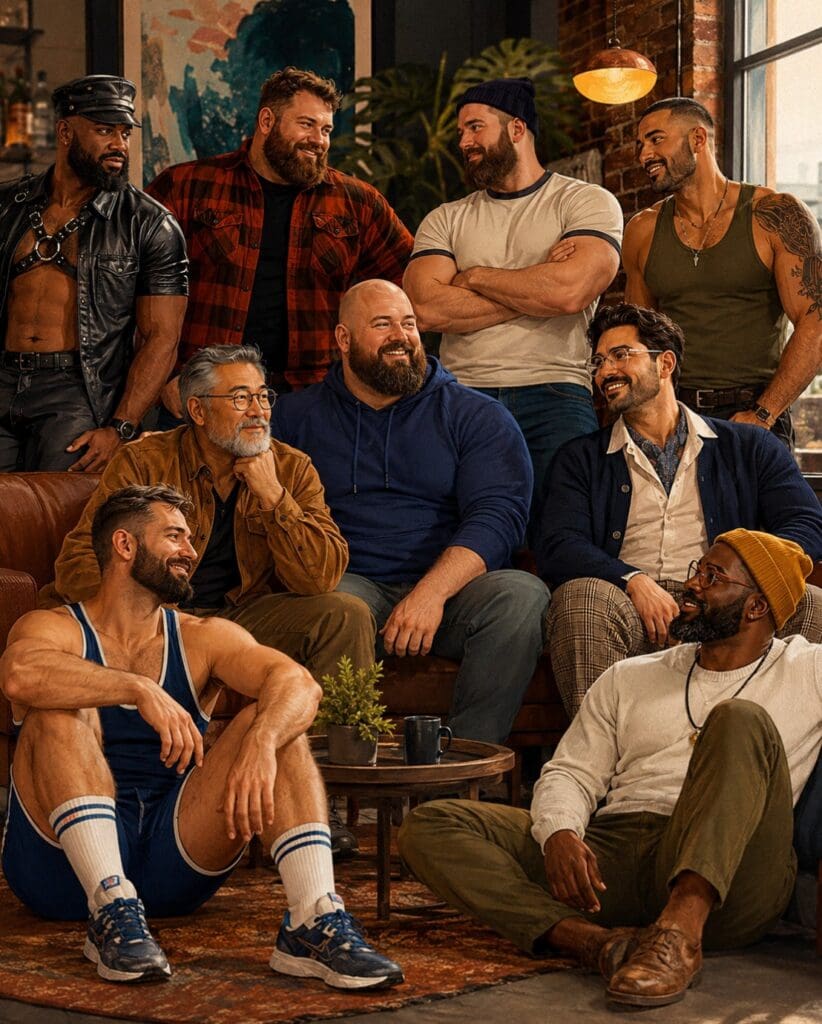
Nevertheless, no one should be reduced to a category. Some Bears are large; others are not. Some are hairy; others are not. Some are masculine-presenting; others are gentle, flamboyant, artistic, shy, camp, quiet or experimental. Consequently, the most respectful answer is often the simplest one: a Bear is someone who recognises himself, or themselves, in the culture and is recognised by the community with warmth rather than gatekeeping.
A Short Bear Vocabulary, Without Turning People Into Boxes
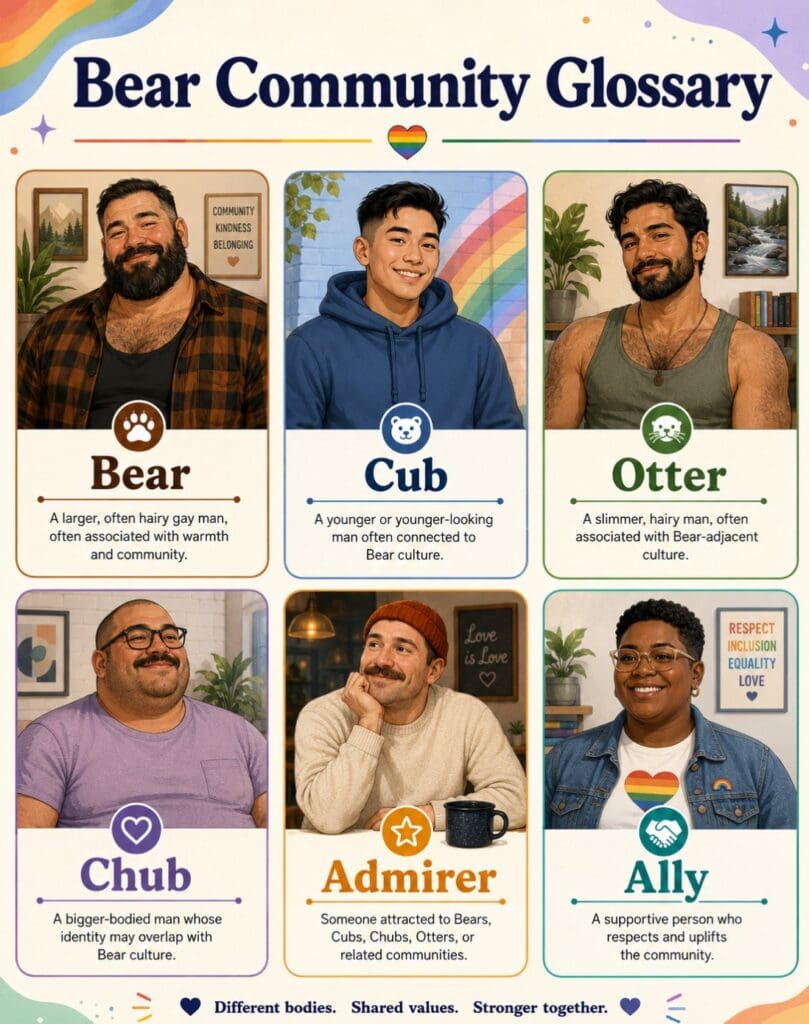
Bear culture has developed its own playful language. However, these words should be treated as community shorthand, not rigid social rules.
A Bear is often a bigger, hairier or mature-looking queer man, although the meaning varies. A Cub is usually a younger Bear or someone newer to the scene. An Otter is often a slimmer hairy man. A Chub usually describes a larger-bodied man who may or may not identify as a Bear. An Admirer is someone who enjoys Bear culture and feels connected to the community, even if they do not personally identify as a Bear. Meanwhile, terms such as Wolf, Daddy Bear, Muscle Bear or Polar Bear may appear in some spaces, although they should always be used lightly and respectfully.
Importantly, these labels are not exams. You do not need to “qualify” with a certain body type, beard length, wardrobe or personality. In fact, Craig Byrnes, the designer of the International Bear Brotherhood Flag, famously approached the question of Bear identity as something people answer for themselves; Mary Baldwin University’s profile of Byrnes notes his view that “am I a bear?” is, in essence, a question one asks in the mirror. (Mary Baldwin University)
Why Bear Culture Matters: Body Acceptance, Not Body Policing
Bear culture matters because mainstream gay culture has often been harsh about bodies. For decades, many gay men have felt pressure to be young, slim, hairless, gym-shaped, fashionable and constantly camera-ready. As a result, men who were bigger, older, hairier, softer, working-class, shy, disabled, neurodivergent or simply not interested in polished perfection often felt pushed to the edges.
Bear culture offered another answer. Instead of apologising for size, hair, age or ordinary human bodies, Bears created spaces where those features could become part of pride rather than shame. Attitude has described Bears as a subculture often seen as more accepting and as an alternative to the highly polished look popularised in parts of gay media during the 1980s and 1990s. (Attitude)
Nevertheless, it is important to be honest. Bear spaces are not automatically perfect. Some communities have struggled with fatphobia, racism, ableism, ageism, femmephobia or narrow definitions of what a “real” Bear should be. Moreover, research on Bear communities has shown that weight stigma can still harm body esteem, even within spaces that are supposed to challenge mainstream body ideals. A 2024 study in Archives of Psychiatry and Psychotherapy found that weight discrimination, rather than body size itself, consistently predicted lower body esteem among participants from a Bear community sample.
Consequently, the healthiest Bear culture is not merely “body positive” as a slogan. It is actively welcoming. It makes room for bigger men, smaller men, trans men, men of colour, disabled men, older men, younger men, shy men, flamboyant men, and people who are still working out where they fit. Ultimately, the best Bear spaces say: come as you are, and do not make someone else smaller so you can feel bigger.
The Evolution of Bear Culture: From North America to the UK
Although Britain has its own Bear scene, the modern Bear subculture is often traced to North American gay communities in the late twentieth century. Historian Les K. Wright’s Bear History Project places the growth of Bear identity in the mid-1980s San Francisco Bay Area, where men calling themselves Bears connected through informal gatherings and early internet spaces; Wright also notes the role of Richard Bulger and Chris Nelson’s Bear Magazine, founded in 1987, in popularising the term. (Les K. Wright)
At the same time, the history is not completely tidy. Them’s overview notes earlier print uses of “bear” in gay contexts, including references from the 1960s and George Mazzei’s 1979 article in The Advocate, while also recognising the importance of Bear Magazine and the AIDS-era need for spaces where men excluded from mainstream gay beauty standards could gather. (Them)
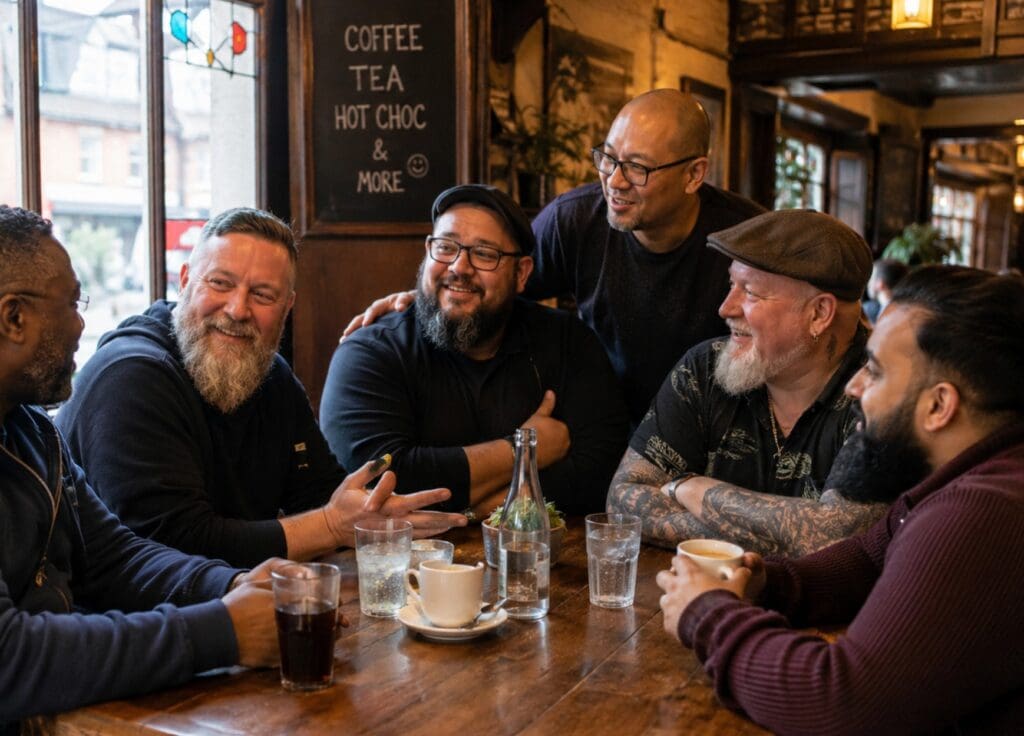
In the UK, the culture arrived less as a single imported identity and more as a set of recognisable social practices: pub gatherings, Pride groups, community organisations, club nights, weekend events, newsletters, online forums and later apps. Furthermore, because British queer culture has always been shaped by pubs, local friendship circles and city scenes, Bear life here developed a very grounded atmosphere. It is often less glossy than a circuit-party stereotype and more rooted in conversation, humour, music, charity raffles, karaoke, shared meals, Pride floats and meeting the same faces year after year.
The Bear Flag: A Symbol of Recognition
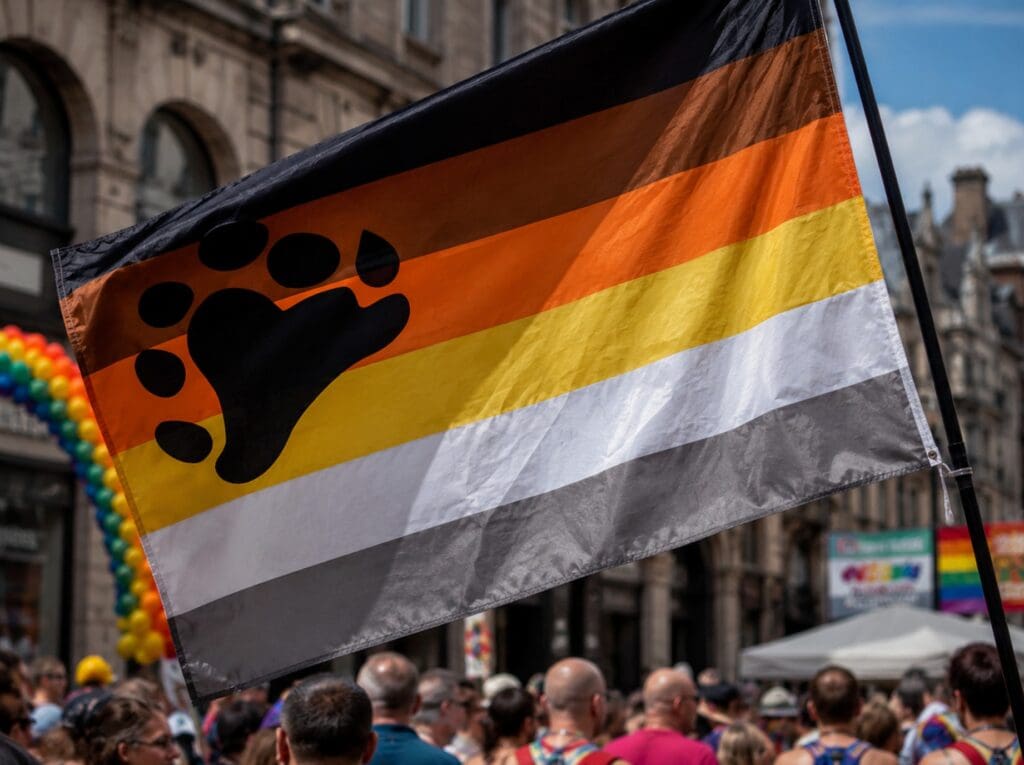
The International Bear Brotherhood Flag is one of the clearest visual symbols of the community. Designed by Craig Byrnes in the 1990s, it uses horizontal stripes in earthy tones with a bear paw in the corner. Mary Baldwin University’s profile explains that Byrnes researched Bear culture while studying psychology and created the flag as part of that work; by the late 1990s, it had become widely adopted at Bear and Pride events. (Mary Baldwin University)
The flag matters because it gives people a way to find each other. In a busy Pride parade, a pub window, an event poster or an app profile, it says: this is a Bear-friendly space. Moreover, for people who once felt invisible in mainstream LGBTQ+ imagery, that small paw print can carry surprising emotional weight.
The UK Bear Scene: Where Community Becomes Visible
The UK Bear scene is not confined to one city. Instead, it works like a network. Manchester has major Bear weekends, London has long-running pub and club culture, Scotland has BearScots, and other cities host Pride meetups, social groups, club nights and smaller gatherings.
Manchester: Great British Bear Bash and Manbears
Manchester is one of the UK’s most important Bear cities. Manbears Manchester describes itself as organising events and activities in Greater Manchester and the North West for Bears, Cubs, Chubs, Otters, Pups and Chasers. (Manbears) The organisation also states that its volunteer team runs the Great British Bear Bash, the Manchester Pride Parade Float and Pre-HiBEARnation. (Manbears)
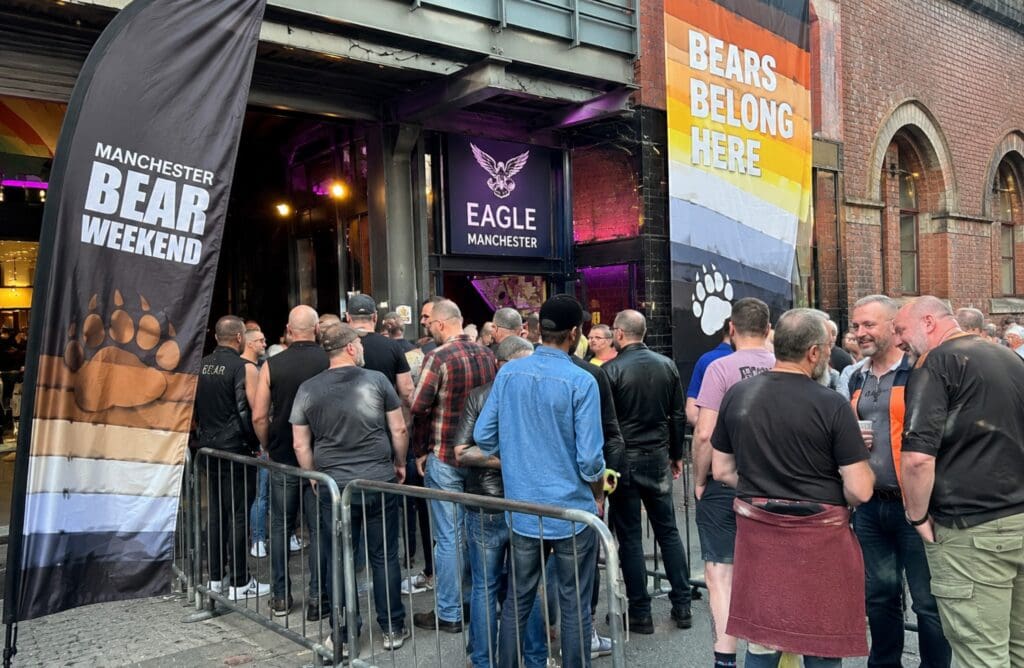
The Great British Bear Bash is especially significant because it feels like a city takeover in miniature. There are social gatherings, club nights, daytime meetups, pub routes, brunches, cabaret-style entertainment and many small moments where visitors become less like strangers and more like temporary locals. For 2026, the official Manbears timetable listed the Great British Bear Bash from Thursday 30 April to Monday 4 May 2026. (Manbears)
What makes Manchester special, however, is not only the scale. It is the friendliness. Around Canal Street and the Village, Bear weekend can feel like a series of reunions: people waving from terraces, groups moving between venues, first-timers being folded into conversations, and visitors checking event wristbands, times and maps while still managing to look wonderfully relaxed.
London: Soho, Vauxhall and the Pub Tradition
London’s Bear culture is more scattered, but it has real depth. Soho has long provided central LGBTQ+ pub life, while Vauxhall has hosted club nights and larger events. Visit London lists The Kings Arms at 23 Poland Street as a longstanding Soho LGBTQIA+ pub and notes its Sunday Bearaoke event. (visitlondon.com)
Meanwhile, BEEFMINCE has become a major name in contemporary UK Bear nightlife. Its own site describes it as an inclusive LGBTQ+ club night celebrating Bears, Cubs and all bodies in between, with parties in London, Brighton, Manchester, Birmingham and Sitges. (BEEFMINCE) Its “Mince Mission” explicitly connects the brand with body positivity and challenging toxic masculinity, which is culturally important because Bear spaces are strongest when they welcome difference rather than enforce a single image. (BEEFMINCE)
Scotland: BearScots and the Northern Network
Scotland also has a visible Bear community. BearScots describes itself as Scotland’s group for Bears and says it holds monthly Bear events in both Edinburgh and Glasgow. (BearScots Offical Website) For visitors, that matters because the Bear scene is not only a London-Manchester story. It is also regional, social and highly loyal, with people travelling for weekends, Pride events and regular meetups.
Beyond the Big Cities
Furthermore, Bear culture now travels through apps, social media, Pride groups, event brands and regional club nights. Bristol, Leeds, Birmingham, Brighton, Cardiff, Glasgow, Edinburgh, Newcastle and Liverpool all have LGBTQ+ spaces where Bear visitors can find community, even when there is no fixed “Bear bar” in the old-fashioned sense. Consequently, the practical advice is simple: check current listings, look for Bear flags, follow local LGBTQ+ venues, and ask respectfully before assuming the vibe.
What a UK Bear Event Actually Feels Like
A good Bear event rarely feels like walking into a fashion show. Instead, it often feels like entering a very sociable pub gathering that slowly turns into a weekend-long friendship machine.
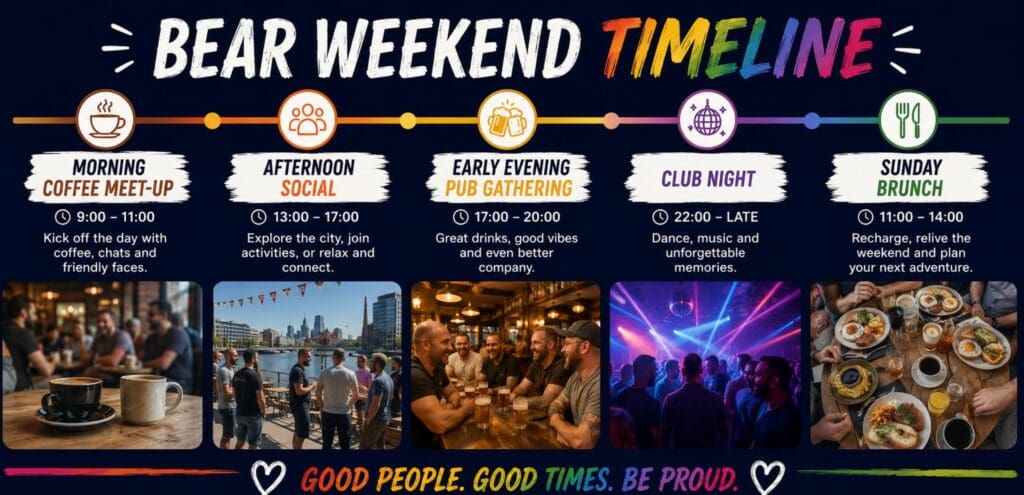
First, there is usually a registration point, a wristband, a cloakroom queue, a welcome desk or a friendly volunteer who has answered the same question twenty times and still smiles. Then, there are small clusters: friends from last year, couples comparing hotel check-ins, solo visitors trying to look casual while scanning the room, and regulars who seem to know everyone. After that, the mood loosens. People start introducing themselves. Someone asks where you have travelled from. Someone else points you towards the next event.
Moreover, the best UK Bear events are not just night-time gatherings. They often include coffee meetups, brunches, quizzes, markets, karaoke, Pride walks, charity moments, themed socials and low-pressure daytime activities. That matters because not everyone wants a late night. Some people come for friendship, confidence, community, travel, laughter, music or simply the relief of being in a room where their body is not treated like a problem to solve.
How to Enter Bear Spaces Respectfully
If you are new to Bear culture, the first rule is simple: arrive with curiosity, not entitlement.
Do not treat people as mascots, body types or novelty experiences. Do not comment on someone’s weight, hair, age or body unless you already know them well and the context is clearly affectionate. Furthermore, do not assume that every Bear space has the same rules. A pub social, a Pride float, a club night, a community brunch and an online group all have different moods.
Instead, begin with ordinary kindness. Say hello. Ask whether a seat is free. Respect personal space. If someone is not interested in chatting, move on gracefully. If you are attending a ticketed weekend, read the event information before arriving. Manbears, for example, places consent at the heart of its Great British Bear Bash and wider community values, emphasising warmth and respect. (Manbears)
Ultimately, Bear culture works best when people understand that friendliness is not the same as unlimited access. A warm community still needs boundaries.
The Politics of Masculinity: Warmth Over Performance
Bear culture has always had a complicated relationship with masculinity. On one hand, it helped many men reject narrow gay ideals that valued youth, thinness and polished perfection. On the other hand, some Bear spaces have sometimes overvalued ruggedness, size, facial hair or “real man” presentation in ways that can exclude femme men, trans people, people of colour, disabled people or anyone who does not match a dominant image.
This is why sociological thinking matters. Hennen’s work is useful because it shows that Bear masculinity can both resist and reproduce mainstream gender norms. (Sage Journals) In other words, Bear culture is not automatically radical just because it celebrates different bodies. It becomes radical when it chooses generosity over hierarchy.
A healthier Bear community does not ask, “Are you Bear enough?” Instead, it asks, “Do you feel welcome here, and are you helping others feel welcome too?”
Body Confidence Without Health Shame
Because Bear culture often includes bigger-bodied people, conversations about health must be handled carefully. A community guide should never shame weight, size or appetite. At the same time, it should not pretend that stigma has no consequences.
The most useful approach is this: support wellbeing without turning bodies into projects. The 2024 study on Bear body esteem concluded that health promotion for Bear communities should be tailored to subcultural norms and support healthier lifestyles and coping with stigma, rather than focusing narrowly on weight loss.
Therefore, in a Bear context, wellbeing can mean walking home safely, checking event access information, resting between Pride events, seeking mental health support when needed, finding movement that feels enjoyable, eating without shame, and building friendships that make life feel less isolated. Moreover, it means understanding that body confidence is not vanity; for many people, it is recovery from years of being told they were too much, too old, too soft, too hairy or not enough.
Finding Your Tribe: Practical UK Tips
If you want to explore Bear culture in the UK, start gently.
First, follow local Bear groups and LGBTQ+ venues in the city you plan to visit. Manchester, London and Scotland have particularly visible Bear networks, but smaller cities often have social nights connected to Pride groups, pubs or club brands. Next, choose one daytime or early-evening event before a late-night one. This makes it easier to meet people without the pressure of a packed room. Then, if you are attending a large weekend such as Great British Bear Bash or BearScots, book accommodation early, because community weekends can fill central hotels quickly.
Additionally, check accessibility. Older pubs, basement venues, busy clubs and Pride routes can vary widely. If access matters to you, message the organiser in advance rather than assuming. Finally, remember that apps can help, but they do not replace community. Use them to ask for tips, arrange coffee, find a Pride buddy or learn which event suits your mood.
BEARWWW and the Modern Bear Community
Digital connection has always mattered in Bear history, from early mailing lists and bulletin boards to today’s apps and social platforms. Consequently, BEARWWW has a natural role in contemporary Bear life.
Before attending a Bear event, Pride weekend or city break, open BEARWWW to connect with gay, bi and queer men nearby. You can ask locals which Bear night is most welcoming for first-timers, arrange a coffee before a busy event, find travel advice, or simply make the community feel less intimidating before you walk through the door.
Join BEARWWW to meet Bears, Cubs, Admirers and LGBTQ+ travellers in the UK and beyond. Because, ultimately, Bear culture is not only about being seen — it is about being welcomed.
Common Misunderstandings About Gay Bears
“All Bears are the same”
They are not. Some Bears are quiet; others are extroverted. Some love club nights; others prefer pubs, walking groups, brunches or Pride volunteering. Furthermore, Bears vary by race, class, age, disability, gender history, relationship style, fashion and personality.
“Bear culture is only about body size”
Body size is part of the history, but it is not the whole story. Bear culture is also about body hair, age, warmth, community, alternative masculinity, friendship and feeling at home outside narrow beauty standards.
“You need a beard to be a Bear”
No. A beard may be part of the classic image, but it is not a passport. Some Bears are clean-shaven, some cannot grow facial hair, and some simply prefer a different look.
“Bear spaces are only for older men”
No. Bear communities often include Cubs, younger visitors, admirers, friends and allies. However, one of the lovely things about Bear culture is that it often values maturity rather than treating age as something to hide.
“Bear culture is automatically inclusive”
Not automatically. It has inclusive roots, but inclusion requires practice. Therefore, the best Bear spaces actively challenge racism, fatphobia, femmephobia, transphobia, ableism and any behaviour that makes people feel unwelcome.
A Gentle First-Timer’s Plan
Start with one city. Manchester is excellent for a major Bear weekend; London is useful for pubs and club nights; Scotland has BearScots; Brighton and Birmingham increasingly appear on contemporary Bear event maps through brands such as BEEFMINCE. (BEEFMINCE)
Next, choose one low-pressure event. A pub social, karaoke evening or daytime meet-up is often easier than walking straight into a large club night. Afterwards, give yourself time. Community does not always happen instantly. Sometimes the first visit is simply about recognising the room. The second visit is where someone remembers your name.
Finally, be kind to yourself. Many people arrive in Bear spaces carrying old body shame, social nerves or memories of exclusion. Nevertheless, the point of community is not to perform confidence perfectly. It is to discover, gradually, that you can belong before you feel fully brave.
[Insert a SFW checklist graphic: “First Bear event: check listings, arrive early, respect boundaries, introduce yourself, plan transport, follow up with new friends”]
Why Bear Culture Still Matters in 2026
Bear culture still matters because body pressure has not disappeared. If anything, social media has made comparison faster, sharper and more constant. Therefore, spaces that celebrate ordinary, older, bigger, hairier, softer, stronger, quieter and more varied queer bodies remain culturally necessary.
Moreover, Bear culture offers something that many people still need: intergenerational friendship. In a good Bear pub or event, younger men meet older men who have lived through different chapters of LGBTQ+ history. Visitors meet locals. Couples meet solo travellers. People who once felt invisible become visible to one another. Consequently, Bear culture is not just a niche; it is a living archive of queer resilience.
Ultimately, to ask “what is a gay Bear?” is to ask how a community turns exclusion into welcome. The answer is not perfect, and it is still evolving. Nevertheless, at its best, Bear culture remains one of the warmest reminders that LGBTQ+ life does not have to be narrow to be beautiful.
About the Author
aLAIN vest / ceo BEARWWW writes about LGBTQ+ sociology, British queer history, travel culture and community life. This guide is designed in the voice of an LGBTQ+ sociologist and travel journalist with extensive lived experience in the UK Bear scene, from Manchester Bear weekends and London pub culture to regional Pride gatherings and community-led events.