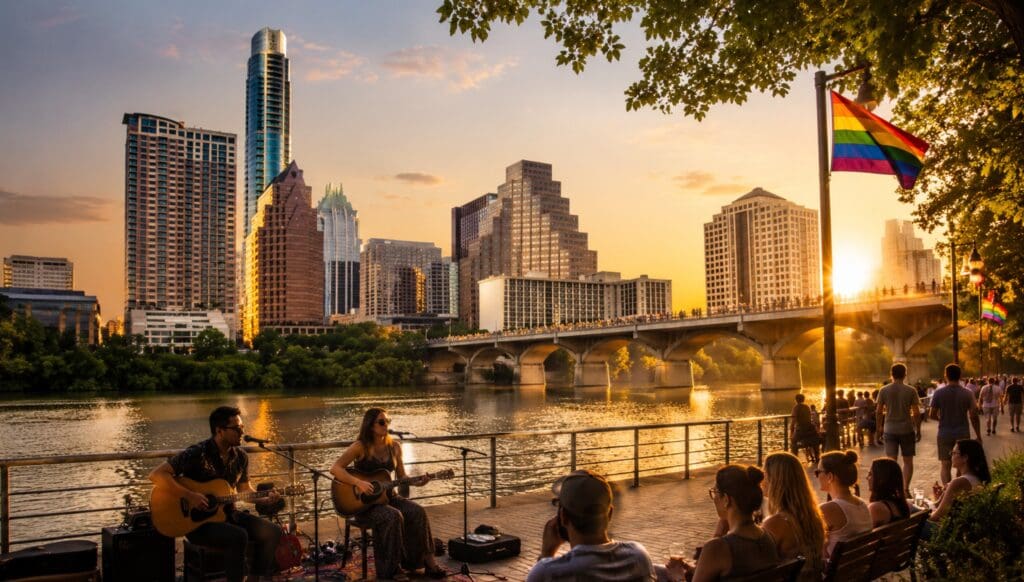
Austin, Texas Rainbow Index & Weather Dashboard
Austin has maintained a perfect score since 2013.
evaluating 49 criteria across laws, policies, and services[reference:3].
Table of Contents
Austin does not have one perfectly contained gay neighborhood.
Instead, queer life is scattered across the city: along the historic LGBTQ+ nightlife corridor on Fourth Street, inside the creative spaces of Red River and East Austin, at outdoor swimming holes, in community organizations, at sports leagues, in bookstores, at food-truck parks, and around festivals that temporarily transform whole districts.
That geography is both Austin’s strength and its challenge.
You can spend Friday night dancing Downtown, Saturday morning swimming at Barton Springs, Saturday afternoon browsing a queer bookstore on East 12th Street, and Sunday eating tacos beneath a string of patio lights. However, you cannot assume those places are all within a short walk. Austin is more spread out than it first appears, and summer heat makes even modest distances feel longer.
Therefore, the best gay Austin trip requires a little strategy.
This guide explains where to stay, how to move between neighborhoods, which venues offer classic gay-club energy, where to find Austin’s more underground queer culture, how to eat well without falling into tourist traps, and how to navigate the contrast between Austin’s local inclusivity and Texas’s broader political climate.
Most importantly, it treats Austin as a living city rather than a directory of bars.
Gay Austin at a glance
🏳️🌈 Queer Austin – Interactive Map 20+ spots
4th Street · Cheer Up Charlies · The Little Gay Shop · Barton Springs · South Congress · Queer-owned businesses · Hotels
📌 Click any pin on the map to see venue details and addresses.
Sources: TravelGay · Austin Texas · misterb&b
📍 Neighborhoods: 4th Street (🔴), East Austin (🟢), South Congress (🟣), Downtown (🔵)
First, understand Austin’s queer geography
Austin is often described as one large gay-friendly city rather than a place with a single formal gayborhood. Visit Austin makes the same point in its official LGBTQ+ Austin guide: queer residents and businesses are spread throughout the city.
Still, Fourth Street remains the most recognizable nightlife anchor.
The Warehouse District’s LGBTQ+ corridor is compact, easy to understand, and unusually convenient by Austin standards. Meanwhile, the more experimental side of queer Austin spills across Red River, East 12th Street, East Sixth Street, neighborhood venues, pop-up markets, arts spaces, and changing event series.
In practical terms:
- Go to Fourth Street when you want a dependable gay night out.
- Go to Red River when you want queer culture mixed with live music and alternative performance.
- Go east when you want food, art, small businesses, patios, and a less standardized social experience.
- Go to Barton Springs when you need to remember that Austin life happens outdoors as much as it does in clubs.
The Fourth Street scene: Austin’s classic LGBTQ+ nightlife corridor
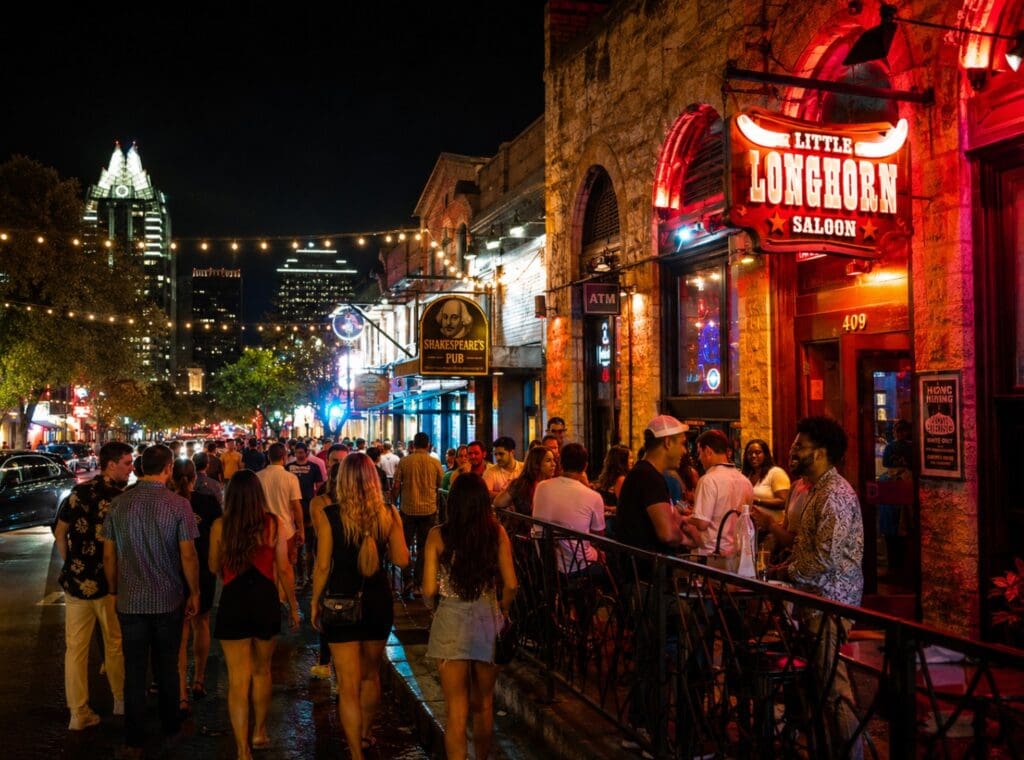
Fourth Street is the easiest answer to the question, “Where are the gay bars in Austin?”
The main LGBTQ+ venues sit close enough together that you can arrive by rideshare, walk between them, and decide what kind of night you want after seeing the crowd. That flexibility is valuable, especially for solo travelers or first-time visitors.
The official Visit Austin guide to the Downtown and Warehouse District describes it as the city’s most concentrated, walkable LGBTQ+ nightlife area.
Oilcan Harry’s: the enduring Austin institution
Oilcan Harry’s has operated as one of Austin’s most recognizable gay venues for decades. Its official site lists the club at 211 West Fourth Street and shows a calendar of performances, themed nights, and special events.
The atmosphere is classic gay-club Austin:
- drag and stage entertainment;
- DJs and dancing;
- an open-air component;
- regulars mixed with visitors;
- a crowd that changes noticeably depending on the event.
Oilcan Harry’s works particularly well as a starting point because it feels established. You are not walking into an anonymous pop-up party; you are entering a venue with a strong local history.
Earlier in the evening, the mood is easier for conversation. Later, it becomes more performance- and dance-focused.
Rain on 4th: polished lounge energy that turns into a party
Located at 217 West Fourth Street, Rain on 4th has served Austin’s LGBTQ+ community since 2004.
Rain generally feels more polished than a neighborhood dive. Depending on the night, expect:
- drag;
- comedy;
- karaoke;
- dance music;
- theme parties;
- a patio;
- a younger and highly social crowd.
It is particularly useful for groups with mixed nightlife preferences. One person can stay near the bar or patio while another moves directly toward the dance floor.
Rain becomes significantly louder and more crowded later in the evening. Therefore, arrive early when you want to talk, or later when dancing is the entire point.
Coconut Club: rooftop movement and genre-crossing dance nights
Coconut Club brings a more tropical, rooftop-driven energy to the district. Its programming can move across disco, house, R&B, Afrobeat, dancehall, pop, drag, and community-centered parties.
The crowd often feels broader and more fluid than at a conventional gay-male nightclub. That makes Coconut Club a useful option for queer groups with varied tastes, including visitors who want LGBTQ+ nightlife without a rigidly traditional club atmosphere.
Because it has rooftop space, weather matters. Summer nights can remain hot long after sunset, while spring and fall make the outdoor areas considerably more pleasant.
The Iron Bear: casual, social, and proudly Bear-centered
The Iron Bear describes itself as Bear-owned and operated. It is currently located on West Sixth Street, a short walk from the central Fourth Street area rather than directly on the main gay-bar block.
The atmosphere is usually less glossy and more conversational than a large dance club.
Expect a combination of:
- Bears, Daddies, Cubs, admirers, and friends;
- pool and karaoke;
- DJs and themed events;
- daytime or early-evening drinking;
- a broad age range;
- a come-as-you-are sensibility.
That does not mean the venue is exclusive to one body type or identity. Rather, Bear culture is part of its social center rather than a marginal theme night.
For travelers who find image-conscious nightlife exhausting, the Iron Bear can feel more accessible.
Fourth Street: who will enjoy it most?
Choose Fourth Street when you want:
- several LGBTQ+ venues close together;
- a simple first night in Austin;
- dancing, drag, and late-night energy;
- minimal transportation between bars;
- a visible gay social environment.
However, Fourth Street is not the whole city. It is Austin’s most convenient LGBTQ+ nightlife cluster, not a complete representation of every queer community in Austin.
Red River and East Austin: the underground, artistic alternative
🏳️🌈 Queer East Austin – Interactive Map 25+ spots
Coffee shops · Bookstores · Music venues · Patios · Food trucks · Arts spaces — all queer-owned or LGBTQ+ friendly
📌 Click any pin on the map to see venue details and addresses.
Sources: Visit Austin · GO Magazine · Community Impact · Austin Chronicle
📍 Neighborhoods: East 12th St · East 5th St · Manor Rd · East Cesar Chavez · Springdale General
The contrast between Fourth Street and East Austin is not simply “mainstream versus alternative.” It is more about concentration.
Fourth Street gives you a clear destination. East Austin makes you assemble your own night.
Moreover, some of the city’s most eclectic queer culture technically sits between Downtown, the Red River Cultural District, and East Austin rather than entirely inside one neighborhood boundary.
That fluidity is very Austin.
Cheer Up Charlies: where queer Austin meets live music
Cheer Up Charlies is located at 900 Red River Street, not deep in East Austin, but it represents the alternative spirit many visitors associate with the east side.
The venue is queer- and women-owned and combines:
- live music;
- DJs;
- drag;
- experimental performance;
- film and arts events;
- an outdoor stage;
- colorful patio space;
- cocktails, beer, and nontraditional bar offerings.
The atmosphere is less formal than Fourth Street and often more mixed across gender identity, orientation, style, and subculture.
One night may feel like an indie concert. Another may be a queer dance party. Another might center local performers, community fundraising, or an unusual theme that would feel too strange anywhere else.
That unpredictability is part of the appeal.
Always check the official event calendar rather than assuming the vibe based on the venue name alone.
The Little Gay Shop: a daytime community stop that matters
At 1902 East 12th Street, The Little Gay Shop sells queer books, art, gifts, publications, and work from LGBTQ+ creators.
It is more than a retail stop. The shop also supports community events, book clubs, markets, and an extensive Austin Queer Business Map.
For a visitor, this is one of the best places to understand Austin’s queer scene beyond nightlife. Staff recommendations, event posters, local publications, and community connections reveal a network that a generic travel search may miss.
The surrounding East 12th Street area also offers food, neighborhood history, bars, and local businesses without the heavily packaged feel of Downtown entertainment districts.
allgo: culture, wellness, and organizing for queer people of color
allgo has supported queer people of color since 1985 through cultural arts, wellness, and social-justice programming.
Travel guides often describe LGBTQ+ Austin as though one nightlife district represents everyone. Organizations like allgo demonstrate why that is incomplete.
Austin’s queer communities are shaped by race, migration, class, language, gender, health, creativity, and political organizing. Checking allgo’s current calendar can lead to cultural events and community programs that offer more meaningful engagement than another night of generic bar-hopping.
The East Austin vibe
East Austin’s appeal lies in movement between different types of spaces:
- dinner at a neighborhood restaurant;
- a queer market or bookstore;
- mezcal or cocktails on a patio;
- a small music venue;
- a food truck after midnight;
- a community or art event;
- an improvised final stop you did not plan.
However, do not expect one clearly marked gay strip. Events matter more than permanent labels.
Check calendars, follow organizers, and decide whether the night is centered on food, music, queer community, or all three.
Where to eat: from Verbena to food-truck patios
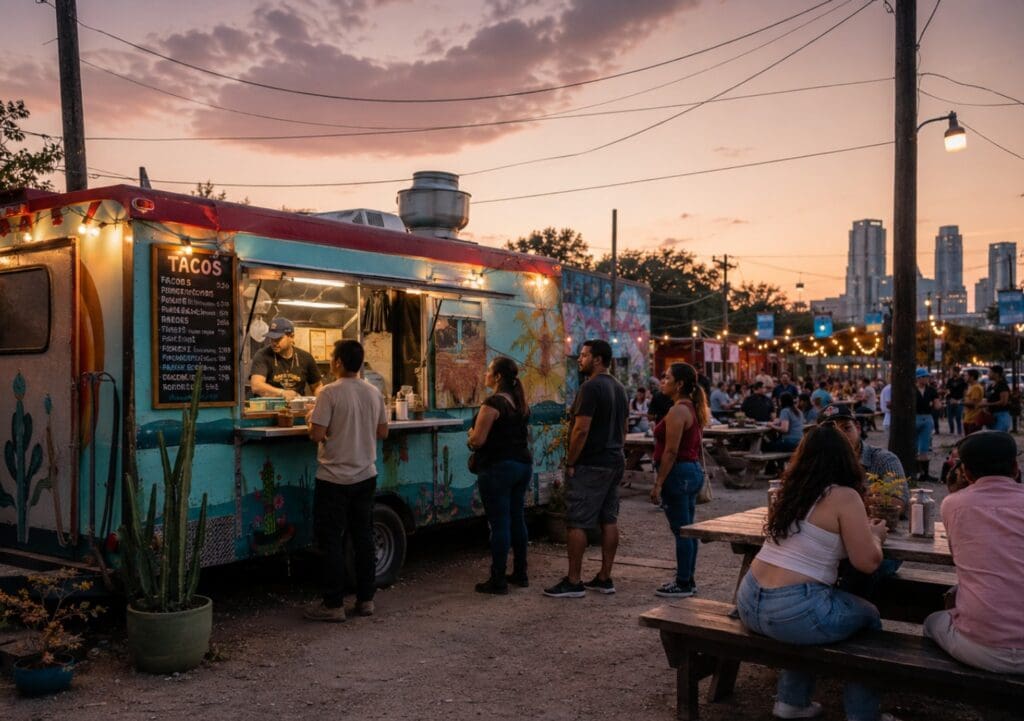
Austin’s food culture is one of the best reasons to build a trip around neighborhoods rather than attractions.
The city works particularly well for travelers who like to mix polished meals with picnic tables, breakfast tacos, barbecue, and late-night snacks.
Verbena: a polished West Sixth dinner before nightlife
Verbena Food & Drink occupies the ground level of the Canopy by Hilton on West Sixth Street.
Its dining room, lounge, wood-burning hearth, and open courtyard make it a strong choice for a more composed dinner before going out. The menu draws on Central Mexican traditions with Texas influences.
Verbena suits:
- a first-night dinner;
- couples;
- groups who want a proper meal before dancing;
- travelers staying Downtown or on West Sixth;
- visitors who want a quieter conversation before nightlife.
It is not a Fourth Street gay bar, nor is it marketed as an exclusively LGBTQ+ restaurant. Its value is logistical and atmospheric: dinner feels intentional, and the nightlife districts remain accessible afterward.
Justine’s and East Austin date-night energy
Visit Austin recommends Justine’s Brasserie as part of an LGBTQ+ East Austin itinerary.
Justine’s is darker, moodier, and more theatrical than a casual taco stop. It works well for a date, a celebration, or a night when you want dinner to be the central event.
Reservations are a smart move on popular evenings.
Jacoby’s: local food with an LGBTQ+ business connection
Jacoby’s Restaurant & Mercantile appears in Visit Austin’s LGBTQ+ itinerary as a gay-owned East Austin dining option.
The setting along the Colorado River corridor feels removed from Downtown’s intensity. It is well suited to groups, a slower dinner, or travelers who want regional food in a polished but not overly formal environment.
Food trucks: the essential Austin format
Visit Austin maintains a current guide to the city’s food trucks and trailer parks.
Food trucks are not simply a budget alternative. They are part of Austin’s social infrastructure. Multiple vendors, picnic tables, dogs, music, and casual seating make conversation easier than it can be inside a formal restaurant.
Good choices depend on location and opening hours, but classic categories include:
- breakfast tacos;
- barbecue;
- tacos and regional Mexican food;
- vegan comfort food;
- burgers;
- Italian food;
- desserts and frozen treats.
For a weekend, do at least one dinner with reservations and one meal eaten outside at a truck or trailer park. The contrast is part of the city.
South Congress: polished Austin without losing all the weirdness
South Congress Avenue, usually called SoCo is one of Austin’s most visitor-friendly areas.
It offers:
- cafés;
- boutiques;
- boots and vintage-inspired retail;
- live music;
- murals;
- restaurants;
- boutique hotels;
- views toward the Texas Capitol.
It can feel curated, crowded, and expensive. Still, it is useful for first-time visitors because it compresses several Austin experiences into one walkable corridor.
The Hotel San José is a 40-room bungalow-style hotel set behind garden courtyards on South Congress. It is stylish without feeling like a large corporate property and works especially well for couples or visitors who prioritize design, quiet mornings, and neighborhood life.
However, South Congress is not within comfortable walking distance of Fourth Street for every traveler, particularly in summer heat. A rideshare at night is often the sensible choice.
Daytime explorations: queer Austin does not begin after dark
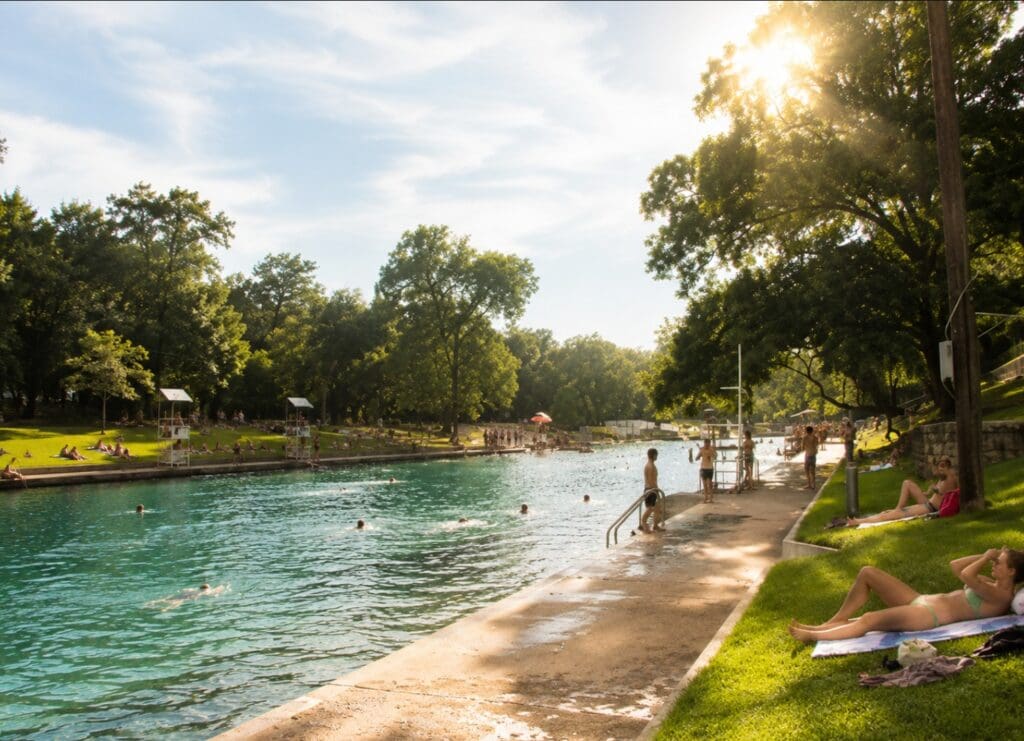
One of the biggest mistakes LGBTQ+ visitors make in Austin is treating daytime as the period between nights out.
Austin’s best community spaces are often outdoors. Swimming, markets, parks, sports, patios, and neighborhood walks are central to the city’s social culture.
Barton Springs: Austin’s shared outdoor living room
Barton Springs Pool is a three-acre spring-fed pool inside Zilker Park. The water remains around 68–70°F throughout the year.
The first entry can feel shockingly cold. Then, after five minutes, the surrounding heat makes the water feel perfect.
Barton Springs is not an exclusively LGBTQ+ space. Rather, it is one of Austin’s most democratic gathering places: swimmers, readers, athletes, families, sunbathers, longtime residents, students, and visitors all share the grassy banks.
For queer travelers, that relaxed public visibility can be meaningful. Couples and groups can spend time outdoors without needing to enter a commercial nightlife environment.
The best time to visit Barton Springs
In warmer months, go:
- early in the morning;
- in the final hours before sunset;
- on a weekday when possible.
Midday in summer can be exhausting even when the water is cold.
Check the city page for current hours, closures, construction access, fees, and environmental conditions before leaving your hotel.
What to bring
- water;
- sunscreen;
- a towel;
- sandals or water-friendly shoes;
- a light shirt for sun protection;
- minimal valuables;
- a reusable bottle;
- a waterproof bag for electronics.
Do not rely on alcohol as hydration. Austin heat can become dangerous faster than visitors expect.
Lady Bird Lake Trail
The Ann and Roy Butler Hike-and-Bike Trail circles sections of Lady Bird Lake and provides one of the best ways to see the city outside a car.
A short walk is enough. You do not need to complete the full trail.
Useful sections connect:
- Zilker Park;
- Downtown;
- the Congress Avenue Bridge;
- East Austin;
- South Congress.
Morning and evening are best in warm weather.
The Congress Avenue bats
From spring through early fall, large numbers of Mexican free-tailed bats emerge from beneath the Congress Avenue Bridge around sunset.
The exact timing and visibility vary with weather and season, so check current information through Visit Austin before planning your entire evening around the event.
The bridge can become crowded. A spot along the lakefront trail may feel less compressed than standing directly above the colony.
Queer sports and IRL community
Austin has a strong network of LGBTQ+ recreational sports.
Stonewall Sports Austin brings LGBTQ+ people and allies together through recreational sports and social activities. Pride Sports Austin also runs inclusive leagues across multiple sports and skill levels.
For visitors staying longer or people considering a move these leagues offer something dating apps cannot: repeated contact without immediate romantic pressure.
Austin also has queer leagues and groups centered on activities such as:
- kickball;
- volleyball;
- softball;
- rugby;
- running;
- tennis;
- pickleball;
- outdoor recreation.
The United States Gay Sports Network lists numerous Austin-area leagues at https://www.usgsn.com/austin.
Community organizations worth knowing
OutYouth
OutYouth supports Central Texas LGBTQIA+ youth and their families through services, programs, counseling, and community space.
It is not a tourist attraction. However, visitors who care about supporting local queer infrastructure can learn about its work, donate, or identify appropriate public events.
Austin LGBT Chamber of Commerce
The Austin LGBT Chamber of Commerce represents LGBTQ+ and allied businesses and organizations across Central Texas.
Its member network is helpful for identifying businesses to support beyond the most visible nightlife venues.
Austin Pride
The Austin Pride Foundation organizes the city’s annual Pride festival and parade.
In 2026, Austin Pride is scheduled for August 22, with festivities centered on the festival, Downtown parade, local organizations, performances, vendors, and after-parties.
Unlike many U.S. cities that hold their main Pride in June, Austin traditionally celebrates later in the summer. Prepare for significant heat.
When to visit Austin
[Insert a seasonal calendar showing spring festivals, summer Pride, and fall music events]
🌸🎸🏳️🌈 Austin Seasonal Events 2026 Spring · Summer · Fall
From SXSW and Kite Fest to Pride and ACL — the city’s biggest moments, all in one calendar.
Spring
Mar – MaySummer Pride
Jun – AugFestival & Parade at Fiesta Gardens (2101 Jesse Segovia St).[reference:15]
Over 200,000 attendees expected.[reference:16]
Parade steps off at 8 PM.[reference:17]
Fall Music
Sep – NovHeadliners (Weekend 1): Charli XCX, RÜFÜS DU SOL, Twenty One Pilots, Lorde, Skrillex[reference:24]
Headliners (Weekend 2): Kings of Leon, The xx, and more[reference:25]
Location: Zilker Park · 25th Anniversary[reference:26]
Sources: Visit Austin · SXSW · Austin Pride · ACL Festival · LEVITATION
📍 Always check official websites for lineup announcements, ticket sales, and schedule updates.
March and April: festivals, mild weather, and high prices
Spring offers some of Austin’s most comfortable weather.
For 2026, SXSW ran from March 12–18, bringing music, film, television, technology, media, and large industry crowds into central Austin. Check future editions at sxsw.com.
Advantages:
- more comfortable daytime temperatures;
- extensive music and cultural programming;
- patios at their best;
- wildflowers and outdoor excursions.
Disadvantages:
- expensive hotels;
- transportation disruption;
- long lines;
- industry-heavy crowds;
- restaurants and venues operating at capacity.
Visit during SXSW because you want the festival, not because you assume it is a normal week in Austin.
May: warm, active, and increasingly hot
May can offer a useful balance, especially earlier in the month.
However, temperatures can rise quickly. Outdoor plans should begin earlier in the day.
June through September: Pride, swimming, and extreme heat
Summer brings Austin Pride, pool culture, nighttime events, and long daylight hours.
It also brings dangerous heat.
The City of Austin’s heat-awareness guidance advises residents and visitors to prepare for extreme temperatures. In 2026, city officials again warned that temperatures could reach or exceed 100°F.
Summer is manageable when you:
- schedule outdoor activity before 10 a.m. or near sunset;
- use air-conditioned breaks;
- carry water;
- avoid long midday walks;
- wear breathable clothing;
- use sunscreen;
- treat dizziness, confusion, nausea, or weakness as warning signs.
Austin Pride is joyful, but Pride in August requires endurance planning.
October and November: the best overall period
Fall is arguably the most comfortable season for a first Austin visit.
The 2026 Austin City Limits Music Festival is scheduled for October 2–4 and October 9–11 at Zilker Park. Current information is available at aclfestival.com.
October offers:
- more manageable temperatures;
- festivals and outdoor events;
- comfortable patios;
- easier daytime exploration.
Again, festival weekends raise hotel prices and crowd levels.
December through February: quieter and unpredictable
Winter is usually mild compared with much of the United States, but cold snaps can occur.
This is a good period for:
- lower-key nightlife;
- restaurants;
- museums;
- live music;
- less expensive hotel dates;
- outdoor activity on mild days.
Pack layers rather than assuming Texas is always hot.
Where to stay
[Insert a hotel map comparing Downtown, East Austin, South Congress, Zilker, and North Austin]
🏨 Hotel Map – Austin Neighborhoods 20+ hotels
Compare hotels across Downtown, East Austin, South Congress, Zilker, and North Austin — with addresses and neighborhood vibes.
📌 Click any pin on the map to see hotel details and addresses.
Sources: Visit Austin · misterb&b · Hotels Austin
📍 Neighborhoods: Downtown (🔴) · East Austin (🔵) · South Congress (🟢) · Zilker (🟡) · North Austin (🟣)
Downtown and the Warehouse District: best for nightlife convenience
Stay Downtown when Fourth Street is your priority.
Advantages:
- walkable access to gay bars;
- easy connection to Congress Avenue;
- many hotels;
- quick rides to East Austin;
- useful for a first visit without a car.
Disadvantages:
- higher prices;
- street noise;
- festival congestion;
- less neighborhood character;
- expensive parking.
Check whether your room faces a nightlife street, especially on weekends.
East Austin: best for food, creativity, and local atmosphere
The East Austin Hotel sits five blocks from Downtown and offers a locally operated boutique base with a pool and a range of room types.
East Austin works well for travelers who want:
- restaurants and patios;
- a less corporate environment;
- easy access to queer businesses;
- a short ride to Fourth Street;
- a neighborhood that feels active during the day.
However, East Austin covers a large area. Always check the exact address rather than relying on the neighborhood label.
South Congress: best for couples and design-conscious visitors
Hotel San José is one of the strongest choices for atmosphere, while other South Congress hotels provide access to shopping, music, restaurants, and Lady Bird Lake.
Stay here when you value:
- a romantic setting;
- morning coffee and walking;
- boutique shopping;
- live music;
- a calmer return after nightlife.
Expect to rideshare to Fourth Street or Red River.
Zilker and Barton Hills: best for outdoor travelers
This area is ideal for visitors whose priorities include:
- Barton Springs;
- the hike-and-bike trail;
- Zilker Park;
- a quieter residential feel;
- early morning outdoor activity.
It is less practical for spontaneous nightlife and may require rideshare or a car.
North Austin: best for specific community venues or lower prices
North Austin can offer different hotel rates and access to venues outside Downtown. However, it is not ideal for a first-time visitor planning to spend most nights on Fourth Street.
Austin traffic can turn a seemingly reasonable distance into a long ride.
How to get around Austin
[Insert a practical transportation map showing the airport, Route 20, Downtown, Fourth Street, East Austin, South Congress, and Barton Springs]
🚍 Austin Transportation Map Airport · Route 20 · 6 key spots
How to get from the airport to Downtown, 4th Street, East Austin, South Congress, and Barton Springs — all via Route 20.
📌 Click any pin on the map to see stop details and nearby landmarks.
🚌 Route 20: Runs every 15–20 minutes · 7 days a week · Fare: $1.25 · Free with college ID or UT ID.
Sources: CapMetro · City of Austin · Visit Austin
📍 Key stops: Airport (🔴) · Route 20 Stops (🔵) · Landmarks (🟢)
From the airport
CapMetro’s Route 20 connects Austin-Bergstrom International Airport with Riverside Drive, Downtown, and the University of Texas area.
It operates seven days a week and is significantly cheaper than a rideshare. However, the journey takes longer and becomes less convenient with heavy luggage or a hotel far from the route.
Use the CapMetro app or official trip planner before boarding.
Rideshare is easier for:
- late arrivals;
- multiple travelers;
- significant luggage;
- hotels outside central transit corridors.
During SXSW, ACL, Pride, major football weekends, and conventions, surge pricing can be substantial.
Downtown and Fourth Street
Walk.
Once you arrive in the Warehouse District, the main nightlife venues are close together. Moving a car between them is unnecessary.
East Austin
Walking works within individual pockets, but distances between East Sixth, East 11th, East 12th, and farther east venues can be deceptive.
Use:
- rideshare;
- CapMetro buses;
- bikes when weather and road conditions allow;
- scooters cautiously.
Do not ride a scooter after drinking.
South Congress
The core shopping and dining corridor is walkable. Crossing into Downtown is possible via the Congress Avenue Bridge, but summer heat, traffic, luggage, and footwear can make the walk unpleasant.
Barton Springs
Use a bus, bike, car, or rideshare. Parking becomes difficult on popular weekends and during festivals.
Renting a car
A rental car is useful when you plan to visit:
- the Hill Country;
- wineries or breweries outside the center;
- swimming holes beyond Austin;
- distant neighborhoods;
- San Antonio or other regional destinations.
For a Downtown nightlife weekend, a car may become more expensive and inconvenient than useful.
Fourth Street versus East Austin: which one is right for you?
Choose Fourth Street when you want certainty
Fourth Street is better for:
- first-time visitors;
- solo travelers;
- dancing;
- drag;
- recognizable gay-bar culture;
- easy movement between venues;
- a clear nightlife plan.
Choose East Austin and Red River when you want discovery
These areas are better for:
- queer art and music;
- mixed LGBTQ+ crowds;
- independent businesses;
- patios;
- food;
- pop-up events;
- a less predictable night.
The best Austin itinerary includes both.
Do Fourth Street on one night. Then build another evening around dinner, a local event, and a queer-centered venue outside the main strip.
A realistic three-day gay Austin itinerary
🏳️🌈 72 Hours in Gay Austin
Friday: Downtown arrival and Fourth Street
4 p.m. – Check in
Stay Downtown, East Austin, South Congress, or near Zilker depending on your priorities.
6:30 p.m. – Dinner at Verbena
Start with a proper meal and enjoy the courtyard before the nightlife crowds peak.
9 p.m. – Fourth Street
Begin at Oilcan Harry’s or Rain. Then move according to the crowd and event schedules.
Midnight – Choose your final stop
Dance at Coconut Club, stay on Fourth Street, or walk toward the Iron Bear for a more relaxed environment.
Do not attempt every venue. Austin nightlife is better when you spend enough time somewhere to meet people.
Saturday: Barton Springs, East Austin, and queer culture
8:30 a.m. – Barton Springs
Swim before the heat becomes punishing.
11 a.m. – Brunch or food trucks
Choose a casual meal and hydrate.
1 p.m. – The Little Gay Shop
Browse queer books, art, and local recommendations.
3 p.m. – East Austin
Explore coffee, shops, murals, patios, or a cultural event.
7:30 p.m. – Dinner
Choose Justine’s, Jacoby’s, or a food-truck destination depending on budget and mood.
10 p.m. – Cheer Up Charlies
Check the program first. The event determines the experience.
Sunday: South Congress and outdoor recovery
9:30 a.m. – South Congress coffee and walk
Go before the street becomes too crowded or hot.
Noon – Lunch
Keep it casual and avoid over-planning.
2 p.m. – Lady Bird Lake or museum time
Choose the trail if the weather is comfortable. Otherwise, use the afternoon for air-conditioned culture.
Sunset – Congress Avenue Bridge
Watch for the bats when the colony is active, or simply enjoy the lakefront at the end of the day.
LGBTQ+ safety in Austin and Texas
Austin has a visible LGBTQ+ community, local nondiscrimination structures, queer-owned businesses, Pride programming, and organizations serving specific communities.
The City of Austin’s Human Rights Commission works to protect residents from discrimination that includes sexual orientation and gender identity.
At the same time, Texas has enacted and considered laws that create serious concerns for LGBTQ+ residents, particularly transgender people, young people, families, educators, and healthcare providers.
The ACLU of Texas tracks current LGBTQIA+ civil-rights issues in the state. Travelers and prospective residents should review current information rather than relying on Austin’s reputation alone.
The most accurate way to describe the situation is this:
Austin is strongly community-oriented and comparatively inclusive, but it exists inside a state political environment that can affect LGBTQ+ people unevenly.
Practical safety tips
In nightlife districts
- Keep your drink in sight.
- Use established rideshare pickup points.
- Avoid driving after drinking.
- Stay aware when walking away from crowded streets.
- Do not leave your phone unattended.
- Confirm that a venue is open before traveling across town.
In the heat
- Carry water.
- Avoid long midday walks in summer.
- Take air-conditioned breaks.
- Wear sunscreen.
- Do not ignore dizziness, confusion, weakness, or nausea.
- Plan Barton Springs and outdoor activity early.
When meeting someone
- Meet in a public place.
- Share your location with a friend.
- Arrange your own transportation.
- Do not disclose your hotel room immediately.
- Trust discomfort rather than trying to appear polite.
For trans and nonbinary visitors
Review current Texas laws, identification requirements, healthcare access, and travel guidance before departure. Local organizations may offer more useful and current information than general tourism websites.
Supporting Austin’s queer community
A queer trip should contribute to the spaces that make it possible.
Consider:
- buying from LGBTQ+-owned businesses;
- shopping at The Little Gay Shop;
- checking the Austin LGBT Chamber directory;
- attending local performances;
- tipping drag artists and musicians;
- donating to OutYouth or allgo;
- joining a public sports or community event;
- visiting outside Pride and major festivals;
- treating queer venues as community infrastructure rather than disposable entertainment.
Austin’s LGBTQ+ spaces operate in an expensive and rapidly changing city. Supporting them matters.
Common mistakes first-time visitors make
Treating Sixth Street as the entire nightlife scene
“Dirty Sixth” is famous, but it is not the center of gay Austin. Fourth Street, Red River, East Austin, and other neighborhoods offer very different experiences.
Assuming everything is walkable
Downtown is walkable. Austin as a whole is not.
Visiting in August without a heat plan
Pride energy does not cancel heat exhaustion.
Going only to bars
You will miss the bookstores, markets, sports, swimming, arts, food, and organizations that explain the community.
Overbooking festival weekends
SXSW, ACL, and Pride can make restaurants, hotels, and transportation difficult. Leave empty space in the schedule.
Expecting East Austin to be one unified queer district
Its appeal is decentralized. Follow events, not only addresses.
Final verdict: is Austin worth visiting for LGBTQ+ travelers?
Yes, especially when you want a destination that combines nightlife, outdoor life, music, food, creativity, and community.
Austin does not offer the dense, continuous gayborhood experience of West Hollywood, Chicago’s Northalsted, or Wilton Manors. Instead, it offers multiple queer Austins.
There is the classic gay Austin of Fourth Street.
The musical and experimental Austin of Red River.
The creative and community-oriented Austin of the east side.
The body-in-the-water Austin of Barton Springs.
The festival Austin of Pride, SXSW, and ACL.
The organizing Austin represented by allgo, OutYouth, the LGBT Chamber, sports leagues, and queer-owned businesses.
“Keep Austin Weird” can sound like a slogan printed on a souvenir. Yet, at its best, the phrase describes a civic instinct: protect the strange, the independent, the handmade, the experimental, and the people who do not want every neighborhood to look the same.
That instinct is part of what keeps Austin queer.
However, the city is not effortlessly inclusive. Its community spaces survive because people organize, spend locally, show up repeatedly, and defend them.
Therefore, the best way to visit gay Austin is not to chase a perfect checklist.
Swim early.
Eat locally.
See live music.
Spend one night on Fourth Street.
Spend another somewhere less predictable.
Support queer businesses.
Respect the heat.
Talk to people.
Austin becomes memorable when it stops feeling like a series of attractions and starts feeling like a city you briefly joined.
About the Author
Alain VEST is independent LGBTQ+ travel journalist.
Their work focuses on LGBTQ+ nightlife, urban culture, queer-owned businesses, regional travel, outdoor community spaces, and the contrast between local inclusion and state-level politics across the American South.
This guide combines current official tourism information, venue schedules, city transportation and safety resources, LGBTQ+ organizations, local business directories, and neighborhood-level travel reporting. Because Austin’s venues, hours, laws, and event calendars can change quickly, readers should verify essential information through the linked official sources before traveling.